Image 01 Image 03

Syria Tag

In recent weeks, the New York Times has been playing up the moderation of Iran's new government, especially that of its new president Hassan Rouhani. Yesterday's editorial, President Rouhani Comes to Town ahead of Rouhani's speech before the U.N. later this week, is one more element of that campaign.
All eyes at this week’s United Nations General Assembly will be on Iran’s new president, Hassan Rouhani. Since taking office in August, he has sent encouraging signals about his willingness to engage more constructively with the West than his predecessor, Mahmoud Ahmadinejad, who insisted on proceeding with Iran’s nuclear program, denied the Holocaust and seemed unconcerned as his country slipped into deeper economic distress. Mr. Rouhani’s assembly address on Tuesday gives him a chance to provide concrete evidence that his talk of change is real.
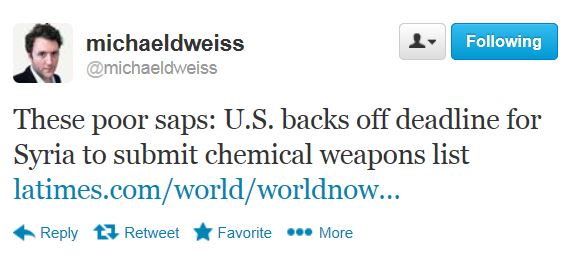
https://twitter.com/michaeldweiss/status/381099542533271553 Perhaps the most important article to appear last week in the media was Iranians Dial Up Presence in Syria in the Wall Street Journal (Google search terms)
The busloads of Shiite militiamen from Iraq, Syria and other Arab states have been arriving at the Iranian base in recent weeks, under cover of darkness, for instruction in urban warfare and the teachings of Iran's clerics, according to Iranian military figures and residents in the area. The fighters' mission: Fortify the Syrian regime of President Bashar al-Assad against Sunni rebels, the U.S. and Israel. ... The fighters "are told that the war in Syria is akin to [an] epic battle for Shiite Islam, and if they die they will be martyrs of the highest rank," says an Iranian military officer briefed on the training camp, which is 15 miles outside Tehran and called Amir Al-Momenin, or Commander of the Faithful. The training of thousands of fighters is an outgrowth of Iran's decision last year to immerse itself in the Syrian civil war on behalf of its struggling ally, the Assad regime, in an effort to shift the balance of power in the Middle East. Syria's bloodshed is shaping into more than a civil war: It is now a proxy war among regional powers jockeying for influence in the wake of the Arab Spring revolutions.
https://twitter.com/UANI/status/380085805097971714

Syria has reportedly turned over information outlining its weapons program to the Organization for the Prohibition of Chemical Weapons. https://twitter.com/AP/status/381048351208513536 From the Associated Press: Syria has sent the Organization for the Prohibition of Chemical Weapons an "initial declaration" outlining its weapons program, the organization said Friday. Spokesman Michael Luhan...

“Our collective failure to prevent atrocity crimes in Syria over the past two and a half years will remain a heavy burden on the standing of the United Nations and its member states.” Ban Ki-Moon Secretary General of the United Nations, September 10, 2013 "The United States...

A lot of attention is focused on Jihadist elements fighting in Syria, and the more "secular" Assad regime. The most underreported aspect of the civil war is that it's not just a civil war, it's a grand power-play by Iran to keep control of Syria as...

Mideast Media Sampler 09/16/2013: Never really intended, Putin gave him a way out....

Jeffrey Goldberg makes several points similar to the points I made in my post last night, The Deal: In order to remove the threat of Bashar Assad, we have to save Bashar Assad. Goldberg writes, New Syria Agreement Is a Big Victory. For Assad: A couple of...

The US and Russia reached an agreement on a plan for Syria to turn over its chemical weapons. https://twitter.com/AP/status/378824698844688384 From the State Department's Framework for Elimination of Syrian Chemical Weapons: Taking into account the decision of the Syrian Arab Republic to accede to the Chemical Weapons Convention and...

Now Bashar Assad is showing the price for him to declare his chemical weapons and talk about -- just words -- maybe, possibly, removing them to somewhere, somehow, some time in the future. https://twitter.com/LegInsurrection/status/378509356183986176 That price is guaranteeing his regime stays in power and the rebels are...

When aliens said "We come in peace," they almost invariably had their sights set on world domination. So beware Vladimir Putin when he comes bearing peace....

Obama's remarks last night on Syria, summarized: "Chemical weapons are bad. So I'm going to attack Syria, but maybe not. And I trust Putin, except maybe I don't. So perhaps let's have a diplomatic solution instead. And suddenly I believe in American exceptionalism---that is, regarding...

Yesterday the New York Times reported With the World Watching, Syria Amassed Nerve Gas. The article documents how, despite international efforts to prevent it, Syria built up its supply of chemical weapons.
Proliferation experts said President Bashar al-Assad of Syria and his father before him, former President Hafez al-Assad, were greatly helped in their chemical weapons ambitions by a basic underlying fact: often innocuous, legally exportable materials are also the precursors to manufacturing deadly chemical weapons. ... The growth of Syria’s ability was the subject of a sharply worded secret cable transmitted by the State Department under Secretary of State Hillary Rodham Clinton’s name in the fall of 2009. It instructed diplomats to “emphasize that failure to halt the flow” of chemicals and equipment into Syria, Iran and North Korea could render irrelevant a group of antiproliferation countries that organized to stop that flow. ... Another leaked State Department cable on the Syrians asserted that “part of their modus operandi is to hide procurement under the guise of legitimate pharmaceutical or other transactions.”
The article describes how hard it was to stop a determined villain from improving his lethal capabilities. An evil person, or regime, intent on killing people will find a way to do it. Also, there are people, corporations and nations who will rationalize giving these evil people the means they need to reach their goals. The article is frustrating. Clearly, a serious, sustained effort to prevent the Assads from acquiring chemical weapons was needed. But it wasn't to be. Among other things the fall of the Soviet Union made it impossible to control the import of the necessary ingredients to create the gas. Executives at an American company were prosecuted for sending materials that Syria could use to manufacture chemical weapons. Of course, once those components were shipped, it was too late. But if there any lessons for preventing other villains from obtaining deadly weapons in the future to be drawn from this article, they are absent.


Something very curious has happened on the heels of the discussions between the U.S. and Russia regarding Syria "giving up" chemical weapons. Russia almost immediately began shipping large quantities of additional conventional weapons to Syria to bolster the regime, as reported by Israeli television (via Times of Israel):
Russia is stepping up weapons supplies to Syria’s President Bashar Assad, to help him prevail in the civil war, as part of the arrangements under which the Assad regime has agreed in principle to have its chemical weapons stockpiles placed under international supervision, Israel television reported on Tuesday night. Negotiations between Russia and Syria on the supervision arrangement, which seem to have drastically reduced the likelihood of US-led military intervention in Syria, have been ongoing for two full weeks, and have also involved Iran, the Israeli Channel 2 report said. Russian President Vladimir Putin, determined to ensure that his ally Assad not face a punitive US-led strike following Damascus’s alleged use of chemical weapons in an August 21 attack that the US says killed over 1,400 Syrians, essentially ordered Assad to submit to international oversight of his chemical weapons stocks, the report said. In return, Putin promised bolstered conventional weapons shipments, “some of which are already on their way” to Syria from the Russian Black Sea port of Novorossiysk.
While certainly Russia has been shipping weapons previously, this would indicate a more intensified effort. At the same time, the Obama administration seems to be backing away from the rebels. The next time John Kerry testifies before Congress -- or holds a press conference -- he should be pressed as to any undisclosed understandings. Even if Assad doesn't use chemical weapons again, he has a long history of large-scale massacres without chemical weapons:

As of this writing, it's unclear where things stand. There is a vague offer by Vladimir Putin agreed to by Syria to turn over chemical weapons, but Russia opposes a binding U.N. resolution to that effect and the details are to be worked out. Putin also insists that the U.S. agree not to use force. We will see how this all plays out, but it appears that Obama is negotiating the terms of a surrender to Putin and Assad. (Transcript here) Reactions: https://twitter.com/ChuckLane1/status/377606769259708417 https://twitter.com/NoahCRothman/status/377603647317630977 https://twitter.com/oliverdarcy/status/377605225743269888 https://twitter.com/oliverdarcy/status/377603196169891840

The Syrian Electronic Army has claimed responsibility for another attack on media outlets, this time through a Hootsuite account associated with at least two international FOX television networks. The incident was first reported by Matthew Keys’ The Desk: The Syrian Electronic Army compromised a Hootsuite account used...