

Image 01 Image 03

Middle East Tag

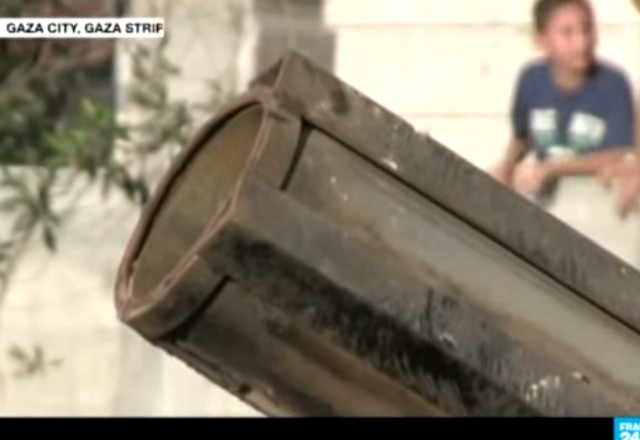
Central to the charge that Israel's conduct warrants an investigation by an "independent" commission to investigate whether it committed war crimes is the premise that Israel, in defending itself against rockets launched by Hamas into its territory, caused a disproportionate number of civilian deaths. Since a commission appointed by the anti-Israel United Nations Human Rights Council is looking to convict, a fair investigation into the violence is in order. Unfortunately, in an article from last week entitled "The U.N. says 7 in 10 Palestinians killed in Gaza were civilians. Israel disagrees," The Washington Post failed to provide the necessary context to allow a proper understanding of Operation Protective Edge.
The war in Gaza will now continue in a battle between databases to determine who was killed and why. The most contested number, the one that attracts the most stubborn insistence and ferocious rebuttal, is not the total fatalities on the Palestinian side, the more than 2,100 dead in the Gaza hostilities. The controversy centers instead on the ratio of civilians to combatants, or as the Israelis call them “terrorist operatives.”
In the second sentence the reporter, William Booth, mentions the "stubborn insistence and ferocious rebuttal," but doesn't acknowledge his own role in supporting the "stubborn insistence." Booth's articles on Operation Protective Edge have often contained similar language describing "mounting Palestinian civilian casualties." Furthermore, in other instances articles on which Booth was bylined listed casualty totals with no judgment as to their veracity. For example on July 19 a dispatch on which he had a byline reported:
The Palestinian death toll from the conflict rose Saturday to more than 330, including about 60 children, according to the Gaza Health Ministry. An additional 2,200 have been injured. The United Nations estimates that about 80 percent of the casualties are civilians, many of them children.
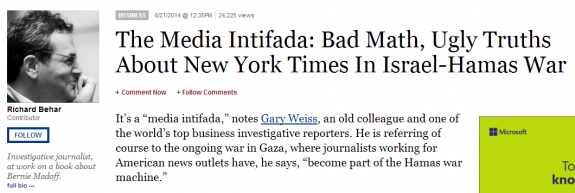
At his Muckraker column at Forbes, The Media Intifada: Bad Math, Ugly Truths About New York Times In Israel-Hamas War, investigative journalist Richard Behar exposes many of the problems - really scandals - with the MSM reporting on Gaza. Though he focuses a lot on The New York Times, he focuses on other news outlets too and how, through a combination of credulousness, bias and laziness, they have become in the words of his friend, and fellow investigative journalist, Gary Weiss, "part of the Hamas war machine.” In the wake of the Jayson Blair scandal The New York Times led the journalistic pack by hiring a "public editor" to handle complaints in the hopes of averting another similar scandal. But the problem with public editors or ombudsmen, as they are also called, is that they don't challenge the assumptions of the editors and reporters. Rather they seem to be explaining why the readers don't understand the high minded principles that professional journalists adhere to. What's important about Behar's takedown of the reporting is that he challenges the assumptions that news organizations accept. Behar looked at the media in general and specifically at The New York Times "because it is, without question, the most important media outlet in the world, in terms of setting the table each day for other outlets.". I can't cover the whole scope of Behar's critique as it is sweeping and comprehensive, but I'd like to focus on a few of his specific criticisms and then on a few of his observations. Richard Behar Media Intifada Behar's first critique of the Times is for its Gaza based reporter Fares Akram, and what he discovered when he visited Akram's Facebook page.

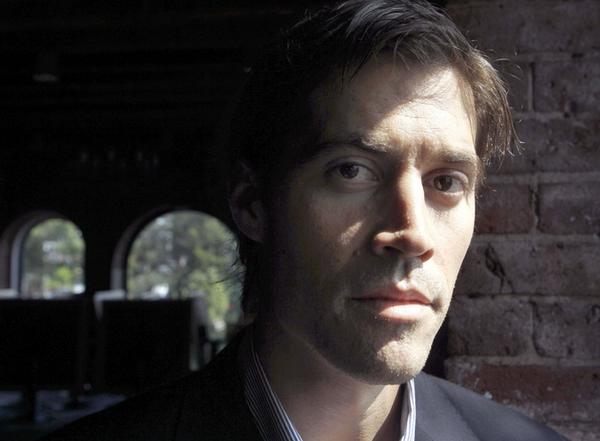
ISIS has released a video purporting to show the beheading of American journalist James Wright Foley, who had been missing for almost two years. The video, which also threatens to do the same to a man identified as American journalist Steven Sotloff, will not be linked to on this blog. Foley had gone missing in northwest Syria in November of 2012, and Sotloff, a reporter for Time, had disappeared in mid-2013, perhaps in Libya. ISIS accompanied the video with a message that:
...U.S. President Barack Obama’s authorization of strikes against the group places the United States “upon a slippery slope towards a new war front against Muslims,” according to BNO. “Any attempt by you, Obama, to deny Muslims liberty & safety under the Islamic caliphate, will result in the bloodshed of your people,” the ISIS person added. Foley also speaks in the video, saying: “I call on my friends, family members and loved ones to rise up against my real killers, the U.S. government.”
There is a longer version of Foley's statement here.

Yesterday the Washington Institute for Near East published Six Ways Hamas Hamas Could Limit Civilian Casualties in Gaza by Jeffrey White. All of White's suggestions involve separating the combatants from civilians, but as White acknowledges, "... there is little chance the group will implement any of these measures." And why would Hamas change? Human shields have been an effective strategy protecting its fighters. White concludes:
As long as the world sees Israel as the primary mechanism of civilian casualties, and as long as many Gaza civilians continue to be more concerned with "resistance" than their lives, Hamas has no reason to change its way of war.
Though White doesn't write it explicitly, the media has a responsibility to tell the whole story and not just the one that Hamas tells or allows them to. Oren Kessler says this explicitly in Reporters Have Finally Found Hamas. What Took So Long? that was published in The New Republic.
Let me be clear: I admire the bravery required of war correspondents, and I recognize the onerous conditions under which they work. I see no conspiracy behind the inability of many of them to adequately cover Hamas. Instead, I see a collective failure by much of the world’s press to give an accurate rendering of one party to the Gaza fighting, and to lay bare—whether explicitly or more subtly—the restrictions it enforces upon them in so doing.
Take for example, As war with Israel shatters lives, more Gazans question Hamas decisions that appeared in The Washington Post. While there is important information in the report - that Hamas has been alienating the civilian population of Gaza - the report always reminds readers that Gazans resent Israel more. For example:

ISIS is the embodiment of evil. But:
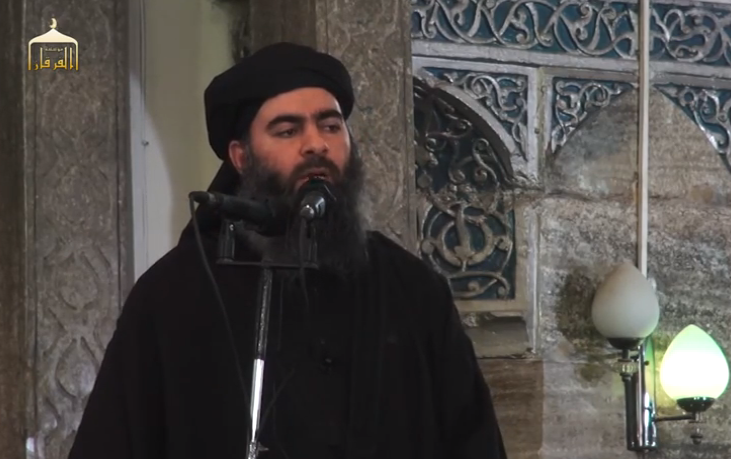
“We don’t understand real evil, organized evil very well,” said America’s former ambassador to Iraq and Afghanistan, Ryan Crocker, in an interview with The New York Times. “This is evil incarnate.” “People like [Islamic State commander] Abu Bakar al-Baghdadi have been in a fight for a decade,” he added. “They are messianic in their vision, and they are not going to stop.”
My question is: does anyone ever "understand" evil? I don't think so. Evil's very nature is to be inscrutable. Evil is altogether mysterious and altogether different from the way most people operate or could even imagine operating. In all the biographies and histories that have dealt with Hitler, for example, who has ever really explained him? No one. Religious people posit a spiritual origin for evil. Non-religious people tend to doubt its existence, until they look into its eyes. If it were necessary to fully understand evil in order to fight it, World War II would have never been won by the Allies. What is necessary is to be able to recognize evil and see it for what it is quite early in the game. Those are the important first steps. The next steps are finding the will and the tools to fight it. Evil is very strong, because it doesn't know the same restraints and limits as morality or good. Regarding ISIS, Elizabeth Warren pipes up:

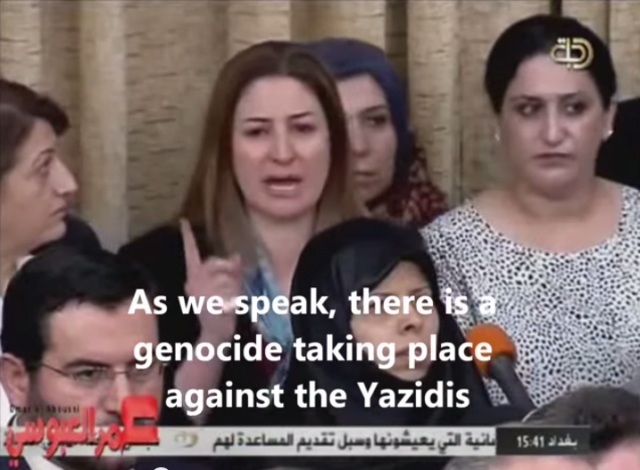
Post-9/11, I read a quip that went something like this: "I just realized what the problem is with the 21st century. We got the numbers mixed up. It's not 2001, it's 1200." In the ensuing years, barbarism and religious wars have made a strong comeback---not that they'd ever really disappeared. But with the rise of ISIS, we now have a group giving itself over to their purest expression. Beheadings and crucifixions are part of their m.o., as well as forced conversions with the threat of death or exile looming, and now the imminent extermination of a minority religious group, the Yazidi, at ISIS's bloody hands. The Yazidi have one representative in Iraq's parliament. Her name is Vian Dakhil and her recent raw cri de coeur to save her people has made her famous. The world loves a show and a dramatic story, but it no longer loves actually taking on risky rescues, and has become accustomed to relying on the Americans to do so. Nature---and geopolitics---abhors a vacuum. The deposing of bad guy Saddam Hussein left a hole that other bad guys would inevitably try to rush to fill. Anyone who would cause the toppling of Saddam had to know it might be necessary for them to stick around at some level for at least a generation if they wanted a chance of ensuring that a new group of leaders of a different and better ilk would be substituting instead. But quite early on it became clear that, due to the efforts of the left in this country and changes in Americans' attitude towards war, occupation, and sacrifice, we lacked the requisite commitment.

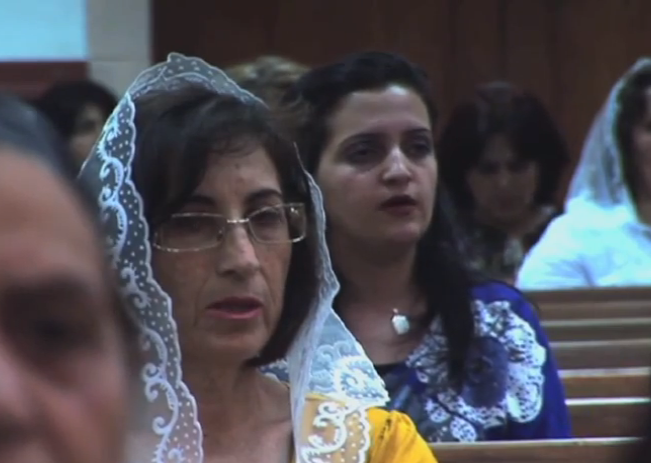
Below the big blaring headlines about Middle East turmoil, there is growing and systematic elimination of Christians being undertaken by Islamists. It is difficult to accurately gauge the extent of the actual number of executions by crucifixion or displacement of families -- but the Christian community is being decimated from areas from North Africa through Iraq. Whether we want to admit it or not, the Arab dictators that the United States supported during the Cold War were non-secularists and supported their nation's minority Christian communities. The Arab Spring's evil genie has been released and not only is Israel facing the consequences, but the Christian slaughter and "relocation" may be the most long-lasting result. In my mind, there is nothing comparable to the Holocaust by Nazi Germany -- though some are making that reference.
When U.S. troops invaded Iraq in 2003, there were at least 1.5 million Christians in Iraq. Over the last ten years, significantly in the last few months with the emergence of ISIS, that figure has dropped to about 400,000. In a region where Christians predate Muslims by centuries, over one million Christians have been killed or have had to flee because of jihadi persecution, while America is basically standing by and watching. This is the sad news that Breitbart’s National Security Editor and one of the world’s leading experts on asymmetric warfare, Dr. Sebastian Gorka, brought to Breitbart News Saturday.

While the media has been focused on the arrests of up to six Jews in the killing of Mohammed Abu Kheidr, Arab violence against Israel has been continuing. The Jerusalem Post reports:
The Sha'ar Hanegev Regional Council area was battered with ten rockets from Gaza. Residents of the communities in the Sha'ar Hanegev area were instructed to remain in fortified shelters. Three rockets hit the Eshkol Regional Council area , one of which started a brush fire, and an additional two rockets landed in open territory in the Ashkelon Coast Council region.
In addition for the first time since 2012, a rocket hit Be'ersheva. 2014-07-06_094248_IDF_Tweet Elder of Ziyon notes a number of attacks in and near Jerusalem and elsewhere over the weekend; including the torching of Joseph's Tomb in Nablus (Shechem)...

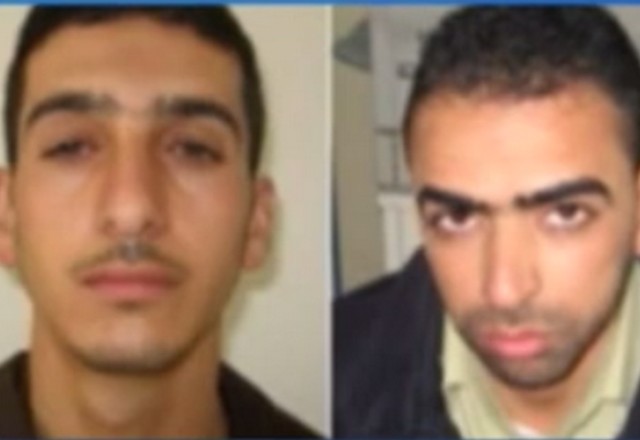
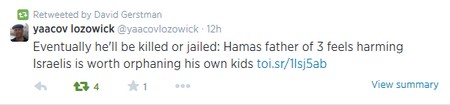
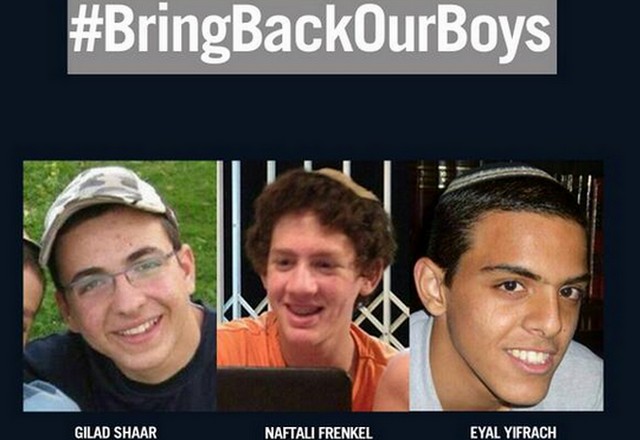
Thursday, Israel's internal security service, the Shin Bet, released the names of two suspects in the abduction of Gil-ad Shaar, Eyal Yifrach and Naftali Fraenkel two weeks ago. The suspects were said to have disappeared prior to the abductions. The two kidnappers are Amer Abu Aysha, a 32 year old locksmith who is married with three children, and Marwan Kawasme a 29 year old barber. Both have long associations with Hamas and, according to a report published in The Times of Israel, both attended the same mosque. Yaacov Lozowick observed: 2014-06-27_024146_Lozowick While Abu Aysha's mother described her son as a devoted family man, she also told the Times that "if her son did take part in the kidnapping, she was proud of him and hoped he would continue to evade capture." Abdullah Kawasme, an uncle of the latter, was killed in a fight with Israeli security forces in 2003. The IDF blog tells more of the ties both suspects had to Hamas:

One of the frustrating aspects of following the Israeli/Palestinian conflict is the "blame Israel first" syndrome. Writing in the Telegraph, Alan Johnson articulates the dynamic that is at play in It's time to Stop Infantilising the Palestinians. (h/t Elder of Ziyon)
First, by granting only one side to the conflict agency and responsibility, the dichotomy distorts key events of the conflict (e.g. the war of 1948, the collapse of the Camp David peace talks in 2000, Gaza after the 2005 disengagement). The Palestinians are cast as passive victims; a compelled people (Haaretz writer Yitkhak Laor claims the second intifada was “instigated” by … Israeli policy); a duped people (activist Tikva Honig-Parnass writes of “Barak’s pre-planned collapse of the Camp David talks in October 2000”); and a people beyond the reach of judgement. Academic Jacqueline Rose views Palestinian suicide bombers as “people driven to extremes” and argues that Israel has “the responsibility for [the] dilemma” of the suicide bomber. Second, the dichotomous understanding of Palestinians and Israelis distorts our understanding of Israel’s security. The threats Israel faces are discounted and the security measures taken by Israel reframed as motiveless and cruel acts.... The third consequence of this dichotomous thinking about the nature of the two peoples is the infantalisation of the Palestinians: they remain perpetually below the age of responsibility; the source of their behaviour always external to themselves, always located in Israel’s actions.
By the way, Alan Johnson was the Professor shouted down with abusive profanity at U. Ireland - Galway, by anti-Israel BDS protesters. A case in point of this dynamic is the common complaint that Israeli security checkpoints impede Palestinian economic progress. It's a common refrain but it ignores the reality on the ground. Aaron Menenberg observed the inner workings of the Palestinian Authority for two years recently and wrote about his experience in Terrorists & Kleptocrats: How Corruption is Eating the Palestinians Alive at The Tower Magazine. Menenberg dealt with regular Palestinians and contrasted their willingness to work for the betterment of themselves and their society with their political leadership's interest in maintaining their perks and positions.

In it's campaign to rescue the three yeshiva students who were kidnapped June 12, Israel has been carrying out operations against the Hamas infrastructure in the West Bank, including arresting prisoners it had previously released. The kidnappings have evoked a feeling among Israelis and Jews worldwide. On the other hand the Palestinians, as a society, have demonstrated callousness toward the victims, if not seeing the kidnappings as a victory. According the Times of Israel the 'noose is tightening' around the kidnappers.
A senior Israeli government official said Friday that the noose was tightening around the kidnappers of the three teenagers who were abducted last Thursday from a hitchhiking post in the Gush Etzion area in the West Bank, as a large-scale, ongoing IDF operation to locate the trio continued through its eighth day. Speaking to Channel 10, the official said that, based on security assessments, the teens were still somewhere in the West Bank and that their abductors were unsuccessful in moving them in the direction of Jordan, Gaza, or Sinai. ... Prime Minister Benjamin Netanyahu met with the families of the three earlier Friday and updated them on the progress of the search. Frankel’s uncle was later quoted saying that all indications were that the three are alive. On Thursday Netanyahu said Israel knew more about their fate than it had done a few days earlier, and Defense Minister Moshe Ya’alon said the operation to find the three was making progress. Also Thursday, an Israeli official named a deported Hamas terror chief, Saleh al-Arouri, as a suspect in orchestrating the kidnapping.
Palestinian Authority Foreign Minister Riyad Al-Maliki, one of the "moderate" technocrats of the new Fatah-Hamas government suggested that the kidnappings are an Israeli fabrication:

The Washington Post's Dana Milbank, who has an increasing reputation as a shill for the left wing, viciously attacked the Heritage Foundation in a column on Monday evening. The column, "Heritage's ugly Benghazi panel" characterized the event as though it were a full-throated, Muslim-bashing hate-crime cleverly disguised as a public forum to discuss the Benghazi attack.
What began as a session purportedly about “unanswered questions” surrounding the September 2012 attacks on U.S. facilities in Libya deteriorated into the ugly taunting of a woman in the room who wore an Islamic head covering. [...]  Then Saba Ahmed, an American University law student, stood in the back of the room and asked a question in a soft voice. “We portray Islam and all Muslims as bad, but there’s 1.8 billion followers of Islam,” she told them. “We have 8 million-plus Muslim Americans in this country and I don’t see them represented here.” Panelist Brigitte Gabriel of a group called ACT! for America pounced. She said “180 million to 300 million” Muslims are “dedicated to the destruction of Western civilization.” She told Ahmed that the “peaceful majority were irrelevant” in the attacks of Sept. 11, 2001, and she drew a Hitler comparison: “Most Germans were peaceful, yet the Nazis drove the agenda and as a result, 60 million died.” “Are you an American?” Gabriel demanded of Ahmed, after accusing her of taking “the limelight” and before informing her that her “political correctness” belongs “in the garbage.” “Where are the others speaking out?” Ahmed was asked. This drew an extended standing ovation from the nearly 150 people in the room, complete with cheers. The panel’s moderator, conservative radio host Chris Plante, grinned and joined in the assault. “Can you tell me who the head of the Muslim peace movement is?” he demanded of Ahmed. “Yeah,” audience members taunted, “yeah.” Ahmed answered quietly, as before. “I guess it’s me right now,” she said.
Milbank's account seemed to suggest an anti-Muslim witch hunt with one lone innocent standing at the back braving the torrent of hate. Except it wasn't true. Milbank's story was immediately challenged by those who know him best -- fellow political reporters in Washington, DC. Mollie Hemingway dissects Milbank's account versus the video excerpts first released by, ironically, Media Matters for America -- the famed leftist attack "media watchdog" group.

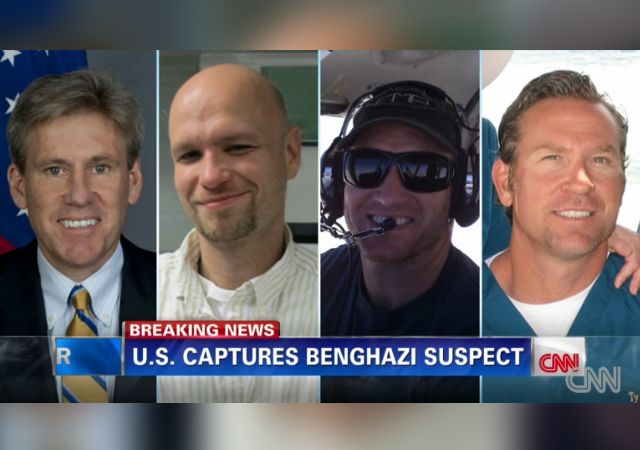
News broke this morning that U.S. Special Forces over the weekend captured the key terrorist figure in the September 11, 2012 attack at the U.S. outpost in Benghazi, Libya.
Abu Khattalah will be brought to the United States to face charges "in the coming days," said Edward Price, a spokesman for the National Security Council. Abu Khattalah, who faces three federal criminal charges, will be tried in U.S. courts, said Attorney General Eric Holder. U.S. Ambassador Christopher Stevens and three other U.S. citizens died in the September 11, 2012, attack, which became a political flashpoint. "We retain the option of adding additional charges in the coming days," Holder said. "Even as we begin the process of putting Khatallah on trial and seeking his conviction before a jury, our investigation will remain ongoing as we work to identify and arrest any co-conspirators."
U.S. officials say that Abu Khattalah is being held in a location outside Libya -- perhaps on a naval vessel. Khatallah had been a key suspect from the start of the post-Benghazi investigation. It also appeared he was never worried about being captured by the U.S. government. Just weeks after the assault on the compound, Khatallah was seen sipping a strawberry frappe on the patio of a Benghazi hotel, according to The New York Times.

When Mahmoud Abbas's "moderate" Fatah movement first reached out to make an agreement with the terrorist Hamas movement, the response in the United State was "mostly nonchalant." Now that the two sides have announced the creating of a unity government, the response has continued to be muted. Certainly not outraged. Last week, of course, the administration didn't wait a day before endorsing the blatant violation of the American sponsored peace process. This was disappointing but hardly surprising given Barry Rubin's observation last September that the United States had gone to "backing the 'bad guys.'” In major American newspapers there was little initial editorial comment. However later in the week, the Washington Post endorsed the American response as did the New York Times. Though, surprisingly, the Times actually qualified their endorsement warning that "the United States has to be careful to somehow distinguish between its support for the new government and an endorsement of Hamas and its violent, hateful behavior," without actually offering a practical suggestion how distinguish that support. There are three main reasons why the administration was wrong to support the unity accord. 1) It is unpopular in the United States In the middle of May, The Israel Project conducted a poll of likely voters and their views on the Israeli-Palestinian conflict. One question dealt with the formation of the Fatah-Hamas unity government. When those originally saying they were undecided offered an opinion, the poll showed a massive rejection of the Palestinian reason for the cooperation.

David Horovitz, the editor of the Times of Israel has written a scathing critique of the Obama administration's treatment of Israel. In the aftermath of the administration's acceptance of the Fatah/Hamas unity government in defiance of the letter of American law, Horovitz wrote yesterday,  12 ways the US administration has failed its ally Israel. Horovitz's criticisms can be broken down into three categories: mistakes in proceeding with the peace process, primarily blaming Israel for the failure of the peace process and other breaches of faith with Israel regarding Israel's enemies in the Middle East. In that last category (the last three of Horovitz's examples) he observes that rather than keeping quiet about reported Israeli air strikes against Syrian arm shipments to Hezbollah, the administration attributed the strikes to Israel risking possible Syrian retaliation against Israel and blasts the administration for "rushing to support Islamic extremists ... when they come to power in a neighboring state," referring to the Muslim Brotherhood's brief stint as rulers of Egypt. But he's harshest in his criticism of the Obama administration for its handling of Iran arguing that "[t]he central goal of US policy in this regard should not be merely denying Iran nuclear weapons but denying Iran the capacity to build nuclear weapons." Regarding the peace process Horovitz faults the administration for looking to solve the conflict in just nine months instead of just working on trying to build a climate of trust: