


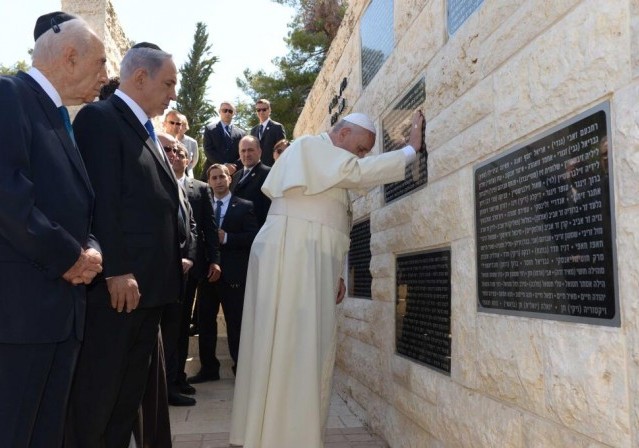
“The Vatican officials explained to us that the pope didn’t pray against the separation barrier, but he prayed against the situation that forces such a wall to be built,” diplomat Lior Haiat said. “Therefore, we thought we need to show him why we built the wall. It’s obvious that the barrier is a result of something, it is not the reason.”
#Powerful! Video of #PopeInIsrael at memorial for #Israeli victims of terror w/ @IsraeliPM & @PresidentPeres: http://t.co/UtQLSOHP8c
— Arsen Ostrovsky (@Ostrov_A) May 26, 2014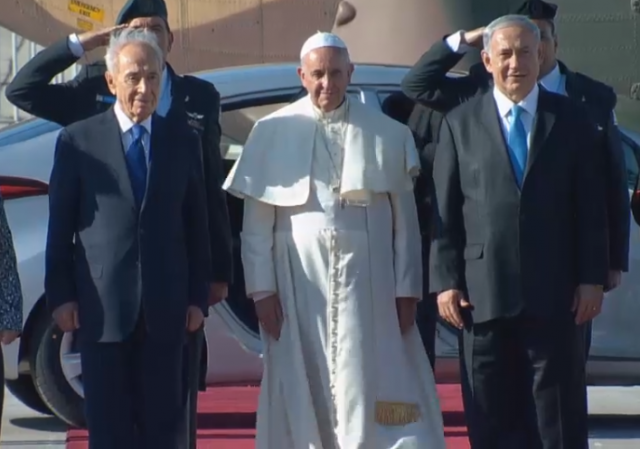
 (Pope Francis speaking at Ben Gurion Airport)[/caption]



The New York Times Reports On a Near Lynch and Leaves Out a Crucial Detail...

Israel signed a bilateral industrial R&D cooperation agreement on Tuesday with China’s Zhejiang Province, known as the Silicon Valley of China, as 350 delegates from the Asian giant attended MIXiii, the Israel Innovation Conference. It also inked agreements with Jiangsu Province’s Science and Technology Department to promote Israeli companies’ participation in Chinese innovation parks and a first-of-its kind pilot program to encourage Israeli companies participation in the Changzhou Innovation Park in Jiangsu (population 79 million). “The science and technology of Israel need market potential and also market rules, and Zhejiang is a great partner,” Zhou Guohni, director- general of Zhejiang Province (population 55 million), told The Jerusalem Post at the signing in Tel Aviv. “We are facing a transformation and upgrade of the industry, and we need Israel’s technology to help transform and upgrade it.” The Economy Ministry’s Chief Scientist Avi Hasson said the agreement “will help many Israeli companies expand into the Chinese market and marks the next stage in the economic and technological relationship between our two countries.”Read on, the expansion of ties is even wider than described above. Meanwhile, on campuses like UCLA, U. Michigan, Wesleyan and a dozen or two more, naive students are trying to get their student governments to call for divestment from selected companies doing business in Israel. The student governments have no power to effect divestment of university endowments, it's all symbolic. Sure, we're going to fight BDS vigorously, to the end, because it's malicious. Witness what happened at Vassar, where SJP actually posted a Nazi cartoon and cited white supremacists for their anti-Zionist theories.
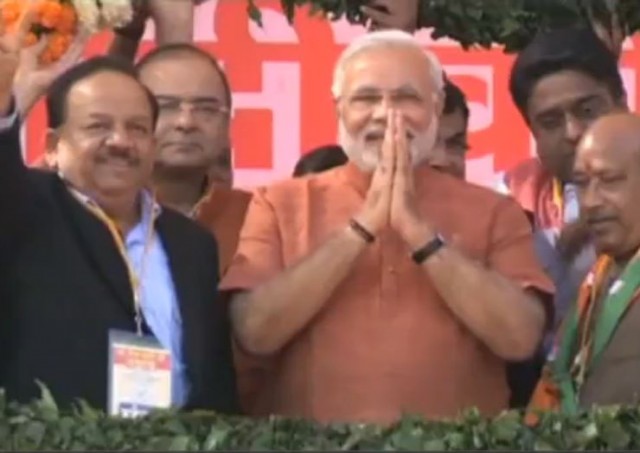
Narendra Modi is the next Prime Minister of India. Modi’s NDA-Alliance won 336 out of 543 seats in the Indian parliament. He has routed the ruling Congress Party led by Rahul Gandhi, the 4th generation member of Nehru-Gandhi dynasty Modi is arguably one of the most capable administrators in India. As Chief Minister of Gujarat State (2002-14) he turned around the economy, created infrastructure and improved public services. With a population of 60 million, Gujarat’s per-capita GDP today is much higher than India’s average. A lot of ink has been spilled in the international press over this relatively unknown man now at the helm in New Delhi. However there is one story readers in Israel need to hear: Modi is a friend of Israel, the like of whom India has not seen before. This fact can be stated without any exaggeration or wishful thinking. All one needs to do is to look at Modi’s track record. Modi is the first Indian leader to have actually visited Israel. He has often expressed admiration for Israel’s achievements in research, technology and innovation; espacially in the field of agriculture and water resources. Every year more than 2000 farmers from Gujarat visit Israel to get trained in advance farming techniques – at their own expense. He welcomed Israeli Companies to enter water management and recycling sector in 50 cities of Gujarat; and invited Israel to be the guest country at Gujarat state’s flagship Agricultural Fair (Vibrant Gujarat Agro Tech Global Fair 2014).
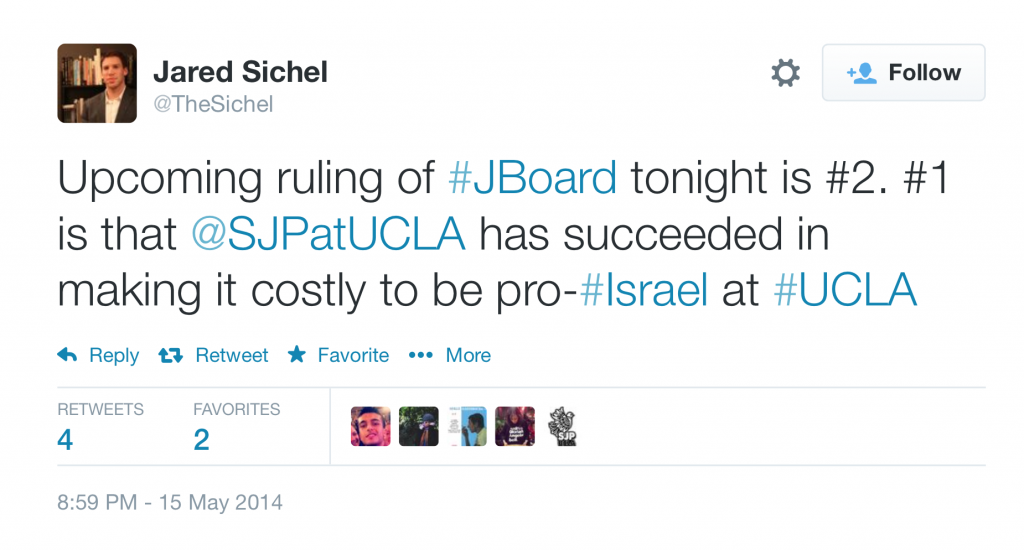 Now, everyone seeking office who goes on a trip to Israel or is associated with a pro-Israel organization may be accused of having a conflict of interest boxing them out of key positions that vote on divestment matters.
SJP is building a chilling effect, showing that those who stand in their way will be subject to long hours of debate, protest, and even "legal" hearings. Some may not agree with SJP, but consider it not worth the trouble to stand in their way.
Now, everyone seeking office who goes on a trip to Israel or is associated with a pro-Israel organization may be accused of having a conflict of interest boxing them out of key positions that vote on divestment matters.
SJP is building a chilling effect, showing that those who stand in their way will be subject to long hours of debate, protest, and even "legal" hearings. Some may not agree with SJP, but consider it not worth the trouble to stand in their way.
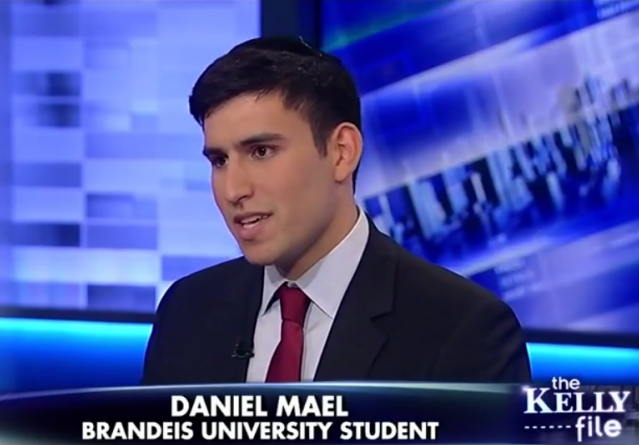
[Daniel] Mael has been a relentless critic of J Street and its college chapters.... One of Mael’s articles even is featured in the trailer for the J Street Challenge.... Considering that The J Street Challenge is one of the biggest thorns in J Street’s side, it’s not much of a guess to believe that Mael’s affiliation with the movie is not popular at J Street...I noted that J Street had issued a press statement requesting that media and bloggers "distance themselves" from Mael after an incident at Brandeis University, where Mael is a student. Mael alleged that a J Street U member verbally abused him, a claim which was denied. For whatever its reason, J Street corporate headquarters through its communications team got involved in this local dispute (emphasis added):
... we ask that others in the Jewish community and media – even those who don’t agree with us politically – will distance themselves from this blogger and others with a history of conduct driven by malice and deceit. While J Street and J Street U remain deeply committed to a vibrant and respectful campus conversation, there is a line that cannot be crossed. Unfortunately, some questionable bloggers and campus figures have consistently and consciously crossed that line. We will not tolerate harassment of our student leaders, and we see no reason for us to have any further interaction — on the Brandeis campus, online or in other venues — with those peddling in slander. We hope others will make the same determination.Since then, two things have happened.
What does not get covered is as important as coverage itself....

Zochrot, Hebrew for “remembering,” has for 13 years been leading tours of destroyed villages, collecting testimony from aging Arabs, and advocating the right of return for millions of Palestinian refugees and their descendants. But it preaches almost exclusively to the converted. Israel is a country where government-funded organizations can be fined for mourning on Independence Day, and where the foreign minister denounced as a “fifth column” thousands of Arab-Israeli citizens who marked the Nakba last week by marching in support of refugee return.The disconnect in this paragraph is unbelievable. Rudoren writes blithely about the Palestinian "right of return" and suggests the lack of Israeli acceptance of the right of return is due to the close-mindedness of Israeli society. But there is nothing benign about the right of return. It means the destruction of Israel as a Jewish state. In fact a founder of Zochrot is rather explicit about his intent. (Strangely Rudoren hasn't reported that a Palestinian professor who took his student to Auschwitz was ostracized by the union at his university.) People aren't usually receptive to ideas that involve their own destruction. This is the New York Times so I hardly expect to read a corrective article. Maybe the paper will deign to publish a few dissents in the letters sections, but the case that Israel's war of independence is an ongoing disaster will remain the prevalent view at the New York Times.
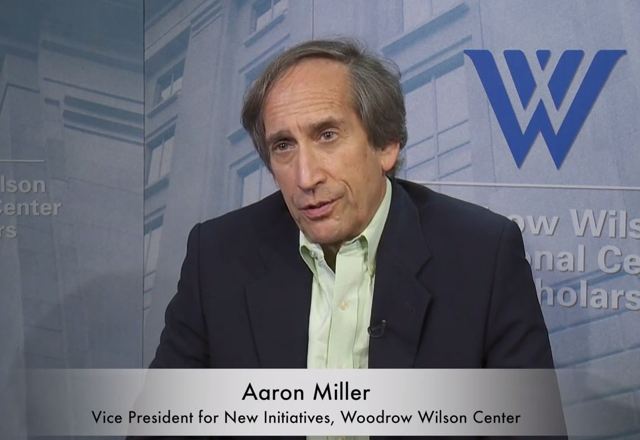
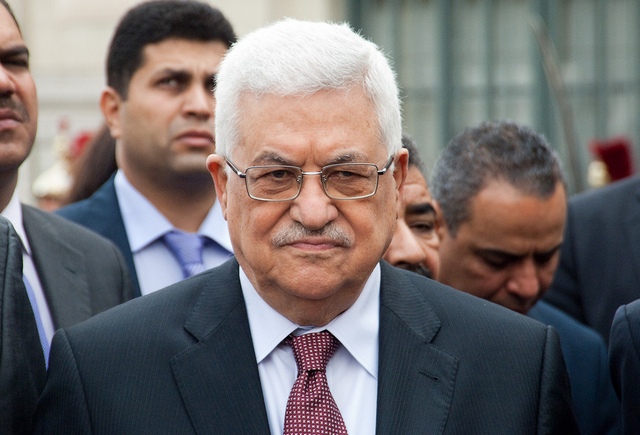
Simply put, the maximum that Israeli Prime Minister Benjamin Netanyahu is prepared to give on the core issues that drive the Israeli-Palestinian conflict can't be aligned, let alone reconciled, with the minimum that Palestinian Authority President Mahmoud Abbas is prepared to accept. You want to know why every effort in the last decade has failed? That's why.If Miller had left it at that he would have been correct. Obvious. But correct. The problem with the op-ed is that he continued. For example:
The idea that Netanyahu is ready to pay the price and could be persuaded to do so was a fundamental misunderstanding of the man and his times. Now the longest continuously serving prime minister in Israel's history, Bibi never envisioned himself as the midwife or father of a Palestinian state. That's not who he is. Ideology, family, politics and his fears of the Arabs all drive him in a different direction. His self-image is as the Israeli leader who is to lead Israel out of the shadow of the Iranian nuclear bomb and to guide it through the challenges of a dangerously broken, angry and dysfunctional Arab world. And he reflects the mood of an Israeli public that sees almost no reason or urgency — regardless of U.S. doom-and-gloom threats of violence, third intifadas, apartheid state or demography — to grapple with the problem. Governing is about choosing. And for now, Netanyahu has made his choice.This is not a serious appraisal of Netanyahu, but psychoanalysis by an unlicensed psychiatrist. Instead of looking at Netanyahu's record, Miller strung together a series of cliches that every right thinking peace processor would believe. I would agree that Netanyahu "never envisioned himself as the midwife or father of a Palestinian state." But he also understands that as a leader of a democratic country he is bound by the obligations of his predecessors. Netanyahu would not have been elected in 1996 if the peace process had been successful. He was elected in the wake of ten days of terror in February and March of 1996. Though he was elected because of his critique of the peace process, he continued it. Backed by assurances of the Clinton administration (later betrayed), Netanyahu withdrew Israel from most of Hebron, and as Charles Krauthammer pointed out, "With Hebron, Netanyahu managed to bring most of the nationalist camp of Israel to recognize that Oslo is a fact." Has Miller, who now demeans Netanyahu at a distance, ever done as much for the peace process?

Here's UM CSG Vice Pres @Bobby_Dishell at AIPAC: http://t.co/dYE6kOJ9xJ He has learned from the best.
— Max Blumenthal (@MaxBlumenthal) March 26, 2014
Bobby Dishell is Campus Coordinator at Teach for America. School privatization hawk and Israel hawk. http://t.co/d62X23oJ1i #UMDivest
— Rania Khalek (@RaniaKhalek) March 26, 2014
So I was not completely surprised when I learned from reader emails over the past several days that there is an attempt at UCLA to disqualify any student who received pro-Israel training or trips from being on the Student Council.
Because of my trip to Vassar and follow up, I didn't have time to write it up. So I'm glad that two others have done so.
Jonathan Tobin at Commentary writes, The Next Step in the Campus War on Jews:
“If you only helped us intercept low-flying [regime] helicopters by providing a limited amount of antiaircraft weapons, with American approval, it would have a huge effect, morally and militarily,” Labwani said. “There are a million ways such weapons can be given to recognized people [in the opposition]. These weapons have ‘fingerprints’ and deactivation modes.” Alternatively, he said, Israel could declare a no-fly zone in southern Syria, as NATO did in Libya in its bid to topple Muammar Gaddafi. Such a move would immediately cause a large segment of Syrian society to support peace and normalization with Israel.But there's more to the interview. Labwani is not currently among the Western backed rebels. He explained why: