


Image 01 Image 03

Israel Tag

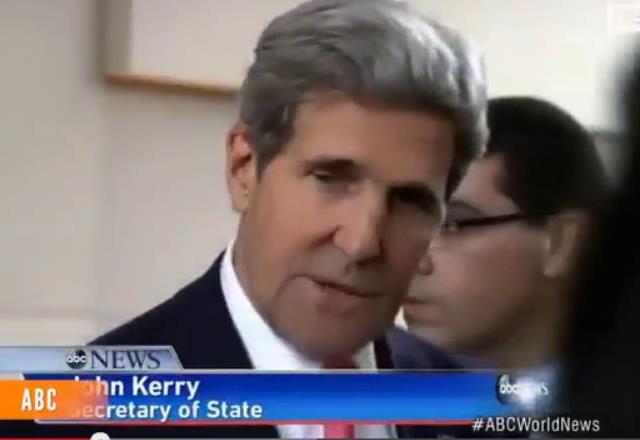
The Times of Israel, based on communications with unnamed Palestinian Authority officials, reports that the Palestinians have conveyed their rejection of John Kerry's draft "framework" proposal:
The Palestinian Authority has informed US Secretary of State John Kerry that it will not accept his framework peace proposal as it currently stands, PA officials told The Times of Israel.... Central clauses of the framework deal as presented by Kerry, and rejected by the PA, the Palestinian officials said, are as follows: Borders: The peace agreement is to be based on pre-1967 lines, but will take into consideration changes on the ground in the decades since. Settlements: There will be no massive evacuation of “residents.” Refugees: Palestinian refugees will be able to return to Palestine or remain where they currently live. In addition, it is possible that a limited number of refugees could be allowed into pre-1967 Israel as a humanitarian gesture, and only with Israeli acquiescence. Nowhere is it written that Israel bears responsibility for suffering caused to the refugees. Capital: The Palestinian capital will be in Jerusalem. Security: Israel has the right to defend itself, by itself. The Jordan Valley: The IDF will retain a presence in the Jordan Valley. The length of time the IDF will remain will depend on the abilities of the Palestinian security forces. Border crossings: Israel will continue to control border crossings into Jordan. Definition of the countries: Two states will result, “a national state of the Jewish people and a national state of the Palestinian people.”
So what's the problem?  Some of these issues probably are surmountable. But one issue probably is not, the recognition of Israel as the Jewish homeland, as further reported by the Times:

Previously we noted that the New York Times has a tendency to play up the successes of the BDS movement and to play down the true nature of the BDS movement. The New York Times has since carried two more articles about BDS; one in the news section and one op-ed. Surprisingly, the opinion article took a critical look at BDS. Unfortunately the news story was consistent with previous New York Times coverage of the issue. In the news section, Jerusalem bureau chief, Jodi Rudoren wrote West Bank Boycott: A Political Act or Prejudice? For the most part Rudoren treats the issue "evenhandedly," giving each side equal time and not judging either side. In the course of the reporting Rudoren interviews BDS activist Omar Barghouti.
“He can say anything he wishes, but immoral? Resistance to his immoral policies can never be immoral,” Mr. Barghouti said of Mr. Netanyahu. “The litmus test is are you boycotting a group of people based on their identity, or are you boycotting something — an act, a company, a business — that you disagree with. “We have three reasons,” Mr. Barghouti said, citing the movement’s goals of ending the occupation; ensuring equality for Palestinian citizens of Israel; and promoting the right of return for Palestinian refugees. “End the three reasons and we won’t boycott.”
Barghouti, who got a degree from Tel Aviv University is a pretty good example of equality of Israel's minorities. That degree also makes Barghouti a hypocrites as his boycott would affect Tel Aviv University too. Rudoren ignores these inconsistencies. She also remains silent about Barghouti's demand for the right of return. Everyone knows that the point of that "right" is the destruction of Israel. In fact, Barghouti's claim confirms that the  the goal of the BDS movement is an assault on Israel's right to exist is correct. Rudoren doesn't appear to grasp this. Oddly, it is columnist Roger Cohen who got things right about BDS. In The B.D.S. Threat, Cohen writes:

Professor Jacobson made a very good point last week:
The BDS movement presents little real threat to Israel currently, while the European governments do present a potential threat, but it is a diplomatic, not boycott, threat.  Kerry, and the boycott movement, conflate the two.
The problem is that despite the fact that there's no evidence that the BDS movement is gaining mainstream acceptance there are many who pretend that it has. Let's look at the New York Times coverage of some recent BDS activity. Last May the paper reported, Stephen Hawking Joins Boycott Against Israel:
The academic and cultural boycott, organized by international activists to protest Israel’s policies toward the Palestinians, is a heated and contentious issue; having Dr. Hawking join it is likely to help the anti-Israel campaigners significantly.
There are two items of note. The first is that the BDS movement is described in terms of being a "protest" against "Israel’s policies toward the Palestinians." It is not described as a movement to delegitimize Israel. The second is the assertion that Hawking's action "is likely to help the anti-Israel campaigners significantly." This is a judgment, but it is also somewhat quantifiable. Will subsequent reporting use similar standards? The article later noted that the Oxford student union overwhelmingly voted against an academic boycott of Israel. Later that month when Alicia Keys announced that she would defy the anti-Israel activists two months later, the New York Times reported:

Over 225 University Presidents have issued statements condeming the anti-Israel academic boycott by the American Studies Association as a threat to academic freedom and education, as have several major academic organizations such as the American Association of University Professors and the Association of American Universities. Of the 80 ASA Institutional Members, at least 8 have dropped their membership and at least 11 have denied being Institutional Members in the first place. It is not an exaggeration to say that ASA has become a pariah in the academic community, and the boycott passed by a vote of less than 25% of the membership (because so few participated) has split the organization. There also has been legislative activity with regard to anti-boycott laws that is stalled because even critics of the ASA boycott are concerned with preserving university and individual academic autonomy. Nonetheless, even though stalled, the legislation does reflect a political backlash against the ASA. Canadian Prime Minister Stephen Harper publicly called the academic boycott part of “mutation of the old disease of anti-Semitism” From the earliest days, the ASA has played victim, mistaking harsh criticism of its boycott as an infringement of its academic freedom.  ASA's incoming President, NYU Prof. Lisa Duggan, also has accused one critic, an author at Forbes, of homophobia.  Others have accused Israel Lobby money of being behind the backlash. All the while, ASA as an organization has sought to put on a happy face, as if none of this troubles them and all is well. But there are significant signs that the backlash is being felt at ASA. First, the ASA activism caucus issued an urgent request to BDS supporters to join the organization to increase individual memberships. Next, ASA has increaed the activity of its non-profit legal advisers to speak out on the subject, defending ASA's boycott. Today I received an Open Letter to college and universities signed by the leftist National Lawyers Guild and other anti-Israel groups and individuals making inflammatory accusations that the Universities that have spoken out against the ASA boycott are engaged in "McCarthy" like witch hunts and are themselves abusing academic freedom by speaking out.

While legislation regarding academic boycotts is stalled in the NY State Assembly after widespread protests, a federal bill has been introduced by House Chief Deputy Whip Peter Roskam (R., Ill.) and Rep. Dan Lipinski (D., Ill.). The bill is embedded at the bottom of this post. Roskam was one of the Congressman behind the Letter signed by 134 Members of the House condeming the anti-Israel boycott by the American Studies Association. The new Bill cuts off funding for institutions of higher education "if the Secretary [of Education] determines that such institution is participating in a boycott of Israeli academic institutions or scholars." "Participation" is defined as:
if the institution, any significant part of the institution, or any organization significantly funded by the institution adopts a policy or resolution, issues a statement, or otherwise formally establishes the restriction of discourse, cooperation, exchange, or any other involvement with academic institutions or scholars on the basis of the connection of such institutions or such scholars to the State of Israel.
My first and quick read is that the Bill, as drafted, is unlikely to accomplish the desired effect. It will make martyrs of the academic boycotters, who are in fact the villains, and amounts to a blunt instrument to deal with a narrow problem. There is no university, that I'm aware of, currently even contemplating an academic boycott of Israel. Also, the definition of "participation" is sufficiently broad that it will ignite serious pushback from universities. The ASA, which had been a pariah, now will be defended by people who are against the academic boycott, but even more against such legislation. I think there are ways to deal with the ASA and related academic boycotts. I'm not sure this Bill is one of those ways, as it puts at risk universities, not the ASA. The story was first reported by Adam Kredo at The Washington Free Beacon:
The “Protect Academic Freedom Act,” jointly filed by House Chief Deputy Whip Peter Roskam (R., Ill.) and Rep. Dan Lipinski (D., Ill.) could serve as a deterrent to other groups considering Israeli boycotts. It would amend the Higher Education Act of 1965 “to prohibit an institution that participates in a boycott of Israeli academic institutions or scholars from being eligible” to receive federal funds, according to text of the legislation. “Attempts to single out Israel for discriminatory boycotts violates the principle of academic freedom guaranteed by the United States,” the bill states.

Anyone who has read this blog the past months knows that I take the international boycott threat against Israel very seriously. It is a venomous movement conceived by propagandists that has had some success in Europe, but few victories in the U.S. Israel has lived all of its existence under boycott. The current boycott movement is a shadow of the Arab League boycott that started even before Israel was a nation and grew with great force as Arab oil wealth grew in the 1970s. Yet somehow Israel's economy survived and prospered nonetheless, helped in great part by U.S. anti-boycott legislation that mostly kept the boycott disease from our shores. The Israeli economy is more diverse, high tech, and privatized than it was in the 1970s. Israel also is less dependent on Europe, and a sought-after participant in the global economy, most of which wants no part of the boycott movement.  The leverage of Europeans who capitulate to anti-Israel groups is much less than in the past. The U.S. Congress also could significantly deflate the boycott movement once again by extending current legislation to cover the new form of boycott movement.  Congress should do so now, and in so doing will aid the peace process by letting the Palestinians know that they cannot achieve more through international boycotts than through negotiations. While it seems invincible because largely unchallenged, the boycott movement is susceptible not only to legislation, but the type of pushback academic boycotters in the U.S. are receiving. The boycott movement, while it should be taken seriously and combatted, should not be allowed to dictate Israel's strategic security needs as part of peace negotiations. Doing business with a few extra European banks will be a hollow achievement if the West Bank is turned into another Gaza-style Iranian missile base. Don't let the boycott tail wag the security dog. Yet John Kerry is playing the boycott card to pressure Israel, running around like chicken little screaming that the sky is falling.

We have reported about legislation making its way through both the NY State Assembly and Senate seeking to stop state funds being used by state higher educational institutions to support groups that engage in academic boycotts. The bills, though they have different language, are a reaction to the anti-Israel academic boycott passed by the American Studies Association. As I have stated before, I hope the legislature will review the language of the bills very carefully, since there certainly will be challenges. Not surprisingly, claims are being made that the legislation violates the academic freedom of the boycotters. It's the challenge free societies face, that those who seek to destroy what we hold precious get to invoke our laws to protect their destructive actions. So people who seek to destroy the academic freedom of everyone through academic boycotts based on national origin cry that their own academic freedom is violated when good people try to stop the destruction. Already a threat of a constitutional challenge was made in a January 30, 2014 letter to the legislature from the Center for Constitutional Rights, which has a working group devoted to supporting the anti-Israel BDS movement. The letter is embedded at the bottom of this post. The gist of the letter is that this is an unlawful attempt to silence unpopular speech. The letter also misrepresents that the ASA boycott only targets institutions. That is false, as I described in my IRS challenge. ASA adopted the full scope of the BDS boycott, but issued non-binding guidelines that purport to scale it back. Even so, the boycott is directed at Israelis based on national origin, which already is unlawful under the NY State Human Rights law. Jewish Voice for Peace, a group which uses the title "Jewish" to give credibility to its anti-Israeli views, is a big supporter and organizer of the SodaStream boycott. JVP has issued an urgent call to try to stop the NY legislation:

A Resolution passed yesterday by the Philadelphia City Council is a good reflection of how deeply the pushback against the American Studies Association academic boycott of Israel has reached in American civil and political society.  (Full Resolution embedded at bottom of post.)
Condemning the American Studies Association’s academic boycott against Israeli academic institutions and urging the Department of Education, the State System of Higher Education and all colleges and universities in Pennsylvania to reject the academic boycott.

* * *

WHEREAS, The academic boycott of Israeli academic institutions, including colleges and universities, serves to restrict academic freedom and hinders the collaboration and free flow of information between academics all over the world; and WHEREAS, Academic freedom, the free flow of information and ideas and international academic collaboration are crucial factors in promoting progress in all areas of study from the hard sciences and technology to the humanities; and .... WHEREAS, Academic freedom is an indispensable component of a free and democratic society and should be guarded vigilantly; and WHEREAS, The American Studies Association’s call for an academic boycott of Israeli academic institutions threatens academic freedom and should therefore be rejected; now, therefore, be it RESOLVED BY THE COUNCIL OF THE CITY OF PHILADELPHIA, That the City Council condemns the American Studies Association’s academic boycott of Israeli academic institutions and urges the Department of Education, the State System of Higher Education and all colleges and universities in Pennsylvania to reject the academic boycott.
The Philadelphis Resolution was proposed by Councilman Kenyatta Johnson, who made the announcement on his Facebook and Twitter pages. https://www.facebook.com/CouncilmanKenyattaJohnson#!/CouncilmanKenyattaJohnson/posts/574424249299048?stream_ref=10

This is a small win, but a win is a win. We need a lot more such legal challenges to anti-Israel boycott groups, who  are propagandists and have no compunctions about lying and making up accusations in the worst tradition of Pallywood. Whether it's hummus, coffee cafes, or academic scholars, there is nothing Israeli that the deranged Boycott, Divest and Sanction movement will not attack. SodaStream has been under attack for years, with BDS groups trying to keep the product out of stores and commercials off the airwaves. The BDS movement is so obsessed with SodaStream that it even uses a term, Greenwashing, to complain about SodaStream touting the environmental benefits of its product. SodaStream has a compelling story to tell, however, as a bridge for peace, one we have focused on before: SodaStream just won a case against a French BDS group, getting a small amount of damages but also an order that the group stop claiming that it is illegal for stores to sell SodaStream products. As reported by Haaretz:

On American TV, a show called "Lovers' Tales," would likely be a romantic comedy. On Ma'an, the independent Palestinian television network, it is a weekly show interviewing freed prisoners. This week Palestinian Media Watch reports on the interview of one Issa Abd Rabbo.
Until his release, Issa Abd Rabbo was serving two life sentences for killing two Israeli university students, Ron Levi and Revital Seri, who were hiking south of Jerusalem on Oct. 22, 1984. At gun point he tied them up, put bags over their heads and then shot and murdered both. Abbas' "hero" has now given an interview to the independent Palestinian news agency Ma'an on its weekly TV program Lovers' Tales, which interviews released prisoners. There he calmly describes how he initiated the killing, spotted the two hiking university students and waited until they sat down to rest under a tree. He then recounts how he tied them up and murdered them in cold blood.
Here's the clip. Note how he betrays absolutely no remorse.

On Saturday, January 24, I appeared on the syndicated radio show of our friend Pete "Da Tech Guy" Ingemi. I had a chance to talk about the backround and nature of the anti-Israel Boycott, Divest and Sanction (BDS) movement, most specifically the American Studies Association academic boycott of Israel. See our BDS and ASA tags for background. I discussed how the pushback against the academic boycott has been overwhelming, with over 200 university presidents, the major academic organizations, and 134 Congressmen denouncing the boycott. This fast rejection of the boycott by American civil and political society has made a pariah of the ASA and the supporters of academic boycotts. That is a significant achievement. But it's not enough. I also had a chance to announce the next phase of the opposition to the academic boycott movement (at 9:30)(full audio embedded at bottom of post):
"We're going to continue to push back, and you'll be hearing about those in coming months, we're not stopping now.... [T]he boycott is discrimination on the basis of national origin. While they don't boycott all Israeli academics, they only boycott Israeli academics, and that's national origin discrimination. And we're going to be, you know it hasn't really been publicly announced 'till now, but we're going to be going around the country, and wherever they meet, we're going to insist that universities and that municipalities apply their local anti-discrimination laws to these events. That if they're going to hold an event that's going to discriminate on the basis of national origin, we want the laws enforced as to them just as they would be to any other group. So it's going to be an active year, like I mentioned Legal Insurrection tends to take a fairly active approach to issues, we don't just write about them, we actually pursue them, and we're going to be pursuing them for the coming months and maybe the coming years."
This will be a joint project with Anne Sorock's Capitol City Project. At Legal Insurrection we are chronically short of time, manpower and resources, so CCP's help is greatly appreciated.

The Israeli public historically doesn't like when Israeli Prime Ministers feud with American Presidents, and take it out on the Israeli Prime Minister. It previously happened with Netanyahu and President Clinton in 1999 and earlier with Yitzchak Shamir and President George H. W. Bush. In the months before an Israeli election both Prime Ministers ran afoul of the American administration and lost the subsequent elections. There have been two high-profile clashes between Obama and Netanyahu of the sort that previously would have landed an Israeli Prime Minister in trouble back home.