

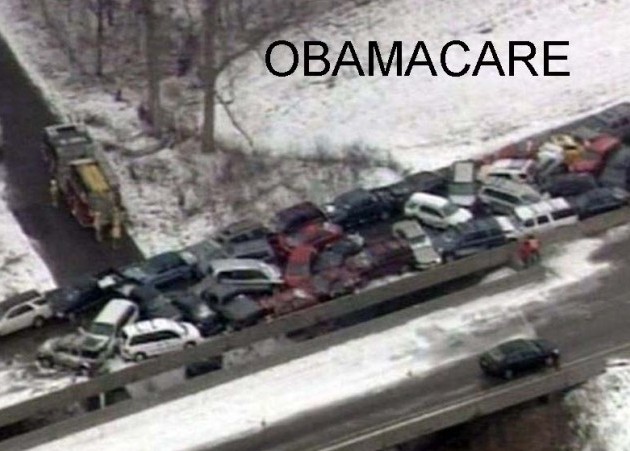
SCOTUS: Your NLRB Recess Appointments are Invalid, Mr. President
The Supreme Court has unanimously ruled that President Obama's recess appointments to the NLRB are invalid....
First Amendment upheld against Massachusetts law involving abortion clinic protests...
By a 9-0 vote, the justices said smart phones and other electronic devices were not in the same category as wallets, briefcases, and vehicles -- all currently subject to limited initial examination by law enforcement. Generally such searches are permitted if there is "probable cause" that a crime has been committed, to ensure officers' safety and prevent destruction of evidence.Chief Justice John Roberts wrote the opinion in Riley v. California and Justice Antonin Scalia agreed with the majority but wrote a concurring opinion. In the ruling Roberts strongly cited the Fourth Amendment's protection of an individual rights and the advances of technology that the cellphone represents.
We cannot deny that our decision today will have an impact on the ability of law enforcement to combat crime. Cell phones have become important tools in facilitating coordination and communication among members of criminal enterprises, and can provide valuable incriminating information about dangerous criminals. Privacy comes at a cost. Our cases have recognized that the Fourth Amendment was the founding generation’s response to the reviled “general warrants” and “writs of assistance” of the colonial era, which allowed British officers to rummage through homes in an unrestrained search for evidence of criminal activity. Opposition to such searches was in fact one of the driving forces behind the Revolution itself. In 1761, the patriot James Otis delivered a speech in Boston denouncing the use of writs of assistance. A young John Adams was there, and he would later write that “[e]very man of a crowded audience appeared to me to go away, as I did, ready to take arms against writs of assistance.” According to Adams, Otis’s speech was “the first scene of the first act of opposition to the arbitrary claims of Great Britain. Then and there the child Independence was born.”
As U.S. lawsuits seeking gay-marriage rights move toward a likely showdown at the Supreme Court next year, major law firms are rushing to get involved — but only on the side of the proponents. A Reuters review of more than 100 court filings during the past year shows that at least 30 of the country's largest firms are representing challengers to state laws banning same-sex marriage. Not a single member of the Am Law 200, a commonly used ranking of the largest U.S. firms by revenue, is defending gay marriage prohibitions. These numbers and interviews with lawyers on both sides suggest that the legal industry has reached its Mozilla moment. The software company's CEO, Brendan Eich, resigned in April after being denounced by gay marriage supporters for a donation he had made in support of California's since-overturned gay marriage ban. Now in a similar vein, attorneys at major law firms are getting the message that if they want to litigate against gay marriage they should do so elsewhere.None of this will come as a surprise to Legal Insurrection readers. We wrote in April 2011, how the large law firm of King & Spalding withdrew its representation of the House of Representatives on the DOMA litigation after the Human Rights Campaign started contacting King & Spalding clients unrelated to the litigation, and threats were made to hold protests at clients' offices. King & Spalding did not, however, simultaneously drop its representation of radical Islamic Gitmo detainees who promote societies that treat women and gays as subhuman. I wrote at the time that there was A Hostile Environment For Pro-Traditional Marriage Views At King & Spalding, such that the expression of any contrary view was a potential career ender. We now know how true that can be, as the Brendan Eich case demonstrated.
To hold that invocations must be nonsectarian would force the legislatures that sponsor prayers and the court that are asked to decide these cases to act as supervisors and censors of religious speech, a rule that would involve government in religious matters to a far greater degree than is the case under the town’s current practice of neither editing or approving prayers in advance nor criticizing their content after the fact... Government may not mandate a civic religion that stifles any but the most generic reference to the sacred any more than it may prescribe a religious orthodoxy.Because the plaintiffs in this case only wanted the Christian-specific aspect of the prayer removed from the town council, the above line of reasoning was invoked to buoy the more basic "tradition" argument also employed by the majority. But what about a constitutional challenge seeking a ban of prayer altogether? That would alleviate the need to inquire into the content of the prayer, thus freeing courts and governments from entangling themselves in the process of picking and choosing deities and faiths to pray to.
Sotomayor dissent: Removal of "race-sensitive" preferences equals "stacking the deck" and "forcing the minority alone to surmount unique obstacles"...
Fresh off a Supreme Court ruling in the case of McCutcheon v. Federal Election Commission, a ruling which struck down overall limits on campaign contributions, the hypocrisy of the Democrat party in New York has been on full display. Sean Eldridge, a congressional candidate in New York's 19th...
On November 26, 2013, the U.S. Supreme Court agreed to hear Sebelius v. Hobby Lobby Stores Inc., a case arising out of commitment of the Green family, the sole owners of Hobby Lobby Stores Inc., to live out their deeply held religious convictions by “operating their company in a manner consistent with biblical principles.” These principles were put to the test when the federal government mandated that the Greens and their family businesses provide four specific potentially life-terminating drugs and devices through their employee health plan in conflict with their deeply held religious convictions. While the Green family has no moral objection to providing 16 of the 20 FDA-approved drugs and devices that are part of the federal mandate, providing drugs or devices that have the potential to terminate a life conflicts with their faith. Accordingly, the Greens and their family businesses filed suit in September 2012 to defend their right to religious freedom under the Constitution and federal law. Throughout, the Greens have been assisted and represented in the legal case by the Becket Fund for Religious Liberty, a non-profit, public-interest legal and educational institute with a mission to protect the free expression of all faiths.The case is scheduled to be decided by the Supreme Court by the end of the June term. Apart from the legal work being done on Hobby Lobby’s behalf, the company has also engaged in a fairly strong public relations campaign. They’ve created a number a videos, featured on YouTube and their website, including this one. http://www.youtube.com/watch?v=k4pL32qQ_3k Hobby Lobby also appears to be engaging in a very active Twitter campaign to help control the narrative — to the extent possible — about their impending case.
The U.S. Supreme Court today agreed to review the lawsuit filed by Hobby Lobby against the federal government over the Obamacare mandate that employers provide contraceptive coverage in their health plans. Hobby Lobby, which is owned by an Oklahoma City family with strong Christian beliefs, says a 1993 law, the Religious Freedom Restoration Act, protects the company from the mandate. The company is particularly opposed to paying for coverage that includes the morning after pill.The court also accepted a related case from Pennsylvania involving a Mennonite family with a furniture-making business. In that case, a federal appeals court initially ruled that the owners could not challenge the mandate on religious ground because a company did not enjoy the same rights as individuals.
The petition in this case challenges a highly unusualpractice followed by one District Court Judge in assessingthe adequacy of counsel in class actions. This judge insiststhat class counsel “ensure that the lawyers staffed on the case fairly reflect the class composition in terms of relevant race and gender metrics.” App. to Pet. for Cert. 35a. The uniqueness of this practice weighs against review by this Court, but the meaning of the Court’s denial of the petition should not be misunderstood.
Playing along is not a victory, any more so than it was in June 2012....
The Supreme Court has another affirmative action case on its docket for next term, as explained by Jennifer Gratz (the plaintiff in Gratz v. Bollinger / U. Michigan), The two-faced defense of affirmative action (emphasis added): Though last week’s Supreme Court ruling in Fisher v. University of...
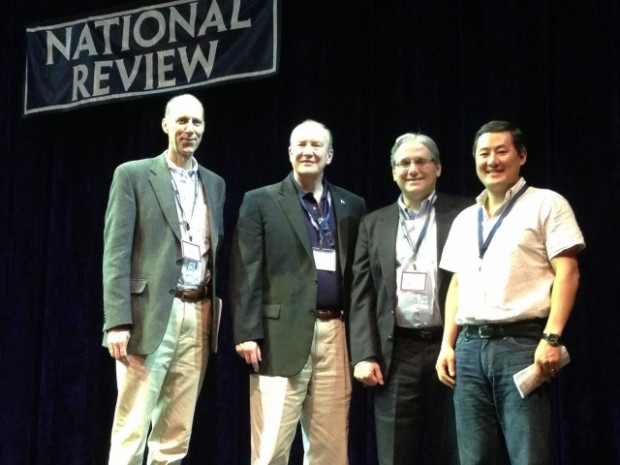
A follow up to the Supreme Court's decision in Fisher v. U. Texas. John Yoo writes at National Review (emphasis mine): Some conservatives are probably taking heart that the Court, by seven to one, reversed the lower court, which had upheld UT’s explicit use of racial preferences in...
Not that there's anything wrong with it (?)....
Update -- The death of the ballot initiative movement as Court gives de facto veto power to government officials who want to lose a case....
Donations tax deductible
to the full extent allowed by law.
Founder
Sr. Contrib Editor
Contrib Editor
Higher Ed
Author
Author
Author
Author
Author
Author
Editor Emerita