

Image 01 Image 03

US Supreme Court Tag

We covered this a few days ago at College Insurrection but the story has gone national. This all springs from a report by the Council of Trustees and Alumni called A Crisis in Civic Education. Among many troubling findings, the report revealed:
There is a crisis in American civic education. Survey after survey shows that recent college graduates are alarmingly ignorant of America’s history and heritage. They cannot identify the term lengths of members of Congress, the substance of the First Amendment, or the origin of the separation of powers. They do not know the Father of the Constitution, and nearly 10% say that Judith Sheindlin—“Judge Judy”—is on the Supreme Court.

The U.S. Supreme Court this morning granted a Petition by the U.S. government for review of lower court decisions putting a halt to Obama's executive immigration action. That action halted deportation for up to 5 million people in the country illegally. Our prior posts have the background: Interestingly, the Order granting Certiorari added a constitutional issue to the case. The lower courts had decided it based on Obama administration failure to follow proper administrative procedure: Texas Immigration Case Supreme Court Order granting Cert. ScotusBlog summarizes today's action and what is to follow:

The Supreme Court heard oral arguments in Friedrichs v. California Teachers' Association last Monday, and the union had a tough day.  Legal Insurrection previewed the case, here.

Background

In brief, public school teachers in California seek to invalidate state law requiring that non-union members must nevertheless pay the public teachers union fees for collective bargaining and related expenses.  Those related expenses are fairly broad and include public relations campaigns on issues to be collectively bargained. Before this case, controlling law from Abood v. Detroit Board of Education allowed such compelled payments on the reasoning that collective bargaining is not political speech, so compelled contributions to collective bargaining expenses does not run afoul of the First Amendment's implied freedom of (and from) association.  However, Abood was internally inconsistent to the extent that it acknowledged that everything a public union does is political in the sense that it has an impact on the public and public policy.

Former Virginia governor Bob McDonnell was indicted back in January of 2014 for accepting gifts in exchange for political influence, and now the Supreme Court will be reviewing his case. The Washington Post reports:
The McDonnells, who were convicted in 2014, were accused of intervening with state officials on Williams’s behalf in exchange for $177,000 in loans, vacations and luxury goods. The former governor was sentenced to two years in prison; Maureen McDonnell received a year and a day. . . . . The Supreme Court will decide whether former Virginia governor Robert F. McDonnell was rightly convicted of corruption for his efforts on behalf of a businessman who bestowed money and gifts on the governor and his family. The court announced Friday that it would intervene in the long-running saga of McDonnell and his wife, Maureen, and the case provides the justices a fresh opportunity to define what kind of political conduct crosses the line into criminal behavior.
McDonnell issued a statement in response to the Supreme Court's announcement.

On Wednesday the Iranian Central Bank argued before the United States Supreme Court that Iranian-owned assets in U.S.-based accounts cannot be used to satisfy judgments against Iran.  The narrow legal question in Bank Markazi v. Peterson is whether and to what extent Congress can dictate the outcome of a pending suit by statute, but the practical question is whether victims of Iranian terror can obtain payment for their and their loved ones' suffering and deaths.

Background

Plaintiff Deborah Peterson sued the government of Iran for the wrongful death of her brother, Lance Corporal James C. Knipple, who was killed along with 240 other Americans in the 1983 bombing of the U.S. Marine Corps barracks in Beirut, Lebanon.  Numerous other Plaintiffs sued Iran either for their own or for loved ones' injuries and deaths in other Iranian terror attacks including the bombing of the Khobar Towers in Saudi Arabia that killed 19 U.S. Airmen. Iran did not appear in court to defend these suits, and the various courts entered default judgments against it in 19 different cases in an aggregate amount of several billion dollars.

The Supreme Court's 2016 schedule begins this morning with oral arguments in a dispute over public union dues.  In Friedrichs v. California Teachers Association the Court is asked to strike down two rules that that artificially prop-up public sector unions. First, the Plaintiff challenges a California statute imposing “agency shop agreements” under which non-union members must nevertheless pay the union for its collective bargaining services. Second, Plaintiffs seek to reverse California law that requires all employees to pay the union for non-bargaining activities unless they opt out each year, asking that the burden be reversed to require annual opt-ins for those who wish to contribute. Both challenges are brought under the 1st Amendment’s implied freedom of association, as incorporated to the states through the 14th Amendment.

Notwithstanding a modest consensus that affirmative action is doomed after Wednesday's arguments in Fisher v. University of Texas at Austin, there are hints the Court might delay a substantive decision, dissatisfying all parties. For background on the case, see Legal Insurrection's preview, here.  The full transcript of Wednesday's oral arguments is here. There were a number of tense and emotional moments both between the Justices and the parties' attorneys and among the Justices themselves.  From the tenor of the questioning, it is likely the University of Texas's ("UT") admissions system will be struck down despite its minimal reliance on race, if the case is decided on its merits.  If so, the result may explicitly or implicitly ban affirmative action on the basis of race in public university admissions. But the Court, including presumptive deciding vote Justice Kennedy, repeatedly returned to procedural issues.

The United States Supreme Court will revisit affirmative action in public university admissions on Wednesday, when Fisher v. University of Texas at Austin returns to the high court for the second time. As the Supreme Court previously explained, the University of Texas ("UT") has a two-part admissions system.  First, under Texas’s statutory "Top Ten Percent Law," any student graduating from a Texas high school in the top 10% of their class is automatically admitted. Second, students not admitted pursuant to the Top Ten Percent Law are given numerical Personal Achievement scores by combining academic achievement and a “Personal Achievement Index” (“PAI”).  The PAI:
measures a student’s leadership and work experience, awards, extra-curricular activities, community service, and other special circumstances that give insight into a student’s back-ground. These included growing up in a single-parent home, speaking a language other than English at home, significant family responsibilities assumed by the applicant, and the general socioeconomic condition of the student’s family.
From 1997 to 2003, the PAI had no racial consideration.  UT admissions were entirely race neutral.

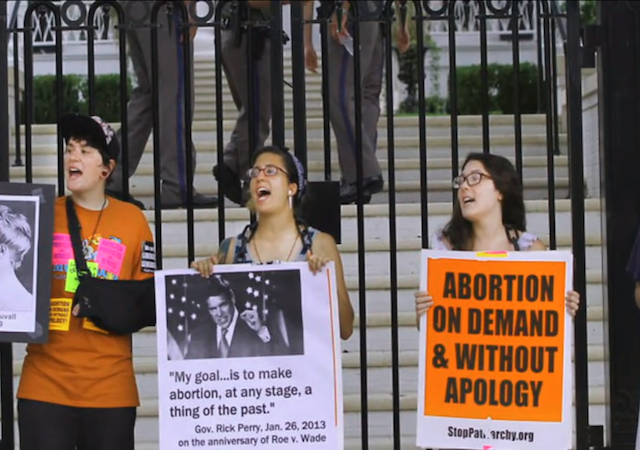
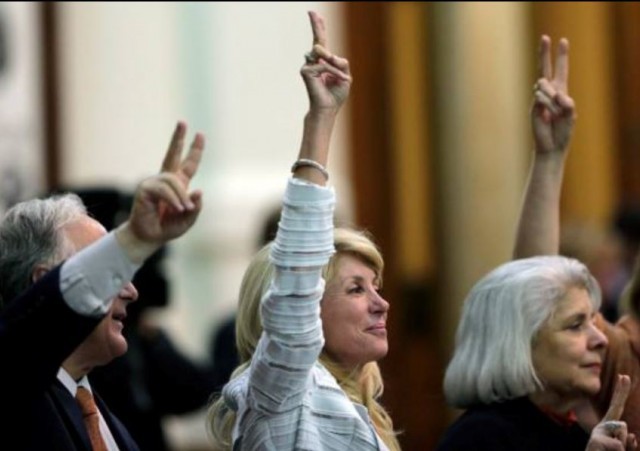
The Supreme Court agreed to consider the constitutionality of a 2013 Texas law (HB 2) that resulted in the closure of half the state's abortion clinics, according to SCOTUS blog. The earliest Whole Women's Health vs. Cole would be heard is February. The issue:
Whether, when applying the “undue burden” standard of Planned Parenthood v. Casey, a court errs by refusing to consider whether and to what extent laws that restrict abortion for the stated purpose of promoting health actually serve the government’s interest in promoting health; and (2) whether the Fifth Circuit erred in concluding that this standard permits Texas to enforce, in nearly all circumstances, laws that would cause a significant reduction in the availability of abortion services while failing to advance the State’s interest in promoting health - or any other valid interest.
According to the pro-life advocacy group, Texas Right to Life, "until SCOTUS completes a review of the constitutionality of HB 2, the law’s safety standards are delayed from taking effect in Texas."

We recently reported that Obamacare Co-Ops have been dropping like dead, rotting flies. Now, in the wake of the continued failures of program implementation, a new challenge has been filed with the Supreme Court:
Foes of President Obama's health care law are taking another crack at upending the legislation, filing a new challenge with the Supreme Court after a separate long-shot case was rejected earlier this year. The petition filed Monday by the Pacific Legal Foundation, like the prior challenge, focuses on an obscure aspect of the law. The case contends ObamaCare violates the provision of the Constitution that requires tax-raising bills to originate in the House of Representatives.

Ted Cruz has hit third place (behind Carson and Trump) and double-digits in Iowa.  He's taken over Rubio's third place spot according to Bloomberg.
Texas Senator Ted Cruz, at 10 percent, is the only other candidate [besides Carson and Trump] in double digits. He's followed by Florida Senator Marco Rubio at 9 percent. The horse-race numbers for the top four mirror a Quinnipiac University poll released Thursday, with the main exception being that the earlier poll had Rubio in third place with 13 percent.
As he continues to campaign in Iowa, Cruz emphasizes the import of the 2016 presidential election.  He tweets:

Last week I had the privilege of attending the Cato Institute's Constitution Day event covering the October 2014 and 2015 Supreme Court terms. It was a wonkishly good time, and afforded me the opportunity to both soak in some new insight on the Court, and kick off analysis and prediction posts for the upcoming Supreme Court term. Overall, the presenters and panelists don't expect the upcoming term to bring us as many "blockbuster" cases. Last term was defined by the shadow of Obergefell and the question of gay marriage; we knew it was coming all term, and its prominence in the hearts and minds of the American people shunted to the side even the important rulings concerning Obamacare and the Fair Housing Act. Still, this term still has the potential to inspire some scorching takes from both wings of the media on the Clean Water Act, wiretapping laws, religious freedom, and abortion laws. We still have a ways to go before we get to examine a full docket, so stay tuned. Cato did a great job of making their presentation accessible to both attorneys and non-attorneys, which (from my experience) is rare for events held by true think tanks. The presentations on Executive power, civil rights, and the state vs. the individual were all 100% relevant with regards to the legal philosophy discussed, and its application to the situations we see and experience every day.

In Kentucky, a county clerk refusing to issue same-sex marriage licenses despite the Supreme Court's recent ruling has made her way into national headlines. Rowan County Clerk Kim Davis claims her religious beliefs have created an issue of conscience which prohibits her from participating in or condoning gay marriage. Citing God's authority, Davis has stopped issuing all marriage licenses. The whole affair turned into one horrid media circus:
ABC Breaking News | Latest News Videos

The effort by liberal media to delegitimize Clarence Thomas as a powerful legal scholar is not new. From his confirmation hearings through to the present, Thomas has endured relentless denigration of his intellect in places like The NY Times. Yesterday brought a stark example. NYT Supreme Court reporter Adam Liptak has an article focusing on the frequency of Thomas using language in his writing similar to briefs submitted by parties, amicus briefs, and lower court opinions, Clarence Thomas, a Supreme Court Justice of Few Words, Some Not His Own. http://www.nytimes.com/2015/08/28/us/justice-clarence-thomas-rulings-studies.html?_r=0 Someone casually reading the headline would suspect Thomas of plagiarism (in spirit, if not technically) and being unique among the Justices. The Headline matters -- Thomas alone is singled out. The opening paragraphs of the article seem damning:

A New York State Judge recently denied an attempt by a group acting for Tommy the Chimp to obtain habeas corpus relief. (Full embed at bottom of post.) But in so denying relief, the judge predicted possible future change citing the U.S. Supreme Court's decision in the same-sex marriage case. #Seriously. Now we have covered the slippery slope as much as anyone in the area of polygamy and polyamorous clusters, including in light of the recent Supreme Court ruling on same-sex marriage: But there's the slippery slope, and then there's this slippery slope as reported by Slate: https://twitter.com/Slate/status/627600511492063232 Don't worry, it's not as bad as the tweet makes it sound, depending on what the definition of "bad" is:

After the recent Supreme Court ruling on "disparate impact" in housing, Amy predicted that social justice activists and lawyers had been given powerful precedent to use racial and ethnic data mining against developers who did not intentionally discriminate:
When the Supreme Court handed down its ruling in Texas Department of Housing v. Inclusive Communities Project last week, social justice activists claimed a major victory in the battle against segregated housing. The decision endorsed a “disparate impact” analysis as applied to a Texas program that plaintiffs claimed distributes federal low income housing credits disproportionately, awarding too many credits to inner-city, predominately black neighborhoods and too few to suburban, predominately white neighborhoods.... Kennedy and the majority endorsed a form of social engineering just as pernicious as those that disparate impact analyses aim to correct. Instead of creating “more equality,” these methods do nothing but invent controversies for social justice groups and the courts to work out, and, as Clarence Thomas says, presume that defendants are “guilty of discrimination until proved innocent.”
In the NY Post, Paul Sperry of the Hoover Institution, highlights how massive data mining by numerous branches of the Obama administration is set to light a fire nationwide even where there is no government-sponsored, or intentional private discrimination in order to recreate communities and businesses, Obama collecting personal data for a secret race database:

Conservatives had a tough go 'round at the Supreme Court this term. Obamacare, gay marriage, and questionable disparate impact analyses were all propped up by a divided court, causing prominent pundits to question the state of the Court, the wisdom of lifetime appointments, and the intentions of Republican-appointed Anthony Kennedy. The Court, for all its successes and failings, serves as both beacon and barometer for the general population. While lawyers pour over briefs and opinions, and argue about pendulums, most people swallow up on-site media reports and adjust their attitudes according to which justice said what. Mainstream SCOTUS watching, then, has become less of an intellectual exercise, and more of an exercise in pop culture fandom---which has had more of an effect on the Court than you would think. During a recent interview with NPR, liberal justice Ruth Bader Ginsburg offered some insight into the Court's left wing, and described how her colleagues maximize the impact of their opinions---even when they find themselves in the minority, as they did in the landmark Bush v. Gore. Via NPR:
The time pressure in the [Bush v. Gore] case was excruciating, with the court issuing an opinion just a day after oral arguments, and, as Ginsburg put it, the four liberal members of the court "were unable to get together and write one opinion." Indeed, each wrote a separate dissent, resulting in such confusion that, as she pointed out, some early press accounts erroneously reported that the decision was 7-2, not as it in fact was, 5-4. After that experience, "we agreed," said Ginsburg, that "when we are in that situation again, let's be in one opinion." It's important, she added, because the public and the lower courts need to know what the court has done or not done. And neither lawyers nor judges will stick with opinions that go on and on.

Earlier this month, the Supreme Court (am I allowed to call it the "Kennedy Court" yet? That would be fun...) made serious waves in the administrative law world when it handed down a ruling that will make it much easier for activists to prove local-level discrimination against minority candidates for low income housing. Even Justice Kennedy, who led the majority's charge in favor of an expanded disparate impact analysis, was forced to admit that the ruling could cause an eventual return to racial quota systems. We're not quite there yet, but rest assured---the crack team at Housing and Urban Development, led by San Antonio golden boy Julian Castro, is keeping an eye on things. A new rule, floated by HUD and released today by the Obama Administration, will require cities and towns to to look for patterns of racial bias in local housing. Officials will then be forced to report every 3 to 5 years on the state of the housing market, and self-set goals for reducing segregation in their jurisdictions. This information won't just go into a bureaucratic vacuum; instead, it'll head straight for---you guessed it---another government database. WaPo explains: