


Image 01 Image 03

Iran Tag

Dozens of organizations have come together to emphasize the danger Iran poses to Israel and the international community. To that end, they've joined forces to host a Stop Iran Rally in Times Square. The Stop Iran Rally has an impressive list of speakers: poster9

When Iran's Supreme Leader Ayatollah Khamenei isn't spending time negating U.S. diplomatic statements, he's taunting Israel and the whole of the West on social media. "We will continue our unprecedented efforts to strengthen Israel's security," said President Obama at the beginning of a video Ayatollah Khamenei tweeted Monday. The video ended with Khamenei saying, "Israel's security will not be ensured whether there will be a nuclear agreement or not."

John Kerry and Energy Secretary Ernest Moniz appeared on FOX News Sunday this past weekend and answered questions from Chris Wallace on the terms of the Iran Deal. Wallace focused on the 24 day lead Iran will be given for inspections, which Kerry suggested is perfectly acceptable. Moniz also clarified his earlier remarks on the subject. David Rutz of the Washington Free Beacon reported:
Kerry: I Never Sought ‘Anytime, Anywhere’ Inspections in Iran Nuclear Negotiations Secretary of State John Kerry, in a talking point similar to White House official Ben Rhodes earlier this week, claimed on Fox News Sunday he never seen discussed the idea of “anywhere, anytime” inspections in the Iran nuclear deal. Host Chris Wallace mentioned the 24-day period Iran can stave off inspections as part of the agreement and how that hardly constituted meeting those standards before Kerry rebuked him. “Well, that’s not accurate,” Kerry said. “I never, in four years, had a discussion about anywhere, anytime.” Like Rhodes’ statement, this contradicts earlier statements made by the Obama administration, and it also makes it painfully clear the White House never thought this extremely important verification measure was ever realistic. President Obama, in April, said that the world would know if Iran cheated on the deal, and Wallace pointed out he said nothing about 24 days.
Watch the video:

Guess the Obama administration isn't waiting for Congress. The United Nations Security Council, at around 9 a.m. (Eastern) this morning, unanimously approved the Iran nuclear deal, Resolution 2231, 15-0. https://twitter.com/AdiKhair/status/623118022337761280 [caption id="attachment_135057" align="alignnone" width="600"][U.S. Ambassador to U.N. Samantha Power, Iran Nuclear Deal Vote] [U.S. Ambassador to U.N. Samantha Power, Iran Nuclear Deal Vote][/caption]

Obama's Iran deal has generated enormous anger, and some of that ire has been directed at the Republicans in Congress. One of the main accusations against them is that they have made Obama's task easier by passing Corker-Menendez, a bill that allows them to stop the president from lifting the Iranian sanctions unilaterally, but only with a super-majority because Obama could (and indeed would) veto the bill. Then Congress would end up needing a 2/3 majority of both houses to stop him. Why do it that way, critics ask, instead of the simple route of exercising the Senate's treaty power (under Article II Section 2 Clause 2 of the Constitution) to advise and consent? That would require a two-thirds vote before the treaty is approved rather than requiring a two-thirds vote to stop it. But what a great many critics fail to appreciate is how watered-down the Senate's treaty power has already become ever since FDR, and how much the de facto power of the executive to make international agreements without Congress' say-so has expanded. It's well worth your time to listen to an interview on the subject with Elizabeth Chryst, who is a former elected officer of the U.S. Senate and an expert on how Congress works in terms of rules and procedures. In this recording, she speaks on the subject of the Corker-Menendez bill and why conservatives are dreaming if they think there was ever any chance of blocking the Iran deal as a treaty. That's not a reality that Chryst likes, and she knows that her fellow conservatives are very unhappy to hear it; but she thinks it's a reality they need to face.

Today, the State Department sent the Obama Administration's now-infamous Iran nuclear deal to Congress for review. This means that starting now, Congress has 60 days to fully read, analyze, and pass judgment on the bill of goods Obama and Kerry are selling. Will any of that work matter, though? Maybe not. The other parties to the agreement with Iran are putting enormous pressure on the Obama Administration to push this deal through the UN before our Congress has the opportunity to either accept or reject its contents. The Administration, in turn, appears to have decided to take away all of the legitimacy of Congressional review by acquiescing to the demands of the international community---and Congress is not happy about it. Via The Hill:
The battle is uniting Republicans, from conservative firebrand and presidential hopeful Sen. Ted Cruz (R-Texas) to GOP leadership and Foreign Relations Committee Chairman Sen. Bob Corker (R-Tenn.). Sen. John Thune (R-S.D.), the chairman of the Senate Republican Conference, urged the administration to hold off on the U.N. Security Council vote.

In his combative press conference last week to defend the P5+1 nuclear deal with Iran, President Barack Obama issued the following challenge:
So to go back to Congress, I challenge those who are objecting to this agreement, number one, to read the agreement before they comment on it; number two, to explain specifically where it is that they think this agreement does not prevent Iran from getting a nuclear weapon, and why they’re right and people like Ernie Moniz, who is an MIT nuclear physicist and an expert in these issues, is wrong, why the rest of the world is wrong, and then present an alternative.
First off it's worth noting that Energy Secretary and MIT nuclear physicist Ernest Moniz said back in April that to be effective the deal would have to include "anytime, anywhere," inspections, so Obama's explanation about why 24 days notice is now good enough fails to convince me. I want Moniz to explain why he changed his position on this AND why 24 days is now acceptable. I would like Deputy National Security Adviser Ben Rhodes to explain why he walked back his comments on requiring "anytime, anywhere" inspections. And I want a more convincing explanation than negotiator Wendy Sherman's excuse that the term was just a "rhetorical flourish." (If that was a rhetorical flourish, I'm curious how many other administration comments about the nuclear deal were rhetorical flourishes.)

It is not often that I feel compelled to defend President Obama. But in this case I will. The recent nuclear deal with Iran reveals that he is not a poor negotiator but rather an excellent one. The President has been mocked for his negotiation skills throughout his tenure by the Left and the Right - from people ranging from Paul Krugman to Bob Woodward to Donald Trump. And interestingly the reasons both sides give for their assessment are as similar as they are contrary. To the Left, Obama is simply too good to be good negotiator. He’s no mere politician, after all. He’s an ideologue! Too filled with idealism, too pure, too above the taint of politics to be talented at negotiation. The Atlantic for example wrote in its 2011 piece “Why Obama Is So Bad At Negotiations” that “The truth is, that while the president's idealism has made him a very poor negotiator, it is what attracted me and I suspect many others to him in the first place. His lack of cynicism and belief that we could tackle our problems together as one nation was unique, beautiful and stunning in our modern political system.” Similarly, the Right argues that Obama is a poor negotiator because, again, he is an ideologue. As GOP presidential candidate Carly Fiorna said on a recent appearance on Hannity “[Obama] has spent a lifetime in politics and ideology. That’s it. That’s his life. If you have no experience in negotiating you don’t negotiate very well. If you have no experience in problem-solving you don’t solve problems very well. If you have no experience in compromising you don’t compromise very well. What’s he good at? Giving a speech and sticking to his ideology.” This perception of Obama as a poor negotiator has been tested by the recently announced Iranian nuclear deal.

The Obama administration and its supporters try to paint opposition to the Iran nuke deal as a Bibi Netanyahu problem. That's a convenient excuse, because it allows Obama to play the Democrat loyalty card among members still upset about Bibi's appearance in Congress. It also plays into "Israel Lobby" demonization, the bogeyman of the left. The opposition to the Iran nuke deal, however, is bringing together usual political enemies. Jeffrey Goldberg at The Atlantic interviews Isaac Herzog, Bibi's primary domestic political opponent, Israeli Opposition Leader: Iran Deal Will Bring Chaos to the Middle East:
Last December, when I interviewed the leader of Israel’s left-leaning Labor Party, Isaac “Bougie” Herzog, at the Brookings Institution’s Saban Forum, he said, in reference to nuclear negotiations with Iran: “I trust the Obama administration to get a good deal.” In a telephone call with me late last night, Herzog’s message was very different. The deal just finalized in Vienna, he said, “will unleash a lion from the cage, it will have a direct influence over the balance of power in our region, it’s going to affect our borders, and it will affect the safety of my children.”

Indian newspapers generally echoed Western sentiments by welcoming the Iran deal and India's Foreign Office also took a line similar to the one taken by the EU and other Western powers. But behind the scenes, India is  getting ready for the coming nuclear arms race in their Arab neighbourhood. Far from buying President Obama's optimism over the 'peace dividend', Indian defence establishment is building up its nuclear defence capabilities. In recent months, India has invested heavily in ramping up missile defences. With Israeli expertise, India will soon be able to detect and intercept missiles within the range of 5,000 km – double the aerial distance between New Delhi and Tehran. As President Obama was announcing the Iran deal to the world, Indian government was busy clearing new defence deals worth billions. Indian News website Firstpost reports:

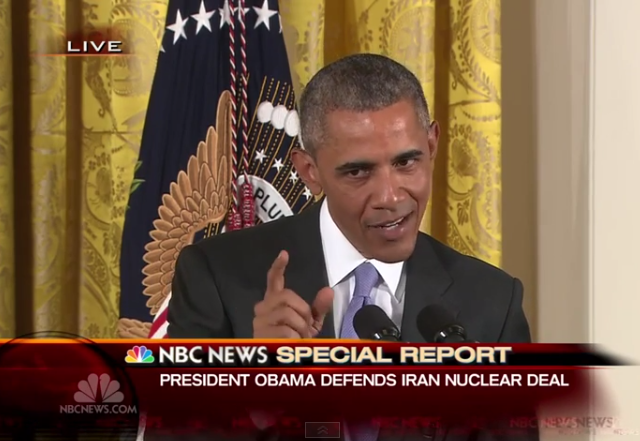
The Obama Administration is busy running a full court press on behalf of its terrible nuclear deal with Iran. Yesterday, the President sat down with Thomas Friedman of the New York Times for a softball interview, and today, he hosted a press conference to answer critics' concerns about the contents of the deal, and the Administration's posture toward Iran's overall behavior. https://youtu.be/SzBlcd4n73g?t=1h8m1s Via Fox news:

President Obama defended his deal to Iran to Thomas Friedman of The New York Times yesterday. It was a bad deal and it represented a retreat on nearly every single element of the deal. In any case this is what Obama told Friedman:
“We are not measuring this deal by whether it is changing the regime inside of Iran,” said the president. “We’re not measuring this deal by whether we are solving every problem that can be traced back to Iran, whether we are eliminating all their nefarious activities around the globe. We are measuring this deal — and that was the original premise of this conversation, including by Prime Minister Netanyahu — Iran could not get a nuclear weapon. That was always the discussion. And what I’m going to be able to say, and I think we will be able to prove, is that this by a wide margin is the most definitive path by which Iran will not get a nuclear weapon, and we will be able to achieve that with the full cooperation of the world community and without having to engage in another war in the Middle East.”
And what about the opposition to the deal?

I can't recall an event since I started this website in 2008 that has been as historically consequential as the nuclear deal the United States and five other countries just struck with Iran. It is the sweep of history. The deal is Obama's deal. He drove it, he crafted it with John Kerry as the scrivener, and he pulled the other powers along with it. The defects in the Iran nuclear deal are being exposed in great detail. Those problems are serious and real. But what has troubled me the most as I read through the varied technical analyses is the same thing that has bothered me since June 2009, when the Iranian people rose up against the Mullah regime after fraudulent elections. Obama was silent for weeks in the face of brutal regime oppression and repression, and then structured a response designed to keep the Mullahs in power. [Video of the Rooftop Revolution in Tehran, June 9, 2009] I wrote about it at the time, Negotiations Preconditioned On Mullah Rule:

This morning, news broke confirming what conservatives have been dreading for weeks---Obama finally got his bad Iran deal, and is now threatening to veto any action by Congress that would derail it. Iran is, of course, celebrating: Israel, on the other hand, is predictably and justifiably furious about the west's capitulation. PM Netanyahu's tweets speak for themselves:

The Obama administration with the help of the so-called P5+1 has reached a nuclear deal with Iran. Not all the details will be made public, but those that have been made public make a mockery of the promises of full, unfettered inspections, sanctions relief based on Iranian performance, and quick "snap back" of sanctions for violation.

President Barack Obama has, at least since 2012, claimed that he has Israel's back regarding his engagement with Iran. But as the Iran nuke negotiations move closer to an agreement, with reports it could happen by tomorrow, it is clear that Obama's words are empty rhetoric. In May ahead of his talk at a Washington D.C. synagogue, Obama said it once again, telling Jeffrey Goldberg, "It’s because I think they recognize, having looked at my history and having seen the actions of my administration, that I’ve got Israel’s back..." Events of this past week gives lie to Obama's contention. No this deal won't make Israel safer. But let's check what Iranians are saying. Last week, for example, Iran's former president, Ali Akbar Hashemi Rafsanjani, someone often called a "moderate" and an ally of current president, Hassan Rouhani, threatened to "wipe Israel off the map."
In response to a question why the Zionist regime has done its best to prevent the path for reaching a nuclear agreement between Iran and the West, Ayatollah Rafsanjani said that even Tel Aviv knows well that Iran is not after acquiring nuclear weapons.

Yesterday the Washington Free Beacon reported that that the Obama administration is willing to do whatever it takes to prevent a veto override when Congress votes on the Iran deal. This morning, CNN hosted a veritable White House press conference about the subject. Former State Department Iran negotiator Hillary Mann Leverett and Obama shill and Haaretz contributor Peter Beinart were anchor Chris Cuomo's entire panel. One point that Beinart made that deserves examination is his assertion that “Iranian dissidents want this deal to go through,” on the theory that opening up Iran will lessen the regime’s human rights abuses. He’s made the same argument here, and we're likely to hear it again in the coming weeks. It's worth asking, then, whether the human rights situation in Iran stands to improve. To begin with, Beinart is being disingenuous when he says that dissidents support the deal. Eli Lake documented in 2013 that, while some support it, many others do not.