

Image 01 Image 03

Gallup Poll Tag

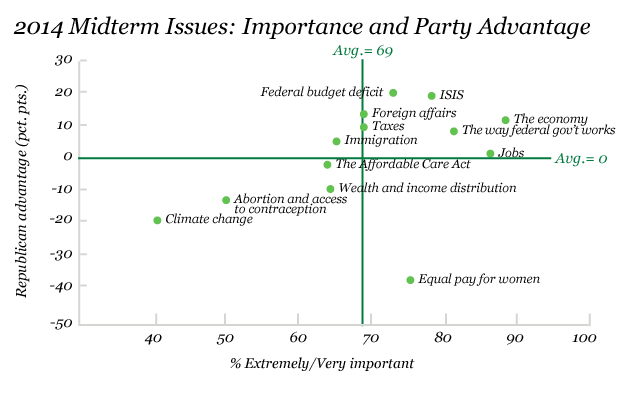
Any reasonable person keeping up with the news cycle knows that Democratic leadership doesn't inspire much confidence in the American people. Legislation dies in the Senate at the hands of a petulant majority leader; both the IRS and the DOJ have come under fire for targeting Americans based on political affiliation; our President golfs while the Middle East burns. In fact, one might say the only thing Democrats are really good at is riling up the base over token "hot button" issues that never go anywhere in Congress, but make for good primetime talkathon fodder. A new poll released by Gallup yesterday has quantified the skepticism of the American people, and shows empirical proof that the games Democrats play have serious consequences when it comes to the level of trust voters have in their ability to lead on the major issues. In late September, Gallup asked registered voters to rate the importance of 13 preselected issues, and then to identify which party they believed would do a better job handling those issues. The results looked like this: h7fjmcrciu6d7y5yx_-zjq
A recent Gallup poll shows that Americans are fairly evenly divided in their beliefs about the proper roll of government. When asked to rate their preference on a scale of 1 to 5 (1 meaning the respondent prefers limited government, and 5 meaning the respondent prefers a government that takes active steps to improve the lives of citizens) 35% of Americans said that they would prefer Washington take a more limited role in their daily lives. 32%, on the other hand, favor big government, and the remaining third of respondents fell somewhere in between. Via Gallup:
Gallup has asked this question four times since 2010, and each time, Americans have divided themselves roughly into thirds favoring a more active government, a less active government, or something in between. This division is especially noteworthy because the government's role in solving the nation's problems has been arguably more salient in recent years during the housing crisis, financial crisis, economic recession, and passage of the Affordable Care Act.
Generally speaking, Republicans favor a smaller role for government, while Democrats are happy with expanding federal reach. One thing that Americans do seem to agree on, however, is the current level of influence policymakers in Washington have on our everyday lives:

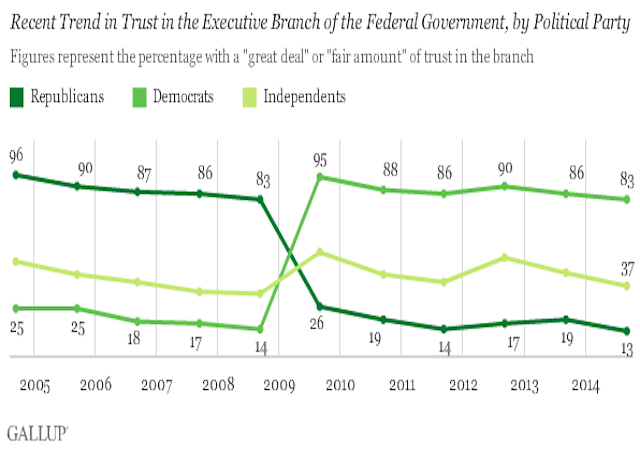
Gallup's new poll on Americans' level of trust in our three branches of government has revealed exactly what you would expect: they don't. We already know that likely voters, for the most part (but just barely,) have some idea of who controls the House and the Senate, but this new poll from Gallup offers a whole new perspective that could make that knowledge even more valuable to conservative campaigns as November looms ever closer. Via Gallup:
Americans have generally had the least trust in the legislative branch, consisting of the House of Representatives and the Senate, but never lower than the 28% who do so now. The prior low was the 31% measured in 2011, shortly after Congress and the president engaged in contentious debt-ceiling negotiations. Trust in the legislative branch had recovered slightly during the previous two years, to 34%, but is down significantly this year. As recently as 2007, 50% of Americans trusted Congress, but that trust has eroded amid a struggling economy and an era of intense partisan gridlock. This has been particularly acute since Congress was divided between a Republican House and a Democratic Senate after the 2010 elections.
This isn't surprising; between the stalemate in the Senate, cannibalism in the House, and no clear consensus on the part of conservatives as to how we should go about actually getting an agenda passed, it's no wonder America has exactly zero faith in either party's ability to get it right. The situation with trust in the executive branch doesn't look much better: