


Image 01 Image 03

European Union Tag

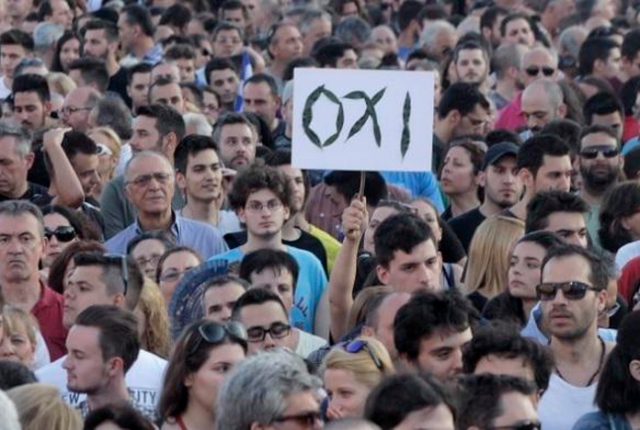
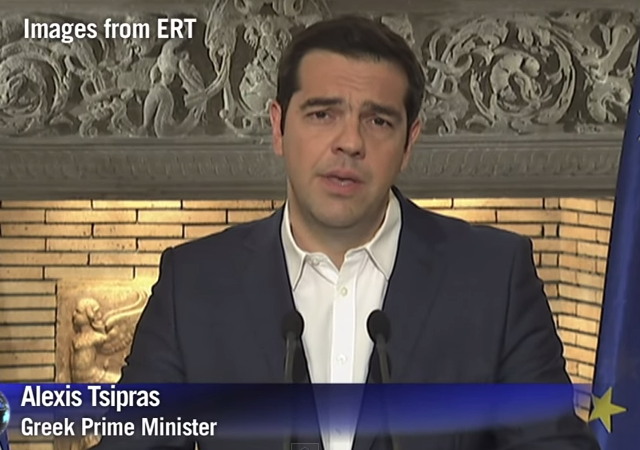
The economy of Greece has been a disaster for years due to massive entitlement and pension programs. Decades of overspending finally caught up with the Greek government in 2010, when their financial system nearly collapsed. Other countries in the European Union, notably Germany, loaned Greece billions on the condition that Greece would impose austerity measures; those measures eventually produced small results at a slower rate than expected. Frustrated with austerity and cuts to benefits, the people of Greece recently elected a new prime minister from the far left Syriza party named Alexis Tsipras. Tsipras won by promising to end the pain of austerity and to renegotiate Greece's debt, which means that the people of Greece have forgotten what caused their problem in the first place. Nicholas Paphitis of the Associated Press via ABC News writes:
Greece's First Radical Left Prime Minister Sworn In Tieless and eschewing the traditional religious swearing-in ceremony, but with a surprise coalition deal in the bag and a sanguine international reception, radical left leader Alexis Tsipras took over Monday as austerity-wracked Greece's new prime minister. Hours earlier, the 40-year-old's Syriza party trounced the outgoing, conservative government in Sunday's national elections, on a platform of easing social pain and securing massive debt forgiveness. Although Syriza fell tantalizingly short of a governing majority in the 300-seat parliament, Tsipras moved quickly Monday to secure the support of 13 lawmakers from the small, right-wing populist Independent Greeks party, raising his total to 162. "''We have the required majority," Tsipras told Greek President Karolos Papoulias, shortly before being sworn in as prime minister, the youngest Greece has seen in 150 years and the first incumbent to take a secular oath rather than the religious one customarily administered by a Greek Orthodox official.
Fans of Tsipras are celebrating, but his victory presents a whole new set of problems.

For years many the feeling was that Europe had unquestioned leverage with Israel and therefore could take sides without losing its clout. But trade and tech have taken their toll on this assumption. Israel is building alliances in Asia, and European leverage is sure to suffer. Former Israeli foreign and defense minister, Moshe Arens, explains in Ha'aretz Why Israel is shifting eastward.
On reflection this is not totally unexpected. For many years the economic development of the countries in East Asia has been outpacing the economic development of Europe. Japan made giant strides in the years after World War II. South Korea followed suit. China has become the economic wonder of the twenty-first century. There are, as well, indications of accelerated economic development in India, the world’s largest democracy. It is natural that Israel’s economic relationship with these countries would begin to rival its relationships with the countries of Europe, a Europe which seems to be in permanent economic crisis and lagging behind the Asian tigers. ... Despite the centuries of anti-Semitism that marked most European nations and the guilt borne by them for their actions during the Holocaust, Europe, in recent years through the machinery of the European Union, has waged a constant campaign of criticism and condemnation of the policies pursued by Israeli governments, going so far as to impose economic sanction against Israel.
The second point was made in an op-ed in late February by Clemens Wergin in the New York Times, Why Israel no longer trusts Europe.
To Europe, the Israeli-Palestinian conflict is the root of all problems facing the region — a view in no way altered by the Arab Human Development Reports published by the United Nations since 2002, which showed that Arab autocracies and cultural backwardness were the root of the region’s woes.

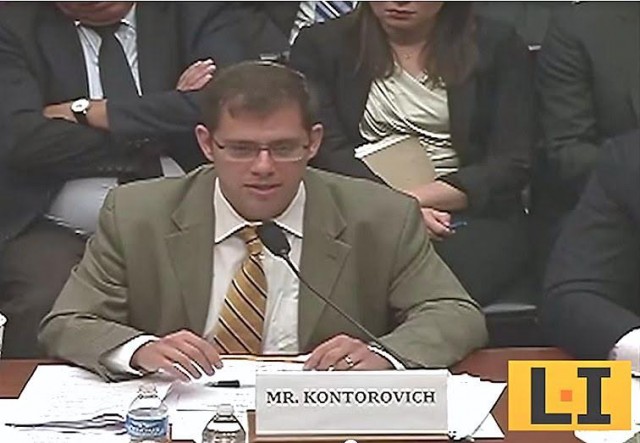
Northwestern University Law Professor Eugene Kontorovich has been doing wonderful work exposing the myth of the Israeli "illegal" occupation of Judea and Samaria (the "West Bank").  You really need to watch the videos we have posted here, The Legal Case for Israel and The historical fiction of Israel’s “occupation”. Given the war on Israel declared by the American Studies Association and two other smaller anti-Israel boycott groups, and the need to correct so much of the anti-Israel propaganda behind it, here is Prof. Kontorovich's explanation of the legal history of the region again: Now Prof. Kontorovich has come out with a challenge to the European Union to treat Israel's "occupation" the way it treats other "occupations" -- and the Europeans are none too happy. As reported by The Times of Israel, Why is this occupation different from all other occupations?:
Many Israelis have long felt that the European Union is biased against them. Two legal scholars – a former Israeli ambassador and an American Jewish international law professor — think they’ve found the perfect case to prove the claim: A new fishing deal, signed between the Europeans and Morocco, which applies beyond Morocco’s internationally recognized borders, taking in the territory of Western Sahara, even though Morocco invaded that area in 1975 and has occupied ever since.