

Image 01 Image 03

Book Review Tag

Allan Bloom's book The Closing of the American Mind was published in 1987, which is now very close to 30 years ago. And yet its relevance has only grown in the intervening years. It describes the influence of the left on the university and what it teaches, and how it has affected subsequent generations of students and how they think about a host of things, including America itself. Here's an excerpt from the book that very much resonates today:
Contrary to much contemporary wisdom, the United States has one of the longest uninterrupted political traditions of any nation in the world. What is more, that tradition is unambiguous; its meaning is articulated in simple, rational speech that is immediately comprehensible and powerfully persuasive to all normal human beings. America tells one story: the unbroken, ineluctable progress of freedom and equality. From its first settlers and its political foundings on, there has been no dispute that freedom and equality are the essence of justice for us. No one serious or notable has stood outside this consensus...All significant political disputes have been about the meaning of freedom and equality, not about their rightness...

Unwinding after a day of regulatory analysis and political opining, I often read true crime novels. A compelling one I just started is In He Killed Them All by Fox News Channel host Jeanine Pirro. Pirro's book engagingly and brilliantly details her experiences trying to bring suspected murderer Robert Durst to justice for the deaths of his first wife Kathleen (Kathie) McCormack Durst, Morris Black, and his longtime friend Susan Berman. The title of the book stems from the dramatic conclusion of the popular 2015 HBO series that centered around these cases, The Jinx: The Life and Deaths of Robert Durst. During the last episode, after being confronted with some damning evidence in the form of letters, Durst headed to the bathroom to regain his composure.

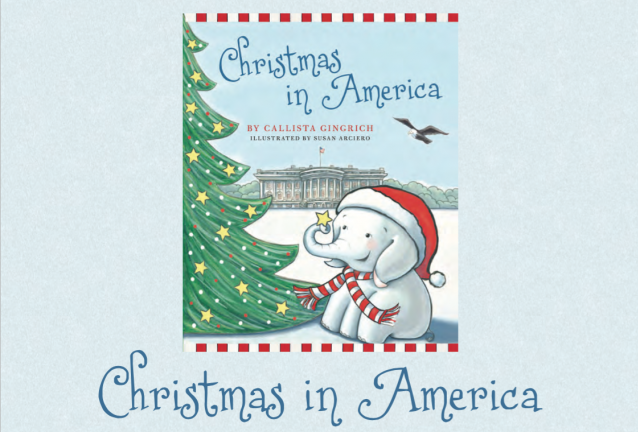
Callista Gingrich's fifth children's book is one you'll want to pick up. Ellis the adorable little elephant journeys through the past, stoping to explore the history of Christmas in America. Far from the watered-down historical fare, Christmas in America serves meaty historical events delicately enough to be palatable to youngsters, but rich enough for readers of any age. So enjoyable were some of the historical specifics, that I found myself geeking out, excited to reread a few of my favorite stories. If your American history knowledge has collected a little dust over the years, fear not. Christmas in America is equipped with a handy guide in the back of the book to bring you up to speed.

First, a bit about you:

The Conservatarian Manifesto is one that needs to find its way onto your essential reading list. The little red book written by National Review's Charles C.W. Cooke provides a tangible framework for a prolific, but largely ignored segment of the political right -- the conservatarians. Artfully weaving hard data (without descending into pedantic statistical lists) with relevant history, Cooke produces several compelling arguments covering an array of topic. Unlike books that dabble in theory but provide no realistically applicable suggestions, The Conservatarian Manifesto goes beyond thoughtful ponderance and illuminates a pathway forward. In sum -- it's a great book, an enjoyable read, and you should buy it. Without further ado, our chat with Mr. Cooke:

First, a bit about yourself:

K: Beer, bourbon, or wine? C: All three. But I mostly drink wine. K: You have one hour to chat with the person of your choosing, deceased or breathing. Who would you choose? C: Charles James Fox. He was a playboy parliamentarian in eighteenth century England who started off a Tory and became a radical Whig. Fox supported the American War of Independence—to the extent that he dressed up in the colors of Washington’s army and cheered British losses in the House of Commons—and he took to using his parliamentary privilege to excoriate the King. He made a bunch of mistakes in his later life, but he was a great friend of American radicalism, a staunch opponent of overweening executives, an opponent of slavery, and a defender of free speech. He could also drink for England. He’d have been a riot. K: We know you're an upstanding American (citizenship imminent), but on a scale of 1 to Queen Elizabeth I, how British would you consider yourself these days? C: Six. Politically, I’m pretty American in my thinking—and I was long before I moved here. But I haven’t lost my accent at all. Nor have I lost most of my Britishisms. At restaurants I still say “thank you” and “please” about seventeen hundred times each minute.