

Image 01 Image 03

US Supreme Court Tag

Today, the Supreme Court heard oral arguments in a case that pits the concept of religious accommodation against company dress codes and hiring practices. Just writing it out makes it sound depressing, doesn't it? The facts don't make things much better. Back in 2008, Samantha Elauf, an observant Muslim, applied and was interviewed for a job at teen-friendly retailer Abercrombie & Fitch. She impressed the hiring manager, but when the time came to make a decision, the manager decided not to hire Samantha because she had concerns about whether or not Samantha would insist on wearing her headscarf to work. This would have been a violation of Abercrombie's "Look Policy," which dictates that employees conform to a strict set of style guidelines that specifically prohibit head coverings and black clothing. After Samantha failed to get the job, a friend of hers already employed with the retailer asked the hiring manager for her reasons, and the manager indicated that the headscarf played a part in her decision. Welcome to the Supreme Court, Abercrombie. Enjoy your stay. The EEOC sued on Elauf's behalf on grounds of religious discrimination, and down came a $20,000 award in favor of her case. The 10th circuit overturned the decision, saying that because Elauf never asked for an accommodation, the company wasn't liable for not offering one; the Court was uncomfortable holding employers to a standard that would require them to ask about a religious exemption they may not know an employee needs.

One of the most interesting developments in the recent media spin cycle is the renewed fascination---on both the left and the right---with Supreme Court Justice Ruth Bader Ginsburg. Ginsburg has been in the national spotlight since her appointment in 1993; her tenure on the Court has afforded her the opportunity to become one of the most influential figureheads in the fight for gender equality and expanded "reproductive rights." Influential, and polarizing. We can't stop talking about her, whether it be about her opinions, her tendency to snooze during the State of the Union, or---most importantly, in some circles---her eventual retirement. In a recent interview with MSNBC, Irin Camron wasted no time in coaxing Ginsburg into answering the one question liberals can't help but flogging every time they get near a member of the Court---how long does Ginsburg plan on sticking around? They're worried, of course, because timing is key when it comes to Supreme Court appointments. Right now the left's worst nightmare is that the next retirement will coincide with a Republican presidency. Ginsburg's history of health problems---colorectal cancer in 1999, and a tumor in her pancreas in 2009---has become a real hobgoblin for SCOTUS watchers, who understand the difference one seat can make when major issues such as gay marriage, abortion, or election law are on the line. Talking heads have picked up on the tension. Check out Maddow's heightened level of concern (via MRC):

We've already talked about how Supreme Court Justice Ruth Bader Ginsburg stole the show at this year's State of the Union address---mostly because the entire internet was 90% sure they caught her during the action: As it turns out, she wasn't merely napping---she was fighting back the effects of a fine California vino. From TPM:
"The audience for the most part is awake because they're bobbing up and down all the time. And we sit there, stone faced, the sober judges," Ginsburg said. "But we're not, at least I was not, 100 percent sober." She explained that the justices have dinner together before the annual speech, which she said Scalia hadn't attended in several years, and that Justice Anthony Kennedy brought along a bottle of California wine that was just too good to resist. "I vowed this year -- just sparkling water, stay away from the wine -- but in the end the dinner was so delicious it needed wine to accompany it."
Watch:

In the months leading up to the first Supreme Court Obamacare decision, there was a concerted media and Democratic effort to portray the legitimacy of the Court, and particularly the legacy of Chief Justice John Roberts, as dependent on the outcome. The argument went that holding Obamacare's mandate to be unconstitutional would be such a huge interference in the political process that the Court would lose its supposed role as neutral referee and become a political player. Because as we all know, that has never happened before (/sarc), see, Roe v. Wade, etc. This pressure reportedly caused Roberts to change his vote, and to join with the for liberal members of the Court in finding the mandate justified under Congress' taxing power. Now the media pressure is mounting on Obamacare II, the subsidy case the Court accepted this term. The issue is whether the statutory language of Obamacare permits subsidies (the only way Obamacare policies are affordable for most) on the federal exchange set up when most states refused. This issue of statutory interpretation is not exceptional legally, except that the political stakes are so high. If the statute is read not to permit the subsidies, Obamacare likely crumbles of its own weight. Enter Linda Greenhouse, Supreme Court and judicial reporter for The NY Times, with scare mongering about the legitimacy of the Court, The Supreme Court at Stake: Overturning Obamacare Would Change the Nature of the Supreme Court:

The upcoming Supreme Court case of King v. Burwell holds much in the balance, including the very financial sustainability of President Obama’s signature law, the Patient Protection and Affordable Care Act (PPACA). If the Supreme Court rules for the plaintiffs, the ability for the law to support itself would almost certainly collapse. At issue in King is the legality of an IRS rule allowing exchanges operated by the federal government to issue tax subsidies to qualified individuals purchasing health insurance through the exchange. This is an incredibly complex issue, and many courts, scholars, and commentators have spent thousands upon thousands (upon thousands) of pages of argument attempting to arrive at the proper conclusion. Ultimately, we must wait until the Supreme Court decides this case at the end of the term to learn the definitive conclusion. The complexity of the law notwithstanding, many commentators remain convinced that any ruling against the government would be one for politics over the law, leading to familiar questions of the “institutional legitimacy” of the Supreme Court should they rule against the government. This is nothing new, especially when it comes to the issue of PPACA. Indeed, in the wake of the 2012 PPACA challenge, a litany of law professors and legal scholars shared in the assessment that striking down PPACA would result in substantial costs “for the Court as institution and for its credibility carrying out its vital national role going forward.”

First, she came prepared with her hometown paper. You know, just in case she got bored:

Then, she got to enjoy the company of her coworkers.

But since this year's State of the Union address was just like every.other.state.of.the.union.address President Obama has given, Ginsberg decided to take a beat mid-speech. Being a Supreme Court Justice is hard work, you know.

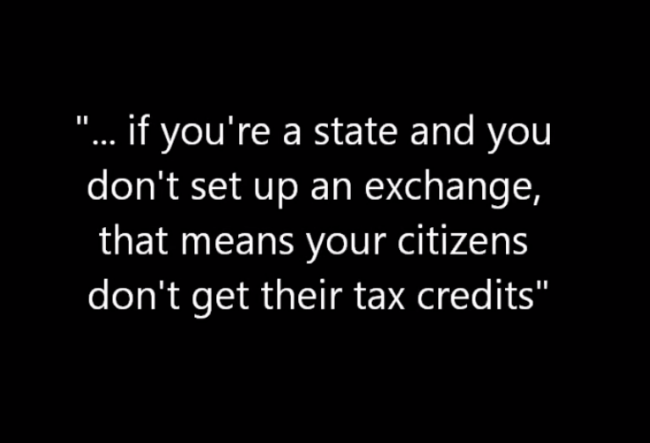
King v. Burwell is the case the Supreme Court agreed to hear involving Obamacare subsidies on federal exchange. You will recall that the legal issue is whether the IRS violated the express provisions of Obamacare by issuing rules allowing taxpayers to claims federal subsidies when purchasing on the federal exchange, even though the language of the statute appears not to allow that. In King, the Fourth Circuit ruled that there was possible ambiguity and another potential reading of the law, such that apparently clear language was not that clear, giving the IRS leeway to interpret the statute. In another case, Halbig v. Burwell, a D.C. Circuit panel had ruled that the subsidies were not available on the federal exchange, but that ruling was vacated pending the entire D.C. Circuit Court hearing the case en banc. In a surprise move, the Supreme Court agreed to hear the King case even though there was no split in the Circuits (after the Halbig decision was vacated). King will be one of the biggest decisions of this term, and if the Obama administration loses the case, it could be the death of Obamacare as we know it, because 37 states have refused to create state exchanges. Obamacare is affordable only with subsidies, and if the subsidies are not available to citizens of 37 states, the system likely collapses. One key issue is whether the wording of the statute was a mistake or misstatement, or reflected a logical policy. Obamacare was set up in such a way as to put pressure on states to create state exchanges by providing for federal subsidies in the form of tax credits only for purchases on state exchanges. This was a conscious decision, as explained by none other than Jonathan Gruber: Into the fray leaps Mark Levin and his Landmark Legal Foundation, which just filed a friend of the court, Amicus Curiae Brief. The full Brief is embedded below.

You can take my vanity plates when you pry them from my cold dead fingers! Not exactly the most serious declaration we're ever published here, but it's relevant to the Supreme Court's latest free speech case, and could end up playing a role in a new standard governing content allowed on custom license plates. The Circuits are currently split on the issue of whether or not state governments can pick and choose between political messages requested for vanity plates; there's no consensus as to whether or not the message on the plate constitutes the speech of the driver, and is entitled to a higher level of protection. The Supreme Court has agreed to review Walker v. Texas Division, Sons of Confederate Veterans, Inc., and free speech advocates are hoping that the facts of this case can be applied to similar situations all across the country:
A panel of the U.S. Court of Appeals for the 5th Circuit said Texas officials were wrong to turn down a request from the Sons of Confederate Veterans. The requested plate would have featured the group’s logo: a Confederate battle flag framed on all four sides by the words “Sons of Confederate Veterans 1896.” After several votes, the board of the Texas Department of Motor Vehicles turned down the request because it found “a significant portion of the public associate the Confederate flag with organizations advocating expressions of hate directed toward people or groups that is demeaning to those people or groups.” A district court upheld the decision, but the appeals panel reversed it.

Title VII of the Civil Rights Act of 1964 prohibits sex discrimination against pregnant women, but how far does Title VII require an employer to go to accommodate pregnant workers who develop conditions limiting their ability to do their jobs? We already know an employer can't use a pregnancy to fire an employee, cut her pay, or deny her health benefits, but should they be forced to go so far as to offer up alternative work during the duration of the pregnancy? This morning, the Supreme Court will tackled Young v. United Parcel Service, which asks whether, and in what circumstances, the Pregnancy Discrimination Act, 42 U.S.C. § 2000e(k), requires an employer that provides work accommodations to non-pregnant employees with work limitations to provide work accommodations to pregnant employees who are “similar in their ability or inability to work.” Bloomberg has the facts of the case:
Young worked out of a UPS facility in Landover, Maryland. Her job required her to load packages onto vehicles and deliver them to their destination. Although she says the vast majority of those packages were envelope-size, her job description required her to lift parcels of up to 70 pounds. In 2006, Young became pregnant after in vitro fertilization, and her doctor and midwife said she shouldn’t lift objects weighing more than 20 pounds during the first half of the pregnancy or more than 10 pounds for the rest. She says UPS refused to accommodate her needs either by adjusting her job responsibilities or by temporarily assigning her to a position that didn’t require heavy lifting. There were “many, many jobs” she could have performed at the Landover facility, including those that required only handling phone calls or addressing packages, she said in an e-mailed response to a reporter’s question. She also said she would have worked in a nearby facility if the company preferred. “I was flexible,” Young said. “I just needed my job.” She went on an unpaid leave of absence and returned to work after her baby was born. She later left UPS.
End game aside, it's a fair question: if you have another, similar group you're accommodating with lighter work during a temporary disability, why not include into the mix pregnant women who develop similar disabilities?

Both parties in the high-profile Elonis vs. United States had their day before the Supreme Court yesterday, and lawyers and analysts alike aren't sure what to make of the Court's reaction to oral arguments. Elonis (described in detail here) is shaping up to be a real barn burner because it tackles a question almost all of us have asked ourselves at some point: can you SAY that on Facebook? "That" being, of course, profanity- and violence-saturated rants directed at a particular person or group of people. We don't have a cohesive standard for what constitutes a "true threat" against another person, and the murky waters of social media have added an extra layer into an already complicated case. Platforms like Facebook and Twitter provide a kind of semi-anonymous catharsis for users; you can post a picture, or a song lyric, or random thought, and (barring any run-ins with the platform's TOS) no one can find cause to complain because it's your space on the internet to use as you wish. Enter Elonis' pointed, violent rants. Is it enough to claim catharsis and artistic expression when your content is clearly aimed at another person, and that person feels threatened? Elonis' attorneys are banking on the Nine to accept this argument:
John Elwood, a lawyer for Mr. Elonis, said prosecutors should have to show that someone accused of making threats intended to put the listener in fear. Merely being reckless with comments on Facebook or elsewhere shouldn’t be enough to make someone guilty, he said. “Many of the people who are being prosecuted now are teenagers who are essentially shooting off their mouths or making sort of ill-timed, sarcastic comments which wind up getting them thrown in jail,” Mr. Elwood said. He cited a Texas prosecution of a teenager who made remarks in a videogame chat room about attacking a school. And he suggested the government’s preferred legal approach would allow the prosecution of someone from Ferguson who tweeted a violent message along with a picture of police officers during the riots.
Justices Alito and Ginsburg balked at this argument, with Alito citing concerns that condoning Elonis' conduct could lead to a situation where estranged spouses could post threatening content against their partner and get away with it, and Ginsburg asking how a prosecutor could somehow tease out what was in the perpetrator's mind when he posted the threatening content.

In the 2003 barnburner Virginia v. Black, the Supreme Court held unconstitutional a statute that in part stated that the act of burning a cross constituted prima facie evidence of an intent to intimidate a person or group. Writing for the majority, Justice O'Connor said that "just as a State may regulate only that obscenity which is the most obscene due to its prurient content, so too may a State choose to prohibit only those forms of intimidation that are most likely to inspire fear of bodily harm." Next week, the Supreme Court will be asked to apply this standard to speech in a new and controversial venue: a man's Facebook timeline. Anthony D. Elonis was sentenced to four years in federal prison after a court determined that violent rants posted to his personal Facebook page constituted a "true threat" to his estranged wife, former coworkers, and even a federal agent. The Washington Post has the background:
About a week after Tara Elonis convinced a judge to issue a protective order against her estranged husband, Anthony, her soon-to-be ex had this to say:
“Fold up your PFA [protection-from-abuse order] and put it in your pocket Is it thick enough to stop a bullet?”
... He was fired after co-workers interpreted one of his Facebook postings as a threat to them. He responded: ““Someone once told me that I was a firecracker. Nah, I’m a nuclear bomb and Dorney Park just f----- with the timer.” ... In other postings, Elonis suggested that his son dress as “Matricide” for Halloween, with his wife’s “head on a stick” as a prop. He pondered making a name for himself by shooting up an elementary school and noted that there were so many nearby to choose from — “hell hath no fury like a crazy man in a kindergarten class.”

I appeared this afternoon during the National Review post-election cruise on a panel with: The panel topic was The State of American Justice. Unfortunately, there is no audio or video I can link to. But take my word for it, it was a good discussion. We started out with a discussion of whether the newly Republican Senate should reinstate the filibuster rule for non-Supreme Court nominees. You will recall that the Senate Democrats eliminated the filibuster in November 2013 (went "nuclear") at the urging of Obama allowing Obama to pack the courts with virtually any nominee he wants.  The discussion centered around a prior presentation by former Senator Jon Kyl who (according to reports, I didn't hear it) advocated a return to the longstanding filibuster tradition which serves the Senate and the people well. The clear consensus on the panel, articulated at length by Whelan, was NO UNILATERAL DISARMAMENT. Harry Reid and the Democrats need to be taught a lesson -- and that lesson should not be that they get to change the rules when it suits them, only to regain the benefit when Republicans take over.  This will be a fight early next year, and we need to bring some backbone to Senate Republicans.  The rule change doesn't so much matter now, but in the event a Republican wins the presidency in 2016, why should Republicans not get the free pass Obama gets?

The issue of subsidies on the federal exchange has been accepted by the Supreme Court. Scotusblog reports:
The Supreme Court, moving back into the abiding controversy over the new health care law, agreed early Friday afternoon to decide how far the federal government can extend its program of subsidies to buyers of health insurance. At issue is whether the program of tax credits applies only in the consumer marketplaces set up by 16 states, and not at federally-run sites in 34 states. Rather than waiting until Monday to announce its action, which would be the usual mode at this time in the Court year, the Justices released the order granting review of King v. Burwell not long after finishing their closed-door private Conference. By adding the case to its decision docket at this point, without waiting for further action in lower federal courts, as the Obama administration had asked, the Court assured that it would rule on the case during the current Term. If it confines the subsidies to the state-run “exchanges,” it is widely understood that this would crash the Affordable Care Act’s carefully balanced economic arrangements.
We previously wrote about the King case, Whipsaw: 4th Circuit upholds Obamacare federal exchange subsidy after D.C. Circuit rejects:

The Sarbanes-Oxley Act of 2002 was passed in an effort to reform the finance and governance structures in corporate America. Although the language of the Act is notoriously broad, it has mostly been applied to those in the corporate world who make missteps during investigations into their financial practices. Then, of course, there are times when white collar crime statutes are used to prosecute fishermen who throw back undersized fish. In 2007, a search of the Miss Katie fishing vessel revealed that the crew had caught and retained 72 undersized red grouper. The vessel's owner, John Yates, was cited, and told to take the 72 grouper to port for seizure. Instead, Yates put the fish back in the water and replaced them with bigger fish. A port inspection revealed only 69 undersized fish, leading to officials' discovery of what Yates had done. Prosecutors indicted and convicted Yates under a provision of Sarbanes-Oxley that provides a maximum punishment of up to 20 years for the destruction of “any record, document or tangible object” in order to obstruct an investigation. The case wound its way through the system before landing on the dias at the Supreme Court---and it looks like the entire panel is skeptical not of the prosecutor's classification of fish as "evidence," but of the prosecutor's decision to prosecute under Sarbanes-Oxley.

Yesterday was oral argument at the Supreme Court in a lawsuit over whether Congress had the power to designate Jerusalem as the Capital of Israel on passports. The case is Zivotofsky v. Kerry, and the issue is a fight between Congress and the Executive Branch, Via Scotus Blog:
Issue: Whether a federal statute that directs the Secretary of State, on request, to record the birthplace of an American citizen born in Jerusalem as born in "Israel" on a Consular Report of Birth Abroad and on a United States passport is unconstitutional on the ground that the statute "impermissibly infringes on the President's exercise of the recognition power reposing exclusively in him."
Prof. Eugene Kontorovich points out that legally the issue is not the same as the political issue of recognition of Israeli sovereignty over all of Jerusalem. Most observers of the oral argument believe it it will be a 5-4 split, most likely in favor of the Executive Branch. But oral arguments are not necessarily accurate predictors of ultimate outcome, so who knows. Regardless of the legal technicalities, the media and public perception is that this is a political issue regarding Jerusalem, particularly in light of hostile and threatening statements made by the Obama administration over Israeli exercise of sovereignty over "East Jerusalem" (the part of Jerusalem illegally occupied by Jordan from 1949-1967). Via Mirabelle from Israelly Cool:
Some of Obama’s biggest recent grievances in that relationship [between Obama and Netanyahu] seem to have been over Jews living in various neighborhoods in Jerusalem. In the past few weeks, Obama or his spokespeople have expressed their displeasure with Jews moving into homes they legally purchased in Silwan, planned construction of mixed Jewish and Arab housing in Givat Hamatos, or Monday’s announcement of homes in Har Homa and Ramat Shlomo. Rather than go on a lengthy rant about my complete and utter disappointment at my own President, I though we’d just take a trip in the Wayback Machine, to 2008 . . .
In 2008, Obama pledged that Israel could keep its undivided Capital of Jerusalem, if it likes it. That was then. This is now:

Yesterday, the 7th Circuit Court of Appeals denied a request by two targets of the Wisconsin John Doe investigation to rehear a decision by a three-judge panel to vacate an injunction issued by the District Court preventing the state investigation from continuing. (Order at bottom of post.) The substantive issue underlying the case is whether the Wisconsin campaign regulations violated the First Amendment, specifically laws that purportedly bar "issue advocacy" coordination between campaigns and outside groups. In the John Doe investigation, the Milwaukee County prosecutor -- who allegedly has a family political bias -- targeted dozens of conservative Wisconsin activists for sweeping subpoenas. Two of the targets -- Eric O'Keefe and the Wisconsin Club for Growth -- filed suit in federal court to halt the investigation, and for money damages. The District Court granted the injunction and allowed the case to move forward. The 7th Circuit, however, reversed the District Court. That original 7th Circuit decision was based, primarily, on the issue of whether a federal court in this circumstance should interfere in a state court investigation. The 7th Circuit panel ruled that the federal court should abstain. I reached out to one of the lawyers for the John Doe targets, Andrew Grossman, as to whether Supreme Court review via a Petition for Certiorari would be sought, and he responded as follows:
"We will be seeking Supreme Court review and have every expectation that the Seventh Circuit's decision will be reversed."

HBO's Last Week Tonight is easily the best satirical news program on TV these days. Hosted by Daily Show alum John Oliver, Last Week Tonight is all over the spectrum ideologically, but regularly has me in stitches. Recently, Last Week Tonight noticed video cameras are not allowed to film SCOTUS oral arguments. Oliver and crew set out to ensure the American public is never without a visual of the Supreme Court arguments again. Enter "Real Animals Fake Paws." Take a look: Oliver released the raw footage on YouTube for enterprising individuals to utilize. Slowly but surely, oral arguments set to "Real Animals Fake Paws" are popping up.

AP reports via HuffPo:
The Supreme Court said Saturday that Texas can use its controversial new voter identification law for the November election. A majority of the justices rejected an emergency request from the Justice Department and civil rights groups to prohibit the state from requiring voters to produce certain forms of photo identification in order to cast ballots. Three justices dissented. The law was struck down by a federal judge last week, but a federal appeals court had put that ruling on hold. The judge found that roughly 600,000 voters, many of them black or Latino, could be turned away at the polls because they lack acceptable identification. Early voting in Texas begins Monday. The Supreme Court's order was unsigned, as it typically is in these situations. Justices Ruth Bader Ginsburg, Sonia Sotomayor and Elena Kagan dissented, saying they would have left the district court decision in place. "The greatest threat to public confidence in elections in this case is the prospect of enforcing a purposefully discriminatory law, one that likely imposes an unconstitutional poll tax and risks denying the right to vote to hundreds of thousands of eligible voters," Ginsburg wrote in dissent. Texas' law sets out seven forms of approved ID — a list that includes concealed handgun licenses but not college student IDs, which are accepted in other states with similar measures.
The Supreme Court Order is here. It denies a request to vacate the stay issued by the 5th Circuit Court of Appeals putting on hold the trial court ruling invalidating the law.