

Image 01 Image 03

Michael Brown Tag

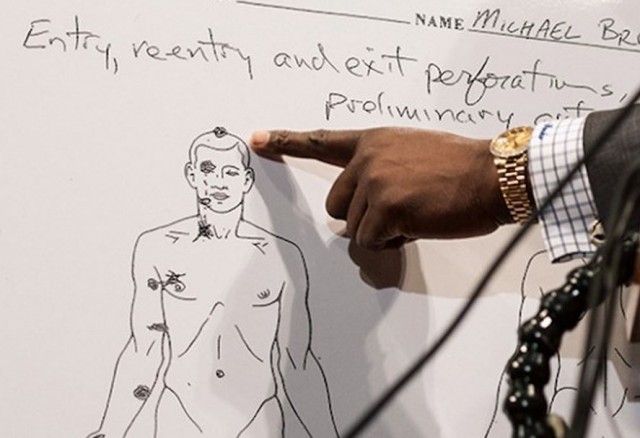
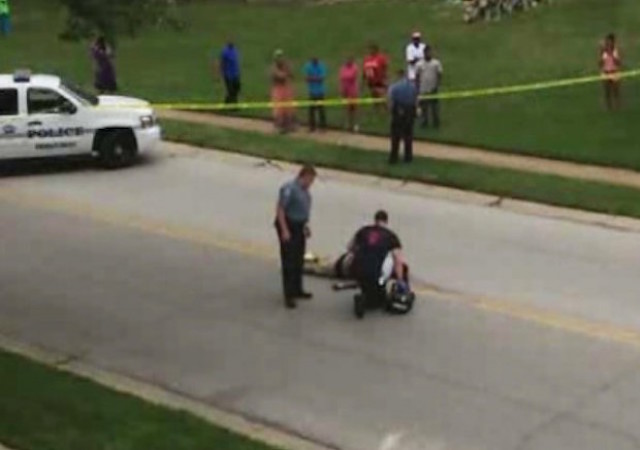
The St. Louis Post-Dispatch has obtained and released the official autopsy report of Mike Brown, the black man shot and killed by Police Officer Darren Wilson in Ferguson, MO this past August.  (The autopsy report is embedded below.) The item in the report that perhaps sheds the greatest light on the circumstances of the shooting is the evidence that Mike Brown has a gunshot wound to the inside of his right hand near his thumb and palm that appears to be a contact gunshot wound.  This would be consistent with the police narrative that Brown was fighting with Officer Wilson for possession of his service pistol when the shot was fired. Gunpowder stippling is typically indicative of the distance between the muzzle of a fired gun and the gunshot wound caused by the projectile.  If the shot is fired at close distance (inches to feet) there is typically unburned gunpowder that causes an observable stippling on the victim's skin.  When the shot is fired from a greater distance (several feet or further) the unburned gunpowder generally does not reach the victim's skin, and thus there is no stippling. Somewhat counterintuitively, however, there is another type of gunshot wound in which no stippling is found.  In a contact gunshot wound, in which the muzzle is in contact with the victim's skin, the unburned gunpowder simply enters the wound along with the projectile.  Because the powder does not contact the skin, there is no skin stippling in a contact gunshot wound.  A contact gunshot wound also typically cause a star-like burst or fragmentation of skin at the site of injury, as the hot gasses propelling the bullet enter and expand within the flesh. The projectile itself, of course, will often fragment skin and bone.

A breaking New York Times report sheds new light on Ferguson police officer Darren Wilson's mortal encounter with local Michael Brown.

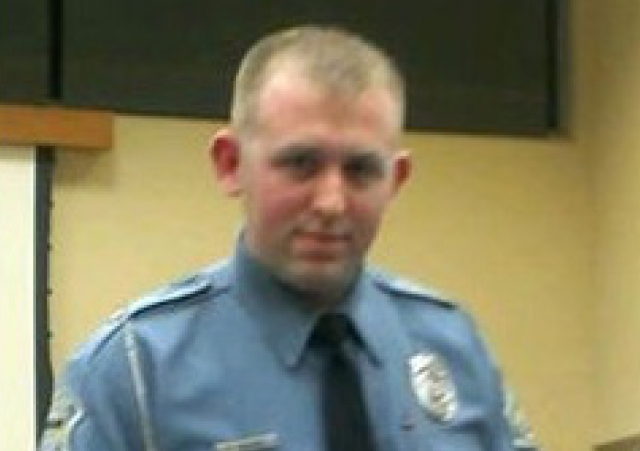
The police officer who fatally shot Michael Brown in Ferguson, Mo., two months ago has told investigators that he was pinned in his vehicle and in fear for his life as he struggled over his gun with Mr. Brown, according to government officials briefed on the federal civil rights investigation into the matter. The officer, Darren Wilson, has told the authorities that during the scuffle, Mr. Brown reached for the gun. It was fired twice in the car, according to forensics tests performed by the Federal Bureau of Investigation. The first bullet struck Mr. Brown in the arm; the second bullet missed. The forensics tests showed Mr. Brown’s blood on the gun, as well as on the interior door panel and on Officer Wilson’s uniform. Officer Wilson told the authorities that Mr. Brown had punched and scratched him repeatedly, leaving swelling on his face and cuts on his neck.

According to the New York Times, Wilson told authorities that he fought with Brown for possession of his service pistol, resulting in two rounds fired inside his police vehicle.  One round struck Brown in the arm, and the other was wasted.

Importantly, Brown's blood was found on the gun by forensics analysis, as well as on the inside of the police vehicle, confirming his presence in the vehicle and the weapon.

Wilson said that Brown punched and scratched him numerous times, causing abrasions and swelling to his face and neck.

The officials briefed on the case said the forensic evidence gathered in the car lent credence to Officer Wilson’s version of events. According to his account, he was trying to leave his vehicle when Mr. Brown pushed him back in. Once inside the S.U.V., the two began to fight, Officer Wilson told investigators, and he removed his gun from the holster on his right hip. Chief Jon Belmar of the St. Louis County Police Department has said in interviews that Officer Wilson was “pushed back into the car” by Mr. Brown and “physically assaulted.”

The Times goes on to quote Brown's friend Dorian Johnson as a sort of opposing witness to Officer Wilson.

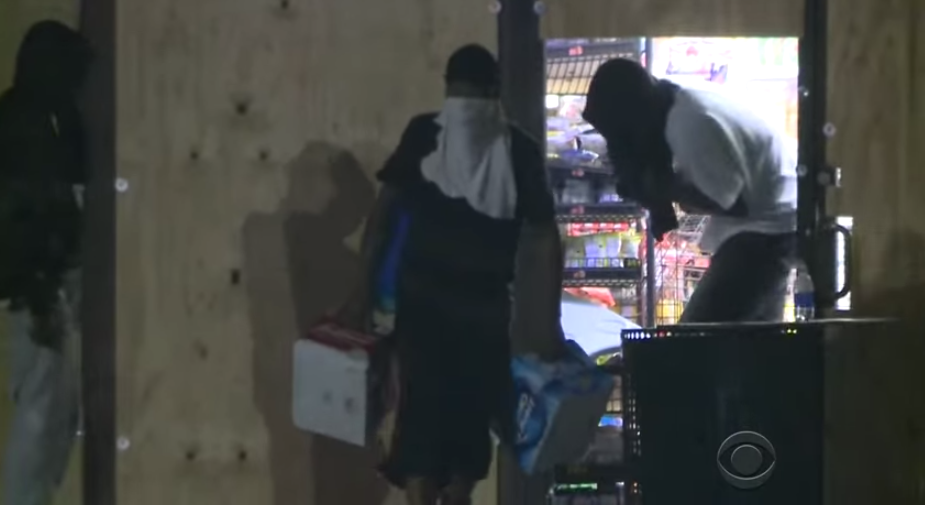
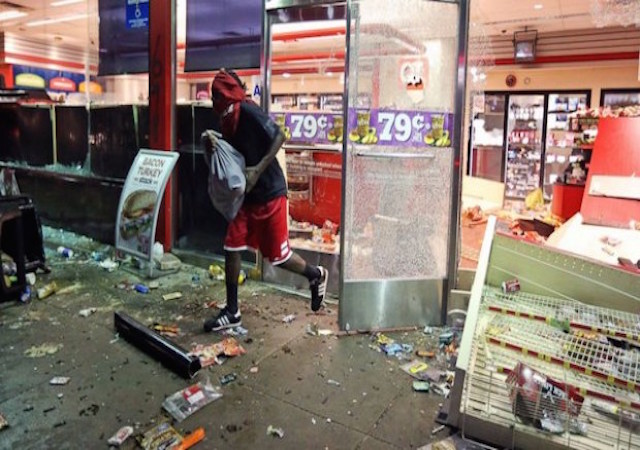
Look up irony in the dictionary, and by all rights you should find a footnote pointing to this news story from CBS re: Ferguson MO: "Ferguson residents frustrated over lack of opportunity." The story notes that the previous night was sufficiently quiet--"just eight arrests"--and that the National Guard is pulling out (meaning, productive people are being released to go back to their day jobs.) The irony arose when the reporter spoke to local Ferguson residents.  The common theme among those interviewed was outrage that local businesses--you know, the ones that had been relentlessly looted and vandalized by local residents--had not hurried to rebuild and offer jobs to local residents. Huh.  Who knew that robbing and burning local businesses might prove a disincentive to them investing and hiring in the community! Anybody remember this guy? Beer