
Image 01 Image 03

Economy Tag

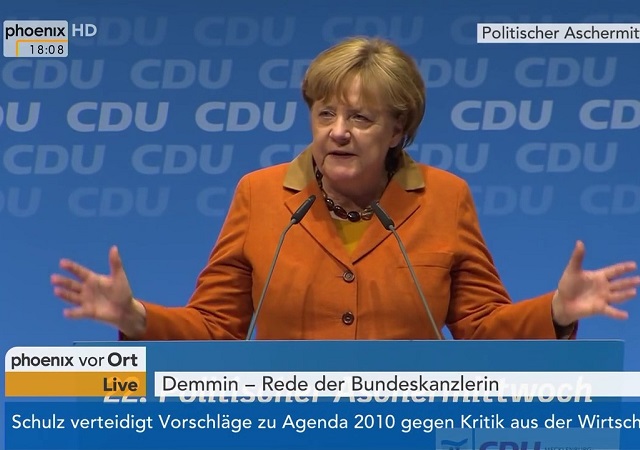
President Donald Trump's latest executive orders on foreign trade have irked Chancellor Angela Merkel's government, prompting tough talk from Berlin. On Friday, President Trump signed two orders seeking to identify trade abuse and other malpractices carried out by foreign governments in order to lower the U.S. trade deficit. Merkel's second-in-command, German Vice Chancellor Sigmar Gabriel, described Trump's moves as unlawful, claiming that he wants to "favour American companies, even if it contradicts international law." Germany's Economy Minister Brigitte Zypries said that President Trump was taking the U.S. in  "completely the wrong direction" and "moving away from free trade" by signing those executive orders. Minister Zypries had previously threatened to take the U.S. to court if the Trump administration were to impose import duties on German products.

President Donald Trump's promises to overhaul regulations and the tax codes along with positive sale outlooks have raised optimism among U.S. CEOs. The Business Roundtable conducted its CEO Economic Outlook Index, "a measure of expectations for revenue, capital spending and employment," found that the optimism jumped to 93.3. That's a jump of 19.1 points and the most since 2009.

The Labor Department has reported that the U.S. economy added 235,000 jobs in February. This stat has lowered the unemployment rate to 4.7% while wages went up "2.8 percent from February 2016." From Bloomberg:
“We’re getting closer and closer to full employment,” said Ryan Sweet, an economist at Moody’s Analytics Inc. in West Chester, Pennsylvania. “Wages had been the one sore spot in the labor market data, and I think that’s coming through here. With inflation accelerating I think we’re going to start to see even stronger wage growth down the road.” The prospect of a Fed rate increase at its meeting next week is “pretty much a slam dunk,” he said.

The news has lately shown steady and growing markets, pushing optimism to new heights. But is it worth it? Central banks around the world have gone into self preservation mode. While the subject is not sexy, everyone should have information on the financial market. It's another reminder how fragile the global economy remains:
These central banks are showing crisis-like behavior to protect their currencies even in the absence of obvious trouble. This exposes them to losses if their currencies fail to weaken on their own. It also raises doubts as to how long they can keep this up in an era when economic and political uncertainties appear to be a lasting feature of the world economy.

Having worked their destructive magic in Detroit, the United Auto Workers union (UAW) has set its greedy sights on the South.  Roundly rejected by Tennessee workers at a Volkswagen auto plant in 2014, the UAW picked itself up, dusted itself off, and redoubled its thirteen-year efforts at a Nissan plant in Canton, Mississippi. The South has long rejected unions, including the International Association of Machinists and Aerospace Workers union who tried and failed to unionize Boeing workers in South Carolina last month.  But the UAW is undeterred, even dragging avowed socialist and failed presidential candidate for the 2016 Democratic nomination down from Vermont to try to convince Mississippians that he—and the UAW—knows what is in their best interests.

Fast food giant McDonald's has lost a few customers and wants to win them back. Executives plan to expand the company's "delivery, mobile and kiosk-ordering options as it looks to cut costs." From CNBC:
"Through enhanced technology to elevate and modernize the customer experience, a focus on the quality and value of our food and redefined convenience through delivery, we have a bold vision for the future and the urgency to act on it," said Easterbrook. "We are moving with velocity to drive profitable growth and becoming an even better McDonald's serving more customers delicious food each day around the world."

President Trump has been meeting with business leaders regularly since his inauguration, including a meeting this week. These sessions cover a wide array of topics and grew out of Trump's December announcement of an advisory panel on manufacturing.
“Today we have 24 CEOs from the largest manufacturing companies in the country and even in the world. They represent--people in this room--nearly $1 trillion of sales and two million employees, large majorities of which are in the United States. They share our commitment to bring manufacturing back and to create jobs in this country,” Trump said.

With higher construction costs and low revenue from low pump sales, a few states have considered raising the gasoline tax in an effort to raise funds for infrastructure. President Donald Trump has promised to put forth $1 trillion to fix infrastructure across the country, but state officials have realized they need to do something for themselves. Tennesse Governor Bill Haslam (R) believes a higher tax would raise $278 million for his state.

A group of academics has published an article in the socialist publication Jacobin in which they advocate for a "federal job guarantee."  This proposal entails a guaranteed minimal income of $23,000 per year and "rising to a mean of $32,500" to people who do not have jobs.  This money would come, of course, from tax payers who do have jobs, most of whom can ill-afford the tax burden this "spread the wealth" scheme entails. This idea has been batted around by socialists (and communists) for decades and is again rearing its ugly head.

Colorado and Washington, two states that sell marijuana legally, enjoyed hefty sales on the drug in 2016. Colorado sold more than $1.3 billion worth of marijuana and marijuana products while Washington saw $972 million during its 2016 fiscal year. The legal sales meant more tax revenue for the states, which brought in $200 million for Colorado.

The Republicans in the House have suggested to overhaul the tax code with a "border-adjustment" proposal, but it has caused a massive split with companies before anyone has even drafted legislation. I brought up this proposal when President Donald Trump explained that he would make Mexico pay for a border wall by placing a 20% tax on imports because it mirrors the House GOP's plan. I also mentioned how these plans will screw the consumer and businesses have started speaking out against it:
Some retailers and other big importers doubt the dollar would rise that much. They warn of tax bills that would exceed profits, forcing them to pass costs to consumers. Some are in the early stages of working on an alternative plan they can present to lawmakers, says a person familiar with those plans.

Three more American companies have announced plans to add and keep jobs in America on the heels of President-elect Donald Trump's inauguration on Friday. Walmart wants to add 10,000 jobs in 2017 across the country while General Motors (GM) will invest $1 billion into several factories to help more than 1,000 jobs. With Walmart, the company will add these new jobs by building new stores, expansion, and adding more e-commerce services. The construction of the new stores will add 24,000 construction jobs:
"Walmart is investing to better serve customers,” said Dan Bartlett, Walmart executive vice president for corporate affairs. “With a presence in thousands of communities and a vast supplier network, we know we play an important role in supporting and creating American jobs. Our 2017 plans to grow our business – and our support for innovation in the textile industry – will have a meaningful impact across the country.”

Following the news that Ford had cancelled its planned $1.6 billion auto assembly plant in Mexico, Mexican officials are concerned about the impact this will have on their economy. The Wall Street Journal reports:
Ford Motor Co.’s decision to cancel a planned $1.6 billion assembly plant in the Mexican industrial city of San Luis Potosí caught the nation’s elected officials off guard and represents a major blow to one of the main engines of Mexico’s economy.

Ford has announced the company will cancel the $1.6 million plant it planned to build in Mexico. Instead, the company will invest $700 million in Michigan:
Ford (F) CEO Mark Fields said the investment is a "vote of confidence" in the pro-business environment president-elect Donald Trump is creating. However, he stressed Ford did not do any sort of special deal with Trump. "We didn't cut a deal with Trump. We did it for our business," Fields told CNN's Poppy Harlow in an exclusive interview Tuesday.

The economic crisis in Venezuela canaptly be described as a centralized control crisis, a crisis socialist and communist states know and for some reason insist on repeating.  Over and over.  We've seen the reports on shortages ranging from toilet paper to food, and rather than risk a revolution that would topple government, the Venezuelan government has decided that it will ease up on price controls on food and other essentials (like toilet paper). NPR, in October of last year, wrote about the problems with Venezuela's price controls and the firm grip the government had its citizens access to food.
For Caracas housewife Anny Valero, today is grocery day — whether she likes it or not. Here's why: It's Monday, and if Valero doesn't go now, she'll have to wait four more days to buy food. In Venezuela, government supermarkets sell price-controlled food, making them far cheaper than private stores. But Valero explains that people are allowed in state-run supermarkets just two days per week, based on their ID card numbers. The system is designed to prevent shoppers from buying more than they need and then reselling goods on the black market at a huge markup.