

Image 01 Image 03

CFPB Tag

"These requirements—agency action, finality, ripeness, and discreteness—reflect that the APA does not make federal courts 'roving commissions' assigned to pass on how well federal agencies are satisfying their statutory obligations."...

In October 2016, a conservative panel on the D.C. Circuit ruled, 2–1, that too much unilateral power was concentrated in the independent Director of the Consumer Financial Protection Bureau, unconstitutionally infringing upon the President's Article II executive powers. In February, the full D.C. Circuit agreed to en banc rehearing of this case—entitled PHH Corporation v. CFPB—meaning that all 11 active judges would decide the case from scratch.

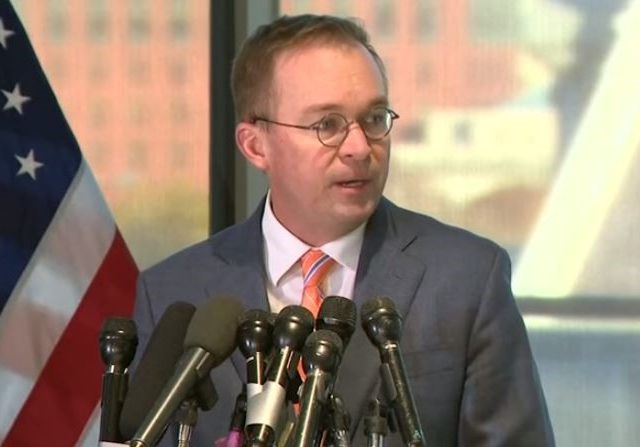
Donald Trump secured a victory in the federal District Court in D.C., as a Judge just ruled that Mick Mulvaney can continue as Acting Director of the Consumer Financial Protection Bureau (CFPB). The Court rejected the claims of Leandra English, appointed by Richard Cordray just as he was leaving CFPB, that she should remain as Acting Director pending nomination and confirmation of a replacement Director. The Opinion and Order (pdf.) is embedded at the bottom of this post. MORE TO FOLLOW

Georgetown Law Professor Randy Barnett had a tweet on December 5, 2017, that I've been meaning to write about. It reflects a subject I, and others, have been focusing on since election night -- the refusal of Democrats and #NeverTrump Republicans to accept the outcome of the election not just emotionally, but as to the transfer of power that continues to this day, over a year since the 2016 election. Here is Prof. Barnett's tweet, referencing the attempt by outgoing CFPB Director Richard Cordray preemptively to install Leandra English as Interim Director over the objections of the Trump administration.

Last week, Bloomberg published an article how one man had enough of fake debt collectors badgering him and his family to collect a phantom debt, money he did not owe. Andrew Therrien used his own money and time to track down these people and only found assistance from the FBI and the Federal Trade Commission (FTC). You know what agency was missing? The Consumer Finance Protection Bureau (CFPB), the brainchild of Sen. Elizabeth Warren (D-MA). Instead of concentrating on fraud, the agency decided to target businesses already well-regulated that help the poor.

Because of her Twitter fights with Donald Trump, much attention has been focused for the past year on Elizabeth Warren's claim, while climbing the law school ladder to Harvard, to be Native American. I addressed this recently in It’s time for Elizabeth Warren to apologize for her Native American deception. Warren's claim to be Native American for employment purposes is not the only scandal that has surrounded her academic career. At ElizabethWarrenWiki.org we documented Warren's Academic Research Controversies.

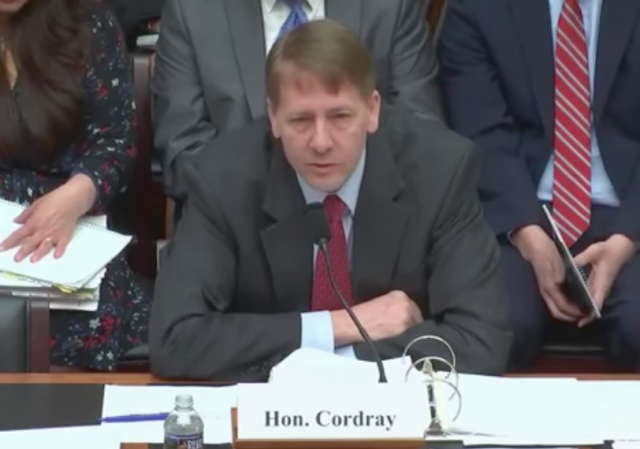
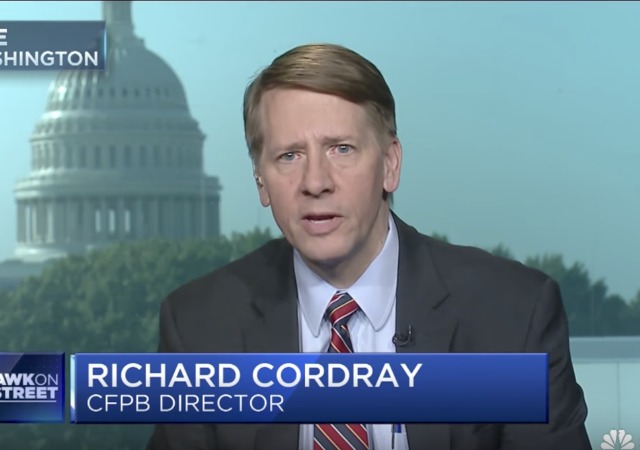
The showdown at the Consumer Financial Protection Bureau is a perfect microcosm of the difficulty unraveling Obama's rule by bureaucracy. Two weeks ago, CFPB chair Richard Cordray announced his resignation. Cordray had run the rogue agency, accountable to no one, as his own personal liberal policy shop, doing little to meet the needs of consumers. Cordray didn't stay the two weeks he'd originally planned.

Richard Cordray announced his resignation from the contentious Consumer Finance Protection Bureau (CFPB) two weeks ago. Friday, Cordray suddenly changed plans, and with no warning, left the agency a week before his scheduled departure date. Prior to leaving, he appointed his Chief of Staff, Leandra English, to replace him as the Acting Director. The move was intended to fill the spot temporarily, forcing Trump to go through the confirmation process for a nominee, which could take months, before putting his own person in place. But Trump didn't wait, and appointed Mick Mulvaney as Acting Director and nominee. This sets up a turf war over who is Acting Director.

You gotta love government agencies. They lash out when private businesses hurt consumers and yet evidence always seems to surface that they do the exact same thing, sometimes even worse. Take the Consumer Financial Protection Bureau (CFPB), an agency not many know about. Dodd-Frank birthed this agency as a way to protect consumers from another financial crisis. Its webpage claims that it "makes sure banks, lenders, and other financial companies treat you fairly."

Back when Senator Elizabeth Warren (D-MA) still claimed to be a Republican, she came up with the idea of the Consumer Financial Protection Bureau (CFPB). That idea, however, morphed into a partisan Democrat operation under Obama, with a structure that sought to exclude itself from Executive or Congressional oversight.  The constitutionality of the CFPB will be decided, yet again, on Wednesday by the D. C. Circuit Court.