


Human-Caused Fire Spreads Near Reno, Forcing Mass Evacuations
Authorities have not released the information on whether the ignition was accidental, negligent, equipment-related, or intentional.
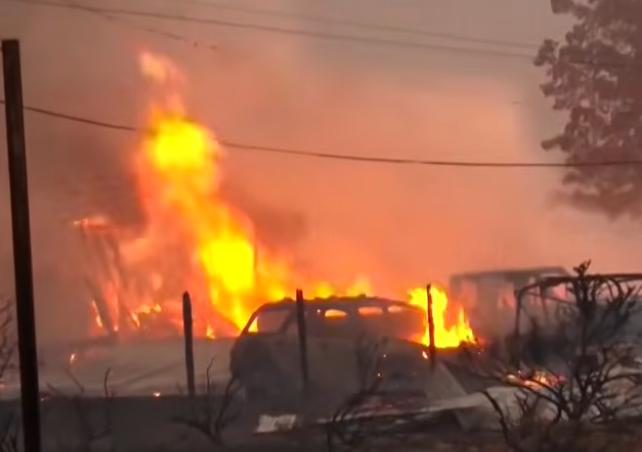
A rapidly spreading, human-caused wildfire known as the Hawk Fire has erupted in northwest Reno, Nevada.
The blaze, which began on Saturday, has destroyed homes and remains uncontained, prompting evacuation orders for about 90,000 residents.
At least six people were injured.
The Hawk Fire began Saturday and quickly grew to 20 square miles (53 sq. km.) as it spread across the Peavine Peak area of the Humboldt–Toiyabe National Forest, where rugged foothills are ringed by homes and businesses near the California state line.
The fire moved exceptionally fast Saturday night, jumping over fire trucks and making it difficult for responders to get to hotspots while residents were trying to get out, Washoe County Sheriff Darin Balaam said.
“It was extremely confusing,” the sheriff said, describing how changing winds sent the flames in different directions.
The Hawk Fire, a fast-moving wildfire burning through neighborhoods northwest of Reno, Nevada, has forced 42,000 residents to evacuate, injured six people, and destroyed multiple structures. Officials said the fire was human-caused. https://t.co/SRrLJXutIP pic.twitter.com/UTCRGK0pNC
— AccuWeather (@accuweather) August 24, 2026
I think it is important to stress that this is a human-caused blaze. There were no natural ignition sources in the area. However, authorities have not released information on whether the ignition was accidental, negligent, equipment-related, or intentional.
A preliminary investigation has found that the Hawk Fire was human-caused, authorities said. They did not immediately release details on whether the blaze was intentionally or accidentally set.
“We do know it was human-caused because there were no natural ignition sources that were present in that area,” Chief Richard Edwards of the Truckee Meadows Fire Protection District said at a news conference on Sunday.
Reno-area Hawk Fire was classified by officials as human-caused. https://t.co/WLnYMIE6l6
— Leslie Eastman ☥ (@Mutnodjmet) August 24, 2026
The Reno-Tahoe Airport Authority closed the Reno-Stead Airport to “general air traffic.”
Reno-Tahoe International Airport remains open.
About 800 emergency responders from local, state and federal agencies are combating the blaze. An additional 300 law enforcement officers have been dispatched.
The Nevada National Guard sent Chinook and Black Hawk helicopters to support response efforts. Sixty National Guard Response Force personnel are helping law enforcement safeguard evacuated neighborhoods, the National Guard said.
Aerial and ground crews worked overnight to stanch the fire, local officials said.
Sheriff Darin Balaam of Washoe County indicated that the Hawk Fire is the third major wildfire to hit northern Nevada in the last few weeks.
The Bug Fire, which began Aug. 8 just north of the Hawk Fire, has burned nearly 94,000 acres and is now around 94% contained. The Stallion Fire, which started two days later, is now 98% contained after claiming just over 40,000 acres.
This year, more than 7.7 million acres have burned in the U.S. – the largest year-to-date area in a decade – as wildfires have torn across the landscape, according to data from the National Interagency Fire Center. Firefighters are currently working to contain 79 large fires in 18 states.
As of Monday afternoon, progress was being made on containment, and people were beginning to return to their homes.
Containment reached 27% and there was no new growth of the Hawk Fire, which has held steady at about 23 square miles (60 square kilometers) since Sunday, authorities said at an afternoon news briefing.
“We are making progress,” said U.S. Forest Service District Ranger Matt Zumstein.
The number of residents under evacuation orders and warnings was reduced to about 63,000, down from more than 90,000 people over the weekend. However, there’s still concern that winds could push the flames through dry brush into newly developed and densely packed neighborhoods in Nevada’s largest city outside of metro Las Vegas.
Gov. Joe Lombardo meets with responders battling Hawk Fire in Northern Nevada https://t.co/pE6Az1i3QJ
— Drew Galang (@drewgalang) August 24, 2026
The improving containment numbers are encouraging, and I pray that our firefighters get this fire out fast, get people safely home, and prevent any more injuries or fatalities.
As soon as the investigation allows, officials owe Nevadans a straight answer on exactly how a clearly human-caused fire began…whether through carelessness, faulty equipment, or something worse.
Then Nevada needs to spell out and enforce practical corrective steps, because communities cannot afford to learn the hard way what Los Angeles has already demonstrated: Preventable wildfire failures can become disasters with terrifying speed.
Donations tax deductible
to the full extent allowed by law.






Comments
Back in the olden days simpler times, “human-caused” fire like this was called Arson.
Short of lightning or a ground squirrel rubbing two sticks together, that leaves a large set of origins.
Arson is such a harsh word. “Human-Caused Fire” buries the anti-social connotation.
Calling it Hawk fire sounds like it was due to birds.
Arson implies intent which isn’t obvious. It’s too soon to tell how it actually started. Let’s wait until the cause is found to start throwing out emotionally loaded words.
.
Arson is a deliberate. This could be a lot of different things and still be human caused. A campfire not properly extinguished, some one who drove their car over dry vegetation, sparks from a chainsaw. That area is covered with a lot of sage brush, piñon, juniper and grass. That results in a hot, fast moving fire.
Whoever is in charge of managing fuel doesn’t want it blamed on him, is what I get out of it.
Good luck finding that person. Whole lot of “not my job” choruses