


Century-Old LA Water Main Bursts, Turning Sunset Strip into a River
From the Potomac to the Pacific: America’s Aging Water Infrastructure Is Failing
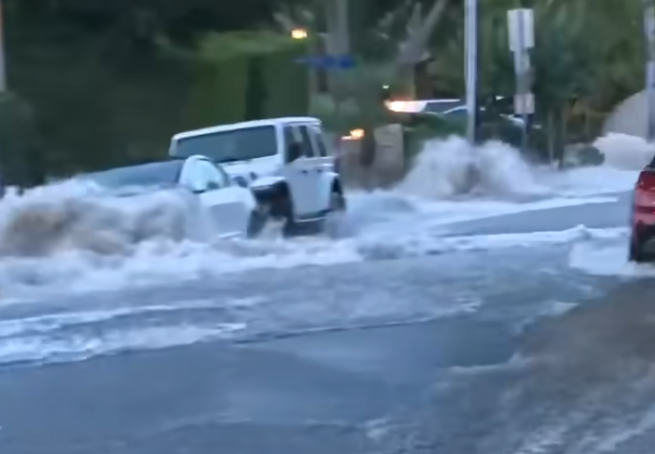
A century-old Los Angeles Department of Water and Power main turned the Sunset Strip into a roaring urban river, blasting millions of gallons of water downhill through West Hollywood’s densely packed streets.
Shocking new image shows damage to 100-year-old pipe at center of West Hollywood water main break https://t.co/aYn6FmnUhE pic.twitter.com/woMGNtFJUp
— California Post (@californiapost) July 17, 2026
The rupture in the 36‑inch riveted steel pipe, installed in 1916, carved out a massive sinkhole, inundated garages and a Metro bus yard, and left residents in one of L.A.’s bluest enclaves literally awash in the consequences of aging infrastructure.
The break was on a riveted steel pipe from 1916 that forms the major arteries for water delivery from reservoirs and tanks to smaller distribution mainlines across Los Angeles. The section of the Sunset Trunk Line was slated to be replaced in 2031, according to the utility.
There are about 547 miles of trunk line underground across the city. In 2019, the Los Angeles Department of Water and Power said roughly 29% of the city’s pipes were over 80 years old, approaching their typical lifespan of 100 years.
Utilities have been struggling to keep the system going, given funds are limited for any kind of major overhaul of the aging pipes.
“Over time rust, corrosion and those sorts of things sets in,” said David Feldman, professor emeritus of urban planning and public policy at UC Irvine. “They have a tremendous grid of pipes and obviously they’re not going to be able to replace every single one,” he said. “They couldn’t afford to and the disruption would be enormous.”
#BreakingNews: Sunset Boulevard is closed indefinitely in West Hollywood after a massive, 100-year-old water main ruptured early Thursday morning, creating a large sinkhole directly under the traffic light at Sunset Boulevard and Holloway Drive. pic.twitter.com/yieGkrTQII
— KTLA (@KTLA) July 16, 2026
Residents were stunned by the flooding, and several thought an earthquake had struck.
The break triggered widespread flooding in the area Thursday morning, with homes inundated and hundreds of vehicles damaged after underground parking garages filled with water. One person was temporarily swept away in the fast-moving floodwaters.
Residents described a chaotic and frightening scene as the water surged through the neighborhood.
“I thought this was an earthquake of some sort, a maybe a natural catastrophe,” said Tehran Von Ghasri, a West Hollywood property owner. “I didn’t imagine this was going to be a water main break, especially with the noises and the flooding.”
“I’ve never experienced this before in the neighborhood, like a complete halt … gridlock,” said West Hollywood resident Ikill Orion. “You would think it was a hurricane or earthquake or something like that.”
Woah!
Surveillance video from Dialog Cafe in West Hollywood shows the moment a water main burst and flooded streets, homes and businesses.
While the water flow has been stopped, the water and sinkhole caused by the rupture are still under repair. > https://t.co/jBcs85zYKC pic.twitter.com/Ul8acj8EAy
— ABC7 Eyewitness News (@ABC7) July 17, 2026
This is going to be a long-term clean-up effort around one of the most iconic spots in the country.
Crews worked overnight on what is expected to be a long-term effort to clean up and repair a broken water main that caused extensive damage in West Hollywood on Thursday.
Yellow tape remained in place Friday morning, blocking streets around Sunset Boulevard and Holloway Drive as crews continued pumping water out of the century-old trunk line.
Asphalt and soil were also being removed so crews could get a better look at the damaged 36-inch trunk line, a major feeder pipe serving the area.
This episode reminds me of the massive raw sewage spill on the East Coast earlier this year, caused by a rupture in the Potomac Interceptor.
This crisis illustrated the predictable consequences of neglected maintenance and questionable spending priorities by DC Water, resulting from political and managerial choices that prioritized image and amenities over core infrastructure, with downstream Maryland communities bearing the public‑health impacts.
With the Los Angeles water infrastructure clearly reaching the end of its lifespan, and with these water resources inherently necessary for public health and regional safety, the entire system should receive serious attention. However, it is unlikely the city will be getting the leadership needed to focus on these issues in the near future.
If only LA had enough taxes to pay for city water pipe maintenance. https://t.co/o9FICvgVdG
— Justine Bateman (@JustineBateman) July 16, 2026
Given that the city is hosting the 2028 Olympics, this incident is a warning that infrastructure must be functional if Los Angeles wishes to be taken seriously for future games.
As officials scramble to coordinate repairs, traffic closures, and damage claims, expect many of the same local leaders who lecture the rest of us on “resilience” and “climate justice” to demand now emergency funds to fix a system they have allowed to decay for the last couple of decades.
Donations tax deductible
to the full extent allowed by law.







Comments
The only conceivable solution is a staggered sleeving of the entire system.
Or maybe make pipe repairing an Olympic event.
I hear Baby2Baby diapers are waterproof — Gavin’s on the case!
Actually, I remember the local water company doing something with a basically blew a plastic liner on the inside of the ductile iron water mains. I don’t know if that would work on something as large as a 36-in main
Sewer lines as well, though 36 in seems like a different proposition than smaller diameter pipes.
It’s called “in-situ lining” and we had it done to the sewer line from our house to the street. We had jointed (every 2 feet) clay sewer pipe that was starting to fail. The alternatives were pipe bursting where you excavate a hole in the street, then run a gizmo up through that bursts the pipe open while dragging a new pipe behind it. Or just excavating the line, which would have killed our big maple tree.
They dig a small hole in the basement floor to access the sewer pipe, and then clean it out with a rooter…they ran a “See Snake” through it to confirm it was clean. They somehow put a fiberglass “sock” through it while a machine impregnates it with epoxy resin and hardener. Then the run a long balloon through it to conform it to the existing pipe, pressurize the balloon with compressed air, and let it sit that way for 24 hours. Once hardened the run a special tool down to the end of it to cut off the small portion that protrudes into the sewer main, and drag that back out.
The end result is a fiberglass-reinforced plastic pipe with a very smooth interior. You lose the wall thickness of that, but it’s only about 1/4″ thick so it doesn’t reduce the inside diameter significantly. It actually improves the sewage flow rate over the existing jointed clay pipe. They company that did it was so confident that they offered a 50-year, transferrable-with-the-house warranty on it.
I have NO idea how big a pipe they can line that way. This water main was reported to be a 36″ diameter pipe (3 feet, or just over a meter for those in countries that never sent men to the moon).
The whole process is distressingly reminiscent of a cardiology shunt insertion.
I was thinking the very same thing. It was a procedure invented by an Irish heart specialist. Angela O’Plastie. They named the procedure after her.
I think you meant “just under a meter”, but redeemed yourself with the “men to the moon” comment. 🙂 No blood, no foul.
Sorry…36″ is 0.9144 meters. I meant “under” and wrote “over”; whatcha gonna do?
Over, under…just about?
What’s far worse in that post is the auto-correct changing “they” to “the” in a bunch of places. I hate software that thinks it knows better than I do. Why couldn’t it fix the “over-under” problem correctly?
3 feet is more than three inches short of a metre.
They did that in Portland with some complex sewer work. Had these just YUGE lengths of plastic, like 500 ft x 1 ft, which they shreaded in, and then pressure fit to the existing tube with lots of steam. Not too dissimilar to placing a stent in a coronary artery, with a slight difference in the amount of steam and brute force employed.
Maintenance isn’t sexy. Done correctly it costs real $ and demands a commitment to follow a clear plan of replacement/refurbishment as it ages. Much easier for local politicians aspiring to higher office or reelection to skimp, to defer those costs and reallocate the $ to whatever new headline grabbing ‘hotness’ exists. Add plain old grift, graft and corruption along with no bid contracts and/or prevailing union wage requirements and the smaller amounts allocated to maintenance doesn’t meet the need.
Pipes that are a century old are a ticking time bomb. It’s the LA Water and Power that is responsible for maintenance of the water distribution system. They waste more money than the LA City Council. The replacement of this sclerotic infrastructure should have begun 30 years ago. The LA Water and Power were busy doling out 10’s of millions yearly in bonuses instead of being proactive in infrastructure maintenance and replacement.
Don’t be too harsh on the powers that be. They had this planned as a response to the Pacific Palisades fire. They only missed it by 18 months and 11 miles.
It’s getting pretty Biblical to live in L.A. these days.
First pestilence, then fire, then flood.
I should be making book on what comes next — famine, or war?
(Earthquakes are NOT on the card — the house isn’t stupid.)
If we’re taking a vote then I vote for famine in LA. Block off the interstate, rail lines cut off access to sea/air ports. Escape from LA as a live stream reality TV event.
They’re already well on the way to a self-inflicted pork and chicken famine.
Reporters (and taxpayers) should demand to see the Asset Management Plan of the utility, along with their long-term capital plan. Also what has happened to all of the fees collected over the last 110 years… surely a portion of that money was set aside for such things, right? Or have the taxpayers been bilked again? And if so, who is going to jail, and who is having their pension clawed back to pay for this?
That’ll buff out… 🙂
This repair work should be on the same DEI approval process, DEI hiring requirements and DEI construction schedule as the California High-Speed Rail Project. Now is not the time to compromise on the core green, DEI values that made LA what it is today.
Let’s see…any guess on how long till PDJT is blamed?
Has the LA Water and Sewer Authority never heard of in situ plastic liners that have been used since the late 1970s?
Since we’re throwing so much money at the homeless and the illegals then why don’t they put them to work fixing all this aging infrastructure.
Might as well do something.
Illegals being near water is how we got the whole explosive diarrhea parasite thing going.
Point
Probably not. The produce was probably imported, and thus was grown by people who are legal where they are.
Bass needs to get Stu Bailley back on the job. And probably Kookie too.
No worries! Karen Bass will see to it. Next year.
I guess Bass was ahead of us on this one by draining the resevoirs so that there wouldn’t be any high pressure high volume leaks. Yous people are just behind the game on this one. /s No water, too much water. just make up your mind.
A 100-year lifespan for a piece of pipe transporting water, daily, is pretty damn impressive.
110-year-old pipe, actually.
No, not impressive. Pretty lucky if you ask me. And now the city of LA is going to be paying big time now that their luck is beginning to run out and the water infrastructure slowly fails and the bill for all that deferred maintenance and replacement comes due.
They are planning on moving water with high-speed rail.
I’m at 69 on mine and hoping/praying for 20 more. Oh wait, ….
There were giants in the earth in those days.
They were called our fathers and grandfathers.
It’s Hollywood baby!! (more or less)
It’s going to get worse. Each year the plan is to replace just over a mile of trunk line, per the above about 30% of the 547 miles is bad, or say 100 miles. So in about 150 years it will be replaced, while the entire system ages.
We can all clearly see an unstable feedback loop there.