


Massive Potomac River Sewage Spill Exposes D.C. Water’s Cracked Priorities
D.C. Water spent $55 million on a luxury headquarters, despite the fact that the sewage pipeline was first installed in the 1960s and requires significant updating and maintenance.
In my recent post on Snowmeggedon 2026, I noted that more robust support for natural gas pipelines would have better and cleaner met the energy needs of the Northeast. The time to prepare infrastructure to withstand severe weather is before the event, not after.
Now the nation’s capital is getting an important lesson on the maintenance and upgrades needed for the region’s sewage system in the wake of freezing temperatures.
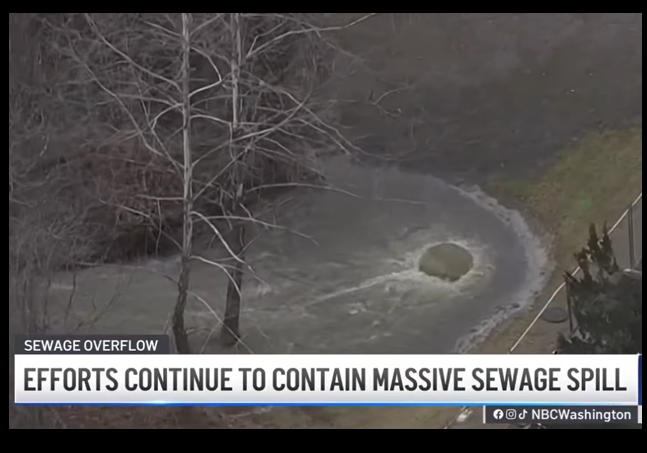
A major sewer line rupture in Maryland is sending tens of millions of gallons of raw sewage into the Potomac River just upstream of Washington, D.C., prompting severe public‑health warnings and emergency repairs.
The collapse happened on Monday in a section of the Potomac Interceptor, which carries up to 60 million gallons of wastewater each day from parts of Maryland and Virginia to a pumping station in Washington.
John Lisle, a spokesman with DC Water, a water and sewer utility company serving Washington, said in an email on Saturday afternoon that the company estimated that 40 million gallons of untreated sewage a day had spilled into the river since the rupture of the reinforced concrete line.
The cause of the break was not yet known.
DC Water is working with several agencies, including the Environmental Protection Agency and the D.C. Department of Energy and Environment, to address potential ecological impacts, Mr. Lisle said.
As of the time this post was prepared, the release has been slowed but not fully contained. DC Water admits weather challenges are a factor at play in the containment process.
Industrial pumps have been running since late Saturday, but heavy snow and extreme cold continue to create challenges for the equipment and operations.
Crews are maintaining the bypass system day and night to keep the pumps and equipment operating, even as temperatures remain well below freezing. The pumps require frequent cleaning and maintenance because fats, oils, grease, wipes, and other debris in the wastewater have caused blockages.
When blockages occur, pumps must be temporarily taken offline for service, which reduces system capacity until the issue is resolved.
D.C. Water crews have installed high-powered pumps in an effort to divert sewage after part of a major pipeline collapsed last week, spilling millions of gallons of untreated wastewater into the Potomac River. https://t.co/NMZU1Lcgrb
— Post Local (@postlocal) January 26, 2026
Untreated sewage in the river raises risks from pathogens such as E. coli and viruses that can cause gastrointestinal illness, skin infections, and diseases like hepatitis. Potomac Riverkeeper Network staff sampled water near the spill and reported extremely elevated E. coli counts; officials are warning people to stay away from visibly contaminated water.
And while the cause of the break is unknown, it must be noted that water or wastewater trapped in sewer lateral lines can freeze, expand, and build enough pressure to crack or rupture pipes or fittings, leading to leaks and backups. Regular maintenance is recommended.
Winter weather can cause severe damage to pipes due to expanding and contracting due to temperature changes. Aging pipes may crack and leak, reducing their effectiveness. To prevent sewer pipe damage, consider regular maintenance on your sewer system and periodically inspecting pipes for any signs of wear and tear.
And while emergency pumps are rerouting wastewater around the damaged pipes, it has become known that DC Water spent $55 million on a luxury riverside headquarters in 2019. And many Marylanders are upset.
DC Water completed its $55 million riverside headquarters in 2019, adjacent to Nationals Park—an architecturally striking building that doubles as an event space. The rooftop patio, according to promotional materials, can be rented for private events and weddings. It is, by all accounts, a showpiece.
Meanwhile, the agency’s underground infrastructure—some of it more than a century old—continues to fail in catastrophic fashion.
This contrast has not gone unnoticed by critics. While DC Water emphasizes sustainability branding and riverfront aesthetics, the core mission of safely handling wastewater appears increasingly fragile.
For Marylanders downstream, this is not an abstract governance issue. The Potomac is a shared waterway. When D.C.’s system fails, Maryland absorbs the consequences—environmental, recreational, and potentially public-health related.
The updates to the 60-year-old system that are needed will be pricey…at least the cost of one or two Somali Learing Centers.
DC Water knew the pipeline was deteriorating, and rehabilitation work on a section about a quarter-mile from the break began in September and was recently completed, Lisle said. Repair work on additional “high priority” sections of the pipeline is expected to start later this year, according to the DC Water website.
The pipeline, called the Potomac Interceptor, was first installed in the 1960s.
…An EPA survey of wastewater infrastructure needs from 2022 estimated that the District of Columbia needs roughly $1.33 billion to replace or rehabilitate structurally deteriorating sanitary or combined sewers within the next 20 years.
Nationally, hundreds of billions in infrastructure investment is needed over the next two decades for clean water problems like aging sewer pipes. In other places where sewer breaks are persistent, it can lead to backups into homes and regular flooding.
Our ancestors built strong foundations, but even the best concrete and steel have lifespans. Pipes crack, systems age, and nature never negotiates.
When officials trade maintenance budgets for architectural showpieces, they mortgage public safety for prestige. The Potomac spill is a warning that must be heeded.
Infrastructure does not crumble overnight; it erodes through years of misplaced priorities. It’s time our leaders remembered that the most impressive headquarters is one built on reliable service, not prestigious riverfront offices.
Donations tax deductible
to the full extent allowed by law.






Comments
Nothing about this is surprising. I’m sure most of the people at the top were giving themselves raises on budget savings while hoping this clock would run out after they retired.
And I suspect that like many government agencies, they are awarded hefty annual bonuses. We all know that the swamp takes care of the swamp!
So long as individuals are not held personally responsible, this sort of thing will continue to happen.
It’s a good metaphor for DC as a whole. Failure to do maintenance (vote out crooks) and you end up with raw sewage being introduced to the public as a whole.
The least they could do is dye it orange, like the EPA does.
Sounds like what happened in New Orleans with all the levee repair money over the years.
My thoughts exactly!
If you needed any further proof that Washington was overflowing with 💩💩💩 here ya go.
(Yeah, I know it’s a sophomoric comment but someone was going to say it and it might as well be me.)
60 million gallons of wastewater each day from parts of Maryland and Virginia to a pumping station in Washington
So, we do send our s*** to DC! I thought it was just a metaphor for Congress!
No Federal bailouts packaged as ‘investment in infrastructure’ or other beltway speak designed to mask the decades of mal investment, neglect of mission priorities and general malfeasance.
Did Schumer open his mouth again?
Meanwhile up in Baltimore, the mayor just pushed back compliance with the federal consent decree on the sewer system after spending $2B just to stabilize a 100 year old system instead of replacing it. Millions of gallons of raw sewage spill into the Chesapeake every year and flood basements. This after Maryland took over the treatment plant recently because staff couldn’t maintain it due to DEI hiring.
Did I mention that the fresh water system is also on the verge of collapse also due to lack of investment for decades while focusing on hundreds of millions spent on costly reservoir containment for cryptosporidium contamination that did not exist but the construction managed to contaminate a critical reservoir?
So billions are required in Baltimore in a state that has financially ruined itself with Governor Moore. No wonder Maryland lost population as people move south.
For kicks and grins, I paid $20 for a Maryland Public Information Act (PIA – which seems fitting) record for the number and names of people who worked at the sewage treatment plant prior to the investigation and take over by the state, and the names and number of people who work there now. Included in the request was “employment status.”
For the who mess, no one was fired or held accountable. There were people who were shifted to other later positions within the city structure. Of all the people that were “let go,” none of them did not have the status that they were eligible for rehire.
As for the water situation, my mom pays more for a monthly “connection fee” than she does for actual water usage. The connect fee went up several years ago after people started to make a concerted effort to conserve water. You connect the dots.
In 2015, when my mom was in a rehab center she was hit with an estimated bill for several months because the water meter could not be found. The meter has been in the same location since the house was built in 1953. City code says that if the meter is not damaged, or has not been moved, and the City says “we can’t find it,” you cannot be charged for water that month.
The City refused to honor their own laws.
Moore is a disgrace, but Mayor Scott is just as bad.
Typical Dhimmi-crat apparatchik corruption, profligacy, stupidity and waste (financially and literally, this time).
This spill was an accident– the product of years of deferred maintenance. How about the deliberate discharge of raw sewage? In the late 1960s I worked in Harlem near 125 St which runs east-west terminating at the Hudson River. One day I walked over to the very edge of the river and saw the discharge of raw sewage from a big pipe. Disgusting. I saw the output of people’s toilets, tampons, everything. The storying gets better. Standing next to me was a guy fishing! For eels. He planned to eat them. He assured me that if you soaked the eels in lemon water it would be ok. Many years later the city built a water treatment plant at that very spot.
Accident? IMO the failure of the system was an inevitable result of failure to conduct maintenance that was entirely foreseeable. If I don’t do routine maintenance on my septic tank system, fail to put in the bacteria or allow trees to grow with their roots busting the lines then a blockage will occur and it will backup into my house and it wouldn’t be an accident but a product of my bad choices.
The difference between “accidental death” and “manslaughter” – negligence.
And your fisherman became famous and got movie deals as The Toxic Avenger, and was sponsored by Pledge.
Kinda emblematic of what DC is…LOL
no politician worth their salt would ever ever spend the money on what is was intended to be spent on
And so, where is the intake for drinking water that DC Water takes from the Potomac River? Up or down river from where the raw sewage is being discharged into the river? While I know that the river water is treated how quickly did they detect the raw sewage entering the river and how did they change the water treatment process or activate an alternative drinking water source?
Having worked for a company that asses risk for utility systems (water, wastewater, electric, etc.) I can state that there is practically no city anywhere that doesn’t need to have their water and wastewater systems replaced or significantly refurbished. Electric systems are generally in better shape because they are maintained by private utility companies.
Kudos to those architects and engineers in days gone by who designed these systems and also to the dedicated utility workers who keep them going no matter what. Boo hiss to the governments that aren’t interested in them until something like this happens.
Baltimore, DC, NYC — notice they’re all lucky to have major rivers to do their black water plumbing for them. Now, I’d love to see a spill of this magnitude at, say, the Fairfax County government center, where there is no handy river to whisk it away and it just has to pool there and fume.
Meanwhile, DC Water is on the job. They have convened an emergency session of their Board to rename the Potomac Interceptor line to the Potomac Irrigator line.
The rupture is just upstream of DC. Will anybody notice the aroma?
.
The sewage wanted to spend time & associate w/its stinky brethren the kind of people Dim’s, Libs, Marxists, Socialist’s are. It should have felt right @ home.