


China’s Fishing Fleet Continues to Gut Fish Stocks, International Laws
Meanwhile, Japan is offering aid to South American counties that are having their water plundered by Chinese trawlers and Somali pirates captured a Chinese boat.
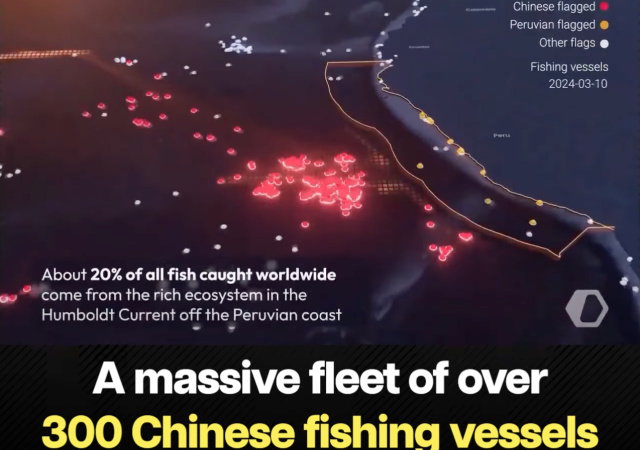
The last few times that Legal Insurrection reported on the Chinese Fishing Fleet, which appears to have taken off in mass after depleting their own waters for food, it was busy hauling catches off the ecologically sensitive area around the Galapagos Islands, plundering Argentinian waters, and dumping enough sewage into the seas that it was visible via satellite.
The Chinese fishing fleets have remained a significant concern, with new analysis highlighting ecological damage in West Africa, gray‑zone coercion in Asian waters, and continuing threats to South American waters.
Having depleted fish stocks in its own coastal waters in the early 2000s, Chinese fishing boats are now destroying fishing stock all across the world.
The destruction in South America by the Chinese fishing vessels is unimaginable.
China now accounted for over 80 percent of… pic.twitter.com/Hzcxu6cyLH
— Isabella Anderson (@IsabellaAn67) December 31, 2025
How bad is it? For starters, an Atlantic Council issue brief recently warned that Chinese trawlers, often operating illegally in prohibited coastal waters off the West Coast of Africa, are driving severe fish‑stock declines, harming local economies, and degrading coastal water quality.
Overfishing by Chinese trawlers poses a serious threat to West Africa’s rich fisheries and water resources, endangering regional food security, national economies, and local livelihoods. Chinese companies— including state-backed firms and private actors—have rapidly expanded into the region’s fishing sector, often operating illegally in prohibited coastal waters. Hundreds of Chinese vessels now fish off the West African coast, primarily between Senegal and Mauritania.
These vessels are much larger than the artisanal canoes used by local fishermen and easily outcompete them. The expansion of Chinese companies’ fishery operations and overfishing in the region strains marine and freshwater ecosystems and undermines longstanding livelihoods of traditional fishing communities. Chinese vessels employ bottom trawling and other destructive methods, which—combined with limited oversight and poor enforcement of national and transboundary laws—have caused severe environmental degradation and declining fish stocks, weakened local economies, and deteriorated coastal water quality.
At the same time, inland fish populations—especially in transboundary rivers such as the Falémé, Niger, and Volta—continue to decline due to runoff pollution from Chinese companies’ illegal mining operations. This policy brief examines the ecological and social risks posed by Chinese trawlers’ fishing in West Africa, and offers policy recommendations to strengthen legal protection and enhance regional cooperation to safeguard the region’s fisheries and water systems.
Who says Colonialism is over!
China is forcing debt ridden countries to give unlimited and unrestricted fishing rights in their Waters in exchange for debt repayment concessions!
Burdened under Chinese debt, Senegal forced to give fishing licences to vessels of Chinese fishing… pic.twitter.com/voYVVTIA4h
— Isabella Anderson (@IsabellaAn67) December 27, 2025
We have been covering the recent tensions between China and Japan over Taiwan. It turns out China’s trawlers are central to its maritime gray‑zone campaign in the region, using civilian‑flagged fishing vessels for intimidation, ramming incidents, and blocking operations near reefs and shoals claimed by Southeast Asian states as well as Taiwan.
In the maritime domain, China has consistently used civilian vessels—especially fishing boats—as tools of statecraft in contested waters. While analysts have focused heavily on the People’s Liberation Army Navy (PLAN) maneuvers near Taiwan, less attention has been paid to the role of unmarked or dual-use vessels operating in parallel with the PLAN. These ships can, and do, conduct surveillance, harass foreign vessels, and reinforce territorial claims under the cover of commercial activity.
Examples include using civilian ships to drop anchors and thereby sever undersea cables, deploying fishing fleets to overfish and damage maritime habitats, and leveraging dual-use infrastructure to project a coercive presence.
Meanwhile, the Chinese fishing “swarm” is still looming off the coast of South America.
Chilean fishermen accused Chinese fishing vessels of depleting Humboldt squid, one of the region’s most-valuable resources, describing them as “termites” in the ecosystem.
The global presence of Chinese fishing vessels has alarmed other countries, as they are suspected of engaging in illegal, unreported and unregulated (IUU) fishing, threatening ecosystems and the livelihoods of lawful fishers. Earlier this year, Argentina deployed its naval force to patrol its exclusive economic zone (EEZ) to deter foreign vessel intrusions.
The South American countries have deployed their Navies to combat the menace of Chinese illegal fishing fleets in their Waters. Yet, the problem is far from getting over.
As a result of China's Illegal Unreported and Unregulated fishing, nations like Argentina, Chile, Ecuador… pic.twitter.com/x00Vq0CqaS
— Isabella Anderson (@IsabellaAn67) January 2, 2026
Reports indicate that Japan plans to aid South American nations in stopping the Chinese fishing fleets from plundering their waters. The plans include funding for drones and patrol boats.
Japan plans to step up assistance to South American countries facing Chinese fleets illegally fishing in their waters, providing surveillance drones and other equipment to bolster maritime patrols.
Ecuador, Peru, Argentina and Uruguay would receive the aid through the United Nations Office on Drugs and Crime. The Foreign Ministry has earmarked 300 million yen ($1.9 million) for the initiative, which includes plans for inflatable patrol boats and equipment that analyzes images taken by the drones to identify a ship’s registration, crew size and routes.
Chinese fishing fleets are active in the waters around Ecuador’s Galapagos islands. With their GPS transponders apparently turned off, the fleets sail south off the shore of Peru. On the Atlantic side, Chinese fleet activity has been confirmed in the waters around Argentina and Uruguay.
🇯🇵 Japan Steps Up to Arm South America with Drones
Japan has launched a bold assistance program to supply surveillance drones and patrol boats to four South American nations—Ecuador, Peru, Argentina, and Uruguay—to combat China's massive illegal fishing fleets in their waters.… pic.twitter.com/HLr8I05MFY
— In Milei We Trust (@InMilei) January 3, 2026
To finish this roundup of news about Chinese fishing threats, I must note that Karma paid a visit to one of the thieving trawlers. A Chinese fishing vessel was recently hijacked off the coast of Somalia.
The vessel in question, Liao Dong Yu 578, was reportedly captured at a position just off the coast near Bandarbeyla, Puntland (09 09 N 050 43 E). The hijackers struck in the early afternoon local time on New Years’ Day, and are suspected to be planning to hold the crew for ransom, Vanguard reported. The report has not been confirmed.
An update on illegal fishing in #Somalia (🧵):
Late last month, the trawler Liao Dong Yu 578 was hijacked near the #Puntland town of Eyl. The vessel was part of a #Chinese fishing fleet that has been pillaging Somali waters for years, aided by senior Somali politicians. pic.twitter.com/VPe4nKQjSh
— Jay Bahadur (@PuntlandPirates) December 23, 2024
Donations tax deductible
to the full extent allowed by law.







Comments
we already know how koi they are
China is an absolute menace without the slightest care for other nations or the world in general.
… and retain their Most Favored Nation trading status.
I have always tried my level best to make sure the merchandise I buy – given a choice – is made in Not-China. It’s difficult.
I fished in the Bering Sea in 80-90’s, even then Chinese fishing boats would sneak across our territory waters and fish at night and scuttle back every morning, our ” Coast guard” never stopped them once while billions of dollars of fish were stolen
It’d be a real shame if there was a coördinated and synchronized drone attack. Even more so if done with drones made in China.
Were those Somalians taking a boat ride to Minneapolis?
Just sink them. Accidents happen at sea all the time.
I wonder if the sails of nuke subs which are hardened to break through arctic ice can breach the keel of a traveler without damaging the sub?
Just wondering.
Treat them as the pirates they are. Give one notice in Chinese and one in English. If they do not immediately vacate – without their catch – then sink them. Haul survivors out of the water and hang them. Then send the bodies back to China COD.
This is old news. The Chinese have long been locusts. Sink them, and be done with it.
Sink them and let that be a lesson to others.
Command the fishing ships that are encroaching on the territorial waters to withdraw or they will be sunk. If they refuse, put a round beneath the waterline and take the sailors prisoner when they abandon ship. Then sink the ship with gunfire and return the sailors to China, postage due. Repeat as needed.
“Postage due” = “COD” 😉
Another reason for Trump/USA to step up building alliances, deposing regimes in S. America. Obviously, previous admins didn’t care, ran around with blinders on, with their grubby paws wide open, milking the systems and weakening the US.
Treat them like those oil smuggling vessels.
Termites.
Apt.
So, all these Green eco warriors – WTF are they on this issue? Where is Greenpeace, eh? Notice the deafening silence?
Where is Captain Nemo when you need him?