


Image 01 Image 03

Iran Tag

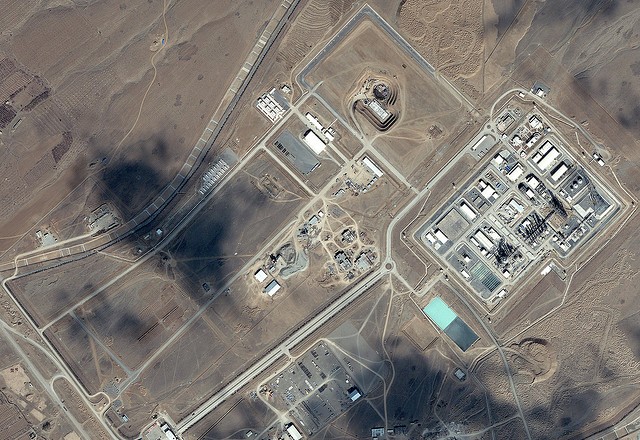
Numerous news organizations are reporting today that Iran's Islamic Revolution Guards Corps (IRGC) claims to have shot down an Israeli drone as the drone approached the Natanz nuclear enrichment site. Reuters reports:
The Revolutionary Guards said of the drone incursion: "This wily act further exposed the Zionist regime's adventurous temperament and added yet another black page to a record filled with crime and mischief." If confirmed, an aircraft built by Israel's state-owned Aerospace Industries known as the Heron, or the more powerful Heron TP, is likely to have been involved for such a long-range mission. Military commanders in Israel have described both as a possible means of monitoring Iran and other countries.
The Heron is also called "Eitan" in Israel and it appears to be the only Israeli drone capable of reaching Iran. The BBC reports:
Natanz is Iran's main uranium enrichment site, and contains more than 16,000 centrifuges. The statement from the Revolutionary Guards said the drone was on course to fly over the nuclear facility at Natanz.
A group of terrorism victims is seeking unsatisfied court judgements. How do they plan to obtain the cash they were awarded? By taking over Iran's internet. At the helm are Israeli civil rights attorney, Nitsana Darshan-Leitner and Robert Tolchin of New York. Darshan-Leitner has won over  $1-billion in judgments, frozen more than $600-million in terrorist assets and collected $120 million in payments, according to the National Post. She hopes to replicate her success in her latest effort. ICANN (Internet Corporation for Assigned Names and Numbers) is an agency of the US Department of Commerce in Washington, DC, which administrator the World Wide Web. ICANN licenses domain names like ".gov" ".ca" and in this case, ".ir". Countries are then able to allocate the domain names, effectively making ".ir" an asset.  Court papers have been served to ICANN and seek ownership of top-level domain names like .ir TLD, the ایران TLD and all Internet Protocol (IP) addresses being utilized by the Iranian government and its agencies. Darshan-Leitner believes these domains are worth the over $1-billion required to satisfy the outstanding debts owed by the Iranian government to the families participating in the civil suit.

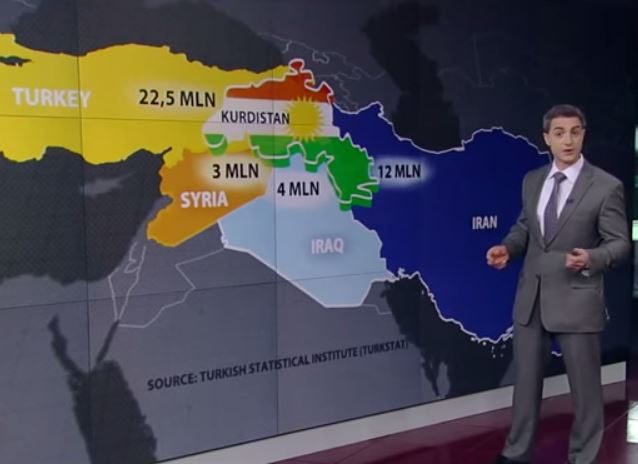
We've been writing about the lack of a free and independent Kurdistan for years, It’s time for a free and independent Kurdistan. While the Palestinian agenda has dominated every international forum, the much more populous and ethnically distinct Kurds have been mostly ignored.  In part, this is because the Kurds span several nation states created by colonial powers after the implosion of the Ottomon Empire.  Turkey particularly has threatened war if a Kurdish nation emerges. In part it is because creating an independent Kurdistan does do not serve a political purpose of snuffing out the only Jewish state in the region. Developments are moving fast that could change everything. Syria lost control of its Kurd territory during the ongoing civil war, and the autonomous Iraqi Kurdistan has operated independently for years. With Iraq losing control of vast territory, and the U.S. not anxious to do anything to help, the Kurds have claimed Kirkuk for their own, as the BBC reports, Iraqi Kurds 'fully control Kirkuk' as army flees:
Iraqi Kurdish forces say they have taken full control of the northern oil city of Kirkuk as the army flees before an Islamist offensive nearby. "The whole of Kirkuk has fallen into the hands of peshmerga," Kurdish spokesman Jabbar Yawar told Reuters. "No Iraq army remains in Kirkuk now." Kurdish fighters are seen as a bulwark against Sunni Muslim insurgents.

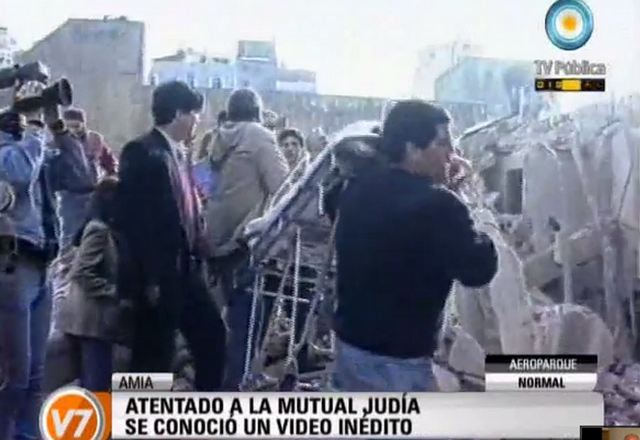
In 1994 terrorists struck the Asociación Mutual Israelita Argentina (AMIA) in Buenos Aires, Argentina. 85 people were killed. In 2003, an Argentine judge issued arrest warrants for four Iranian officials (but denied warrants for twelve others) for their involvement in the terror attack. In 2007 INTERPOL, an international police organization, issued warrants for five Iranians and one Lebanese for the involvement in the AMIA bombing. Early last year Argentina's government reached an agreement with Iran to form a "truth commission" to investigate those who were responsible. The agreement was immediately controversy because, in the words of former Israeli Deputy Foreign Minister Danny Ayalon, it was "inviting the murderer to participate in the murder investigation.” Last week, an Argentine federal court struck down last year's "truth commission" agreement with Iran to investigate the AMIA bombing. Several senior Iranian officials and Hezbollah have been implicated in the attack that killed 85 people in that Jewish community center.
Thursday's ruling declared the agreement unconstitutional and ordered Argentina not to go ahead with it. The deal had been delayed anyway by Iranian reluctance to move forward in implementing it. ... Israel and world Jewish groups had denounced the "truth commission" deal with Iran, calling it a diplomatic win for Tehran that offered no benefit to Argentina. The deal would have let Iran review Argentina's investigation into the bombing.
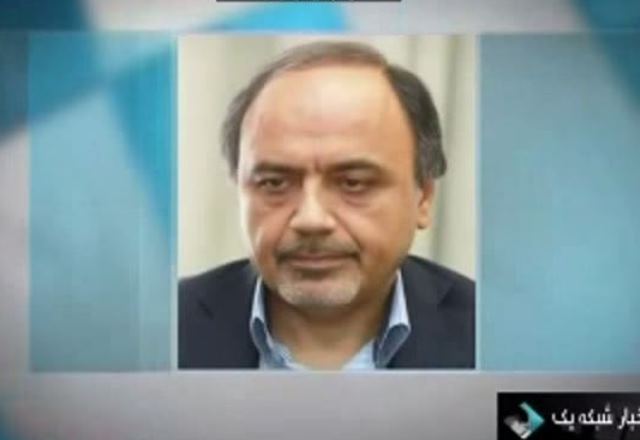
Alberto Nisman, the prosecutor who took over investigation of the case, established responsibility to the highest level of Iran's government. Among those implicated were then President Ali Akbar Hashemi Rafsanjani and Iran's previous defense minister Ahmed Vahidi. Vahidi and intelligence officer Moshen Rabbani were among five Iranians who were flagged by INTERPOL for arrest in the case. (Video from March 2013) While current Iranian President was a member of the group that ordered the attack, Nisman told David Horovitz of the Times of Israel last year that Rouhani was not present at the meeting where the attack was planned. An English version Nisman's indictment is here (PDF). An op-ed in the New York Times at the time of the Argentine-Iranian agreement accused Argentina's government of doing "an about-face on terror."

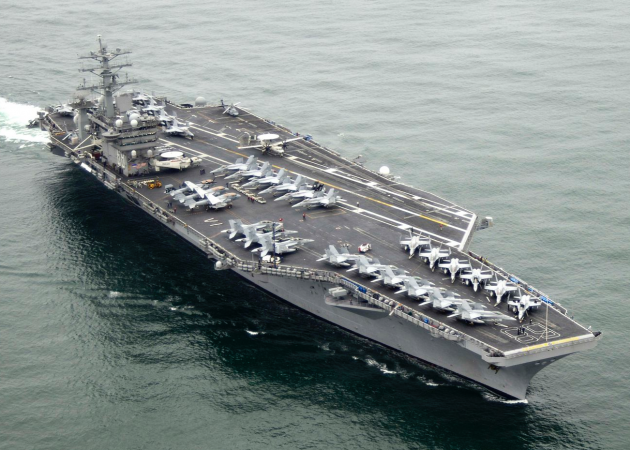
Recently released commercial satellite images have revealed the Iranians are attempting to reconstruct a replica of one of the United States’ largest and most powerful warships, the USS Nimitz.
Construction on the crude model appears to be in full swing at a shipyard near Bandar Abbas, as shown in newly released commercial satellite images. 'They got this barge and threw some wood on top of it to make it look like the USS Nimitz. That's all we know for sure,' a U.S. defense official told AFP... The wooden, non-operational aircraft carrier made to look like a Nimitz-class nuclear-powered American vessel was first spotted on the Persian Gulf last summer, the New York Times reported. Besides having the shape of the 1,100-foot-long carriers, such as USS Abraham Lincoln and USS Carl Vinson, the shipbuilders also replicated the distinctive white markings on bow. A satellite flying over Gachin shipyard also photographed a fake plane parked on the deck of the equally fake carrier.

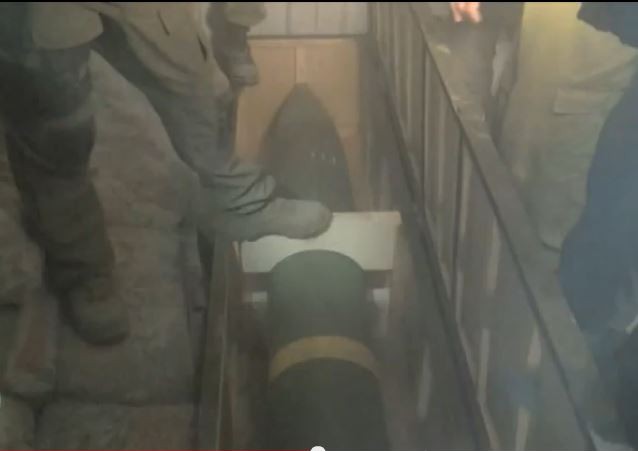
The Leftist-Islamist anti-Israel coalition relentlessly complains about the Israeli military blockade of Gaza.  On a number of occasions they have put together flotillas of civilians to break the blockade. One of those flotillas, organized by Turkish Islamists and loaded with European leftists, led to the controntation in 2010 in which nine people were killed after Israeli troops boarding the ship were attacked and beaten: (Mavi Marmara Passengers Attacking IDF, May 31, 2010 -- additional footage here) That blockade is legal, as even a U.N. panel ruled (and U.N. panels almost never side with Israel). Israel today seized a ship loaded with long-range missiles destined for Gaza via Iran. Here are two videos:

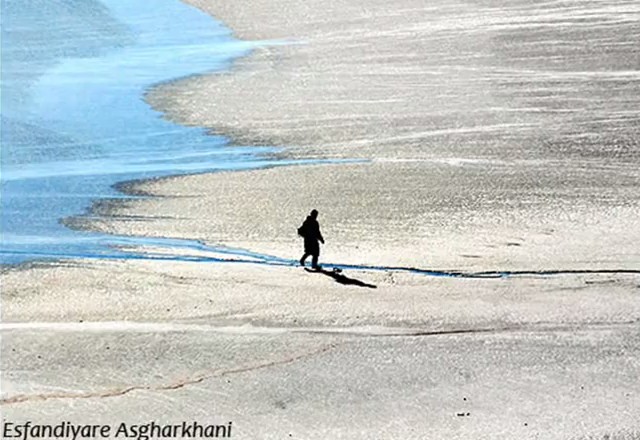
According to an article last month in the New York Times Iran is facing a major water crisis.

Iran is facing a water shortage potentially so serious that officials are making contingency plans for rationing in the greater Tehran area, home to 22 million, and other major cities around the country. President Hassan Rouhani has identified water as a national security issue, and in public speeches in areas struck hardest by the shortage he is promising to “bring the water back.”

Experts cite climate change, wasteful irrigation practices and the depletion of groundwater supplies as leading factors in the growing water shortage. In the case of Lake Urmia, they add the completion of a series of dams that choked off a major supply of fresh water flowing from the mountains that tower on either side of the lake.

According to a recent op-ed in the New York Times, Iran didn't always have a water problem.

That cooperation began in 1962, after a severe earthquake in the Qazvin region of Iran killed more than 12,000 people. The earthquake collapsed a chain of wells that engineers had drilled in a qanat, or tunnel, style. Hundreds of thousands were at risk from lack of drinking water. Israel flew in teams of drillers. New water supplies were identified, and a series of artesian wells were drilled. The drilling was such a success that Israel’s water engineering company, today a private enterprise, was hired to identify and gain access to underground resources elsewhere in Iran.

Beginning in 1968, a desalination company owned by the Israeli government built dozens of plants in Iran. These are now aging, while Israel continues to innovate: On its Mediterranean coast, it recently opened an immense, energy-efficient desalination plant. More than half of Israel’s drinking water — purer, cleaner and less salty than natural sources — now comes from seawater.

Recently, Joshua Muravchik wrote Why the Left Should Stop Carping and Love the Jewish State, Again, at The Tower Magazine. In one paragraph he presents the gist of his argument.
Moreover, when viewed in the light of the core values of the Left—and, indeed, much of the contemporary Right—Israel actually comes off remarkably well; often much better than its most violent critics. These values are summed up by the great slogan of the French Revolution: “liberté, egalité, fraternité,” “liberty, equality, fraternity.” Israel’s record with respect to these core values ranks among the best in the world, while that of its principal enemies, the Arab nations, is dismal. Indeed, Israel’s record is in some cases better even than its European and other Western critics. Because this record is often obscured in the angry polemics against Israeli policies toward the Palestinians, it is worth examining it in depth.
One thing Muravchik mentions is the record of Israel's Arab enemies. It's indeed something worth looking into. However there's also the record of Iran, Israel's major non-Arab enemy that's worth examining. The liberal (or leftist) world has made a cause of reaching out to Iran. In doing so the Left ignores the way Iran violates many of its cherished values. I'd like to look at a few of these issues.

Minority Rights

Contrary to the impression presented by Iran's leadership, Iran has a huge minority population, including Kurds, Azeris, Balochs and Arabs. According to this list, minorities make up at least 40% of Iran's population. (I recently attended a lecture that put the figure at 50%.) What rights do minorities in Iran have? In last year's election, then-candidate, Hassan Rouhani promised greater freedom for Iranian minorities.

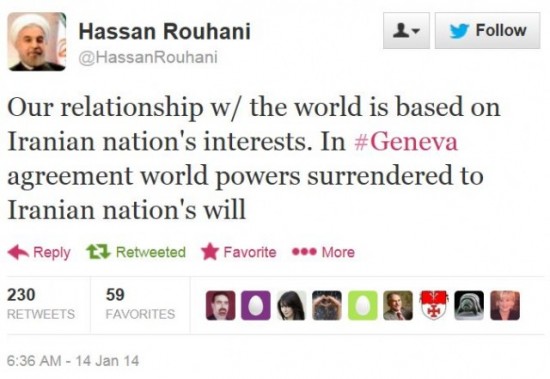
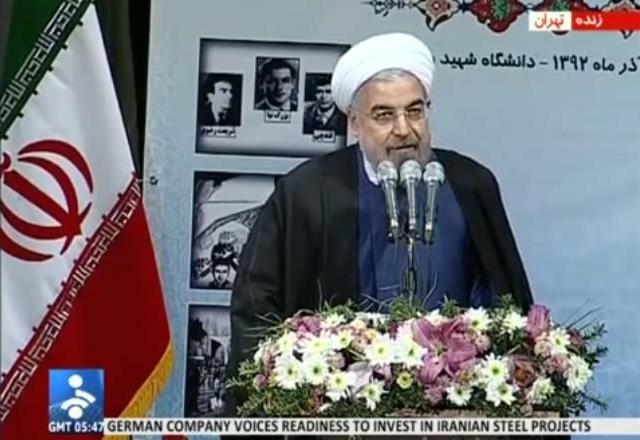
The new "moderate" President of Iran has declared victory and international surrender (featured image above). But what are the terms of our surrender? According to Iran, we don't really know; according to the State Deparment, we will find out. Via L.A. Times, New Iran agreement includes secret side deal, Tehran official says :
Key elements of a new nuclear agreement between Iran and six world powers are contained in an informal, 30-page text not yet publicly acknowledged by Western officials, Iran’s chief negotiator said Monday.... A State Department spokeswoman, Marie Harf, denied later Monday that there was any secret agreement. "Any documentation associated with implementation tracks completely with what we've described," she said. "These are technical plans submitted to the International Atomic Energy Agency," the United Nations' nuclear watchdog agency. "We will make information available to Congress and the public as it becomes available," Harf said.
Remember last fall when the Obama administration insisted it had not consented to Iran's right to enrich uranium, even though Rouhani was claiming we had consented? Q&A: Is there a 'right' to enrich uranium? Iran says yes, U.S. no How's that looking now? Again from the L.A. Times article:

When I was almost fifty four, it was a very good year It was a very good year for kindly faced clerics Whose Justice Minister was an executioner And Defense Minister waged an anti-American war When I was almost fifty four.
Nearly two years ago Jeffrey Goldberg interviewed President Obama about how he would deal with the threat from Iran. Given Goldberg's support for Israel, the interview was part of an administration campaign to tell Israel and Israel's supporters in the United States that "we've got Israel's back." It's unsettling now, that Goldberg has declared that For Iran, 2013 Was a Very Good Year.
Remember that interim Iranian nuclear agreement forged in Geneva on Nov. 24, the one accompanied by blaring trumpets and soaring doves? Would it surprise you to know that the agreement -- a deal that doesn’t, by the way, neutralize the threat posed by Iran’s nuclear program, just freezes the program, more or less, in place -- has not yet been implemented? Would it surprise you to learn that this deal might not be implemented for another month, or more? Or that in this long period of non-implementation, Iran is free to do with its nuclear program whatever it wishes? And that one of the things it is doing is building and testing new generations of centrifuges? Ali Akbar Salehi, the head of Iran’s Atomic Energy Agency, recently said , “We have two types of second-generation centrifuges. We also have future generations which are going through their tests.” Happy New Year, everyone.