


From TED Talk to Total Flop: The Rise and Fall of the Insect Farming Boom
Despite billions in subsidies and glossy promises from international institutions, the “eat the bugs” movement is collapsing under the weight of its own impracticality.
Have you ever wondered how the globalist push for “eating the bugs” began?
It turns out the movement started with a TED talk followed by a United Nations report.
“We have to get used to the idea of eating insects.”
This proclamation came from, of all people, an insect researcher. Dutch entomologist Marcel Dicke pitched eating bugs in his 2010 TED talk as critical to sustainably feeding a growing human population, because insects have a much smaller carbon footprint than beef, pork, and chicken.
To make his point, he even featured photographs of what might be a common meal in this bold new future: a stir fry with mealworm larvae, mushrooms, and snap peas, finished with a chocolate dessert topped with a large fried cricket.
Three years later, the United Nations published a comprehensive report that echoed many of Dicke’s ideas and argued that insects could be a more eco-friendly food source not just for humans, but also for livestock. The report received widespread media coverage and helped to trigger a wave of investment from venture capital firms and governments alike into insect farming startups across Europe, the US, Canada, and beyond, totaling some $2 billion.
However, globalist theory has now met the reality of humanity. The insect farming industry is collapsing.
While some people may be open to adding bugs to their diet, insects remain a novelty food in the US and Europe, rather than a commodity capable of displacing meat. Insect farming startups have also struggled to make insect meal a viable replacement for soy or fishmeal in livestock feed, as the cost of insect meal is significantly higher.
- In 2020, insect companies farmed an estimated 1 trillion bugs.
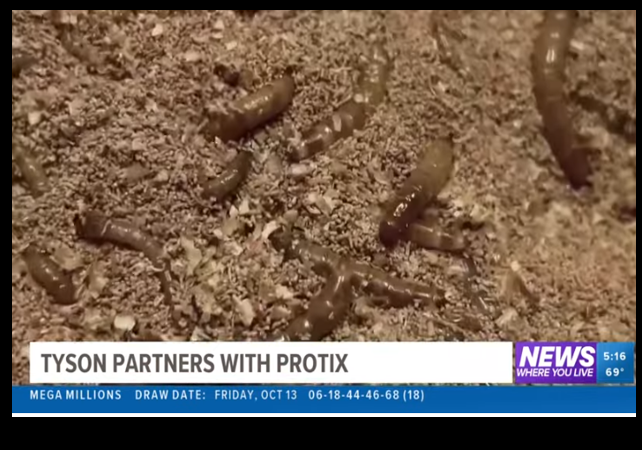
- In late 2023, Tyson Foods announced it had invested in the Dutch insect farming startup Protix to build a large insect farm in Nebraska.
- In early 2024, Innovafeed opened a pilot insect farming plant in Decatur, Illinois, in partnership with ADM, but suspended operations a year and a half later due to funding challenges.
- In late 2023, the largest insect farming startup, Ÿnsect, ran out of money after raising over $600 million in funding.
Last year, I reported that Ÿnsect, once the largest insect‑protein producer in Europe, was headed toward bankruptcy after failing to secure the financing needed to continue its operations and execute its restructuring plan. Clearly, the move away from “eating the bugs” is continuing. The firm is now officially kaput.
Europe’s largest insect farm, driven by Agenda 2030, came to an end despite having received hundreds of millions of dollars in public and private funds allocated to the “alternative” food industry project.
The French company Ÿnsect declared bankruptcy and entered judicial liquidation, thus closing one of the most controversial projects, which had been presented as a key piece in the transformation of the European food system, in line with left-wing progressive initiatives promoted by the European Union.
Europe's largest insect farm, Ÿnsect, who received $200 million in taxpayer money and another $400 million from private investors, went bankrupt in late 2025.https://t.co/n9yqgSl9TN pic.twitter.com/IgRQQut960
— Marc Mongrain (@Lukathor) March 17, 2026
Back in 2023, I covered Tyson’s plans to build an insect farm in Nebraska. Now, Tyson’s plans to build the facility have been put on hold… indefinitely.
That’s according to email exchanges last December between Tyson Foods and the Nebraska Department of Water, Energy, and Environment, which were obtained through public records requests by the nonprofit Society for the Protection of Insects.
Tyson and Protix did not respond to questions for this story.
The companies’ stalled plans aren’t unique in the insect farming space.
Interestingly, a study titled “Have the Environmental Benefits of Insect Farming Been Overstated? A Critical Review,” authored by an international team of academics from the UK, the US, and Europe, has been published in the scientific journal Biological Reviews. Co-author of the report, executive director of the Insect Institute, and affiliate instructor at the University of Washington Tacoma’s School of Interdisciplinary Arts and Sciences, Dr. Dustin Crummett asserts that insect protein has been “widely hyped over the past decade.”
Crummett explains to Food Ingredients First how the findings show that there is essentially no public demand for farmed edible insects, and farming insects for pet food or farmed animal feed can be, at times, worse for the environment than conventional options.
We also speak with lead author Corentin Biteau of the French National Observatory on Insect Farming.
“The most surprising finding was that, although insects are often said to be more sustainable than meat, the vast majority of companies are not trying to replace meat because of low consumer acceptance. Worse, for the human food market, approximately 90% of insect-based foods do not replace meat. Instead, they replace plant-based products like bars, snacks, and pasta, which have a smaller environmental impact,” Bitaeu explains.
“Another issue is the low use of waste. While there is a narrative that the industry can contribute to a circular economy, large-scale farms rarely use genuine food waste. This is due to regulatory restrictions, sanitary risks, logistics, or nutritional variability, which are the same barriers that prevent feeding waste to conventional livestock.”
Instead, major producers use grain co-products like wheat bran, meaning insects compete directly with traditional livestock for feed rather than creating a circular system.
Putting this all together, it is clear that reality has intruded on the global elite’s favorite sustainability fantasy.
Despite billions in subsidies and glossy promises from international institutions, the “eat the bugs” movement is collapsing under the weight of its own impracticality.
Consumers have decisively rejected the idea, investors have lost patience, and the science no longer supports the hype. The much-vaunted “protein revolution” has turned out to be little more than another expensive social-engineering experiment.
As the insect-farming bubble bursts, it’s clear that people prefer steak over crickets…and common sense over coercion.
Donations tax deductible
to the full extent allowed by law.







Comments
Politicians controlling food sources also played a huge role in the insect-for-food movement.
Yup. Yet another greenie idea that was so popular that it had to be mandated.
they should make the folks at Davos
dine on this …. every time they meet.
Breakfast, lunch, and dinner.
“‘ . . . the science no longer supports the hype.’” It never did.
You have to be a real Dicke to believe that people will want to eat bugs.
Wait … there’s such a thing as the Society for the Protection of Insects??? Why?
Entomological Edibles won’t be the new Starbucks? No fruit fly smoothies?
Mmmmm, Strawberry Swarm!
I have a friend who lives in the SEATAC influence zone, and about a year ago she got into the cricket-protein fad. Her usual morning breakfast is some sort of smoothie of various frozen fruits and God knows what else and her circle persuaded her that cricket powder was just the thing to add some protein to her breakfast. I decided to do the classic two-minutes-research on the web. I was horrified to discover that there is basically zero government regulation from the FDA. She stopped pretty soon thereafter but whether it was because of the info I sent her, I have no idea.
“Insects are susceptible to microbial contamination (e.g., bacteria, fungi, and mycotoxins), as their nutrient content make them a good host for pathogens under certain conditions. This may impact the consumer (specifically in the event that uncooked insects are ingested) and also may cause food spoilage. A claim has been made that insect pathogens are taxonomically different than those that affect humans and, thus, can be regarded as harmless; however, in order to verify this claim, testing would be required on any insect source that was going to be used as a food ingredient, especially because some parasites (e.g., the dwarf tapeworm) may infect people that have ingested an infected insect, such as a beetle or mealworm. Toxicant contamination of the insects is also a safety aspect that should be considered. This can arise from the area where it is being raised or what it is fed in the diet. Insects have the ability to uptake and concentrate substances from their environment or feed.
…..Typically the FDA is the arbiter of items used as food. In this case, the FDA has been apathetic when addressing the use of insects as a food.
https://www.burdockgroup.com/insect-protein-what-are-the-food-safety-and-regulatory-challenges
TED talk…
“Thunder buddies…” 🙂 🙂
So the whole idea was full of bugs.
.
They’re features, not bugs!
And yet, all that wasted money is still gone…all those CEOs and Presidents and CFOs, and VPs got their 6 figure paychecks while the gravy train lasted.
Laughing all the way to the bank.
Soylent Green is PEOPLE!
who the f funds these!!??
Why anyone would voluntarily pursue the menu recommendations from Snowpiercer. often puzzled me.
“Europe’s largest insect farm, driven by Agenda 2030, came to an end despite having received hundreds of millions of dollars in public and private funds”
So another grift where politicians send public money to their buddies who kickback some of that money back to those politicians.
It was totally stupid to target this to humans.
I do think however that this has great merit when considering wildlife or livestock. We are stupid to not explore it further.
Endangered fish… Salmon, Trout and huge portions of the ecosystem could benefit.
Anyone check beef prices lately…. holy moly. If you can get a cheaper source of feed for livestock, that makes the viability of farming so much easier.
Poultry?
Dog food? We spend a few hours a month making a monthtly batch of dogfood for our geriatric Malinois (eggs, sweet potato, chicken, rice) because the kibble stuff is rough on his digestive track.
But of course, being smart was not their goal, this was all about destroying and displacing traditional industry, not helping.
From the article above,
Insect farming startups have also struggled to make insect meal a viable replacement for soy or fishmeal in livestock feed, as the cost of insect meal is significantly higher.
All of the following is keyboard science…so worthless.
They were out to kill the beef industry- and I’m going to wager that it was mostly boondoggle $ and not serious nor actual innovators and that’s why they couldn’t turn a profit. Also I would expect it to be more expensive at the concept stage. Soy farming is mature and done at scale. No way you are competing with that at the concept stage.
Insects and livestock both convert “stuff” into protein and the challenge is insects compete with livestock for the same “stuff” – the free-est of stuff would be sewage- however sewage at ag scale is not comparable.
In terms of “crop” I would speculate insects like core crops could be subject to disease, but not the same disease. So viable crop rotation could be “insects” Insect fencing… well that’s a new territory.
I didn’t see water consumption as a factor. Take areas where farmers are competing with fish. If bug farming reduces ag dependency on irrigation- huge win. However the dang birds will make an secondary industry out of scarecrows.
dunno- but I’m still wagering there were never serious people involved and it was all politically motivated without a true goal of competing, supplementing or co-existing.
I could almost see it as chicken feed
however as the article stated there are cheeper feeds .. my chickens love to eat nice fresh bugs in the garden and the yard … but I dont have to buy them …
“novelty food”
It’s disgusting.