


Report: Major Banks Restricted Services for Conservatives During Biden Admin
Some of the banks relied on the Southern Poverty Law Center to determine which customers and merchants constituted a “reputation risk.”
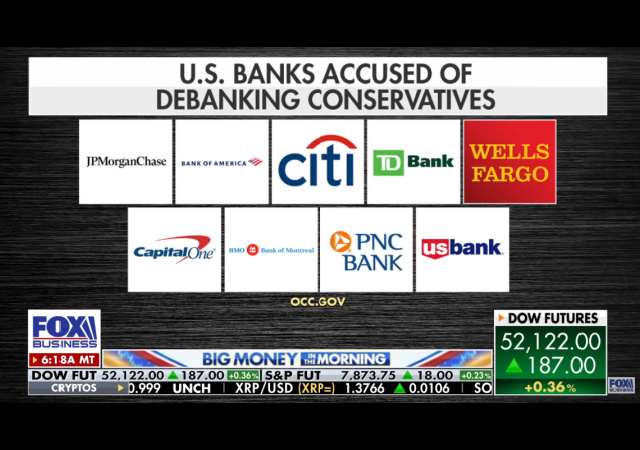
The Office of the Comptroller of the Currency (OCC) Debanking Review found that major banks closed accounts belonging to conservatives, religious groups, and others the Biden administration did not favor.
Guess what organization popped up quite a few times? Southern Poverty Law Center.
More on that later.
The OCC performed the review after President Donald Trump signed an executive order to determine if any of the banks’ “policies or practices may have required, encouraged, or otherwise influenced banks to deny or limit access to financial services to Americans because of their political or religious beliefs or lawful business activities.”
JPMorgan Chase Bank, Bank of America, Citibank, Wells Fargo Bank, U.S. Bank, Capital One, PNC Bank, TD Bank, and BMO Bank all had policies between 2020 and September 2025:
In the report, the OCC found that broad reputation risk policies—which lacked clear standards and objective, risk-based criteria—disadvantaged certain Americans based on their political, religious, or social views or based on their lawful business activities. The OCC also found that banks maintained public and nonpublic policies restricting certain industry sectors’ access to financial services, including those in oil and gas exploration, coal mining or coal-powered plants, firearms or ammunition manufacturing or distribution, construction or operation of detention facilities, the manufacturing, distribution or online retail of tobacco or e-cigarettes, and digital asset activities.
In preparing the report, the OCC reviewed nearly 100,000 complaints to OCC-regulated institutions and received approximately 50,000 documents consisting of approximately 420,000 pages from these banks regarding their policies, procedures, practices, and individual customer decisions.
“Today’s report provides irrefutable evidence that the nation’s largest banks have denied, debanked and discriminated against customers and lawful businesses,” said Comptroller of the Currency Jonathan V. Gould. “Americans should have access to financial services regardless of their beliefs, affiliations, or political views. Fair access to financial services is not a mantra—it is a mandate. The Trump Administration is committed to ending the weaponization of finance against hardworking Americans, once and for all.”
- In February 2021, a payment processor owned by one bank closed the account of a merchant that sold merchandise promoting President Trump and the Make America Great Again (MAGA) brand.
- In February 2023, one bank declined to provide financial services to a public education organization due to its partisan leanings—namely, the organization’s political arm’s endorsement of solely Democratic candidates.
- One bank implemented an environmental and social risk management policy that restricted it from entering into a business relationship with customers that did not have policies that aligned with the bank’s responsible firearm standards. This included, for example, limitations on the sale of high-capacity magazines and restrictions on firearm sales to individuals under the age of 21.
Why? Because the banks viewed those customers as “reputation risks.” Yes, the banks thought associating with those customers could lead to protests or lead to negative media.
Staff didn’t use facts to determine who fell into that category. It’s all about feels:
The agencies observed that supervisory staff have little ability to predict whether or how certain activities or customer relationships present reputation risks that could threaten the safety and soundness of an institution. Instead, by focusing on reputation risk, supervisors attempt to understand and anticipate public opinion regarding issues and events and then attempt to directly connect this public opinion regarding issues and events to an institution’s condition in ways that have proven nearly impossible to assess or quantify with accuracy.
The OCC found that the banks appear no better than bank regulators at meaningfully and fairly evaluating reputation risk. Despite efforts to establish policies and corresponding processes that objectively measured reputation risk, the banks acknowledged the highly subjective nature of a reputation risk assessment. As one bank policy provided: “Because of the perception-based nature of Reputational Risk, it is difficult to define all situations that should be escalated” for oversight. Another bank observed that “[j]udgment of what poses sufficient reputation risk to warrant further review is dependent on the facts of each situation and therefore, there can be no definitive checklist.” A third bank explained that “[d]ue to the occurrence and circumstance of Reputational Risk being heavily dependent on diverse stakeholder judgment, the establishment of a robust Risk Culture is critical in moderating potential Reputational Risk.”
The banks even used non-traditional sources to determine a customer’s reputation risk.
Non-traditional sources such as the Southern Poverty Law Center. You know, the organization that paid the KKK and other racist groups. One SPLC higher-up even had a love affair with a member and laundered money.
Yes, banks relied on the SPLC to assess reputational risk.
PNC didn’t issue a line of credit to a media company in 2021. The OCC didn’t name the company, but bank employees raised concerns because of a speech the owner, described only as a “conservative political commenter,” once gave.
The employees also noted that the media company owner’s foundation helped fund “several Christian conservative groups, including several identified as hate groups by the Southern Poverty Law Center.”
JPMorgan subsidiary WePay, which provides payment services directly to customers or through a third-party online platform, canceled many accounts belonging to political or religious merchants.
WePay monitored for compliance using a tool that screened profiles, websites, and other information for terms to identify merchants engaging in unlawful activities. These terms included MAGA, Make America Great, and America First.
Yeah, um, the terms “included the names of certain ‘hate groups’ identified by organizations like the Southern Poverty Law Center for their perceived non-mainstream social or religious views.”
WePay closed an account belonging to a conservative legal advocacy organization because it was supposedly associated with a known hate group. WePay only knew about the “hate group” because SPLC identified it as one.
“Notwithstanding certain efforts by the largest banks to rein in these practices, I am not confident that they will be enough,” Comptroller Gould said. “Accordingly, the OCC will be assessing further changes to the regulatory and supervisory framework applicable to the largest banks to reduce the likelihood of these harmful practices recurring in the future.”
Donations tax deductible
to the full extent allowed by law.


Comments
Did these banks think they were in Canada, dealing with uppity truckers?
Fines and lawsuits for discrimination are the only thing these vapid Business Majors understand.
John Derbyshire’s magazine Vdare.com was debanked and bankrupted, a few years ago. The outrage didn’t get noticeable public notice.
Forgot, it was NY’s attorney general that did the deed, bankrupting them with supeona demands. Letitia James by name. And cancel culture at all turns.
https://vdare.com/articles/vdare-com-vs-cancel-culture-my-story-lydia?scroll_to_paragraph=6
Is there any regulatory action that can be taken against these banks?
Or option B is there an option for damages in litigation from the companies impacted?
It was sheer stupidity for the woke banks to do this. Conservatives spend and invest like every one else. The bankers hate was stronger than their greed.
The big banks don’t need you.
I never said they did.
Just putting it out there: Old Glory Bank.
“Our Co-Founders: John Rich, Dr. Ben Carson, Larry Elder, and Governor Mary Fallin.”
The link didn’t work for me.
I have no idea what that link is, never mind how I got a handle on it. Try this naked one:
https://oldglorybank.com/about
There’s a certain view that Conservatives are poor, stupid, and uneducated hicks so losing them as customers is less of a risk than losing the Democrat voting inner city ghetto dwelling foodstamp reliant customers, or the card carrying Democrat Party-Academia-Media Complex members.
I agree
Who keep all the BIG deposit accounts.
Is this a typo or are they bipartisan?
In February 2023, one bank declined to provide financial services to a public education organization due to its partisan leanings—namely, the organization’s political arm’s endorsement of solely Democratic candidates
Not a typo. This particular bank apparently objected to all partisan groups.
More proof that it’s time to start throwing communist democrats in cages.
Is this supposed to be news?
Apparently, it’s news to the “Office of the Comptroller of the Currency (OCC) Debanking Review.”
If they start investigations like this too early, the statute of limitations would still be open nd they might have to actually do something.
I’ll play devil’s advocate here. How many of these banks were threatened with audits, federal reserve-related problems, and FDIC cutoffs unless they complied with administration demands?
I worked for one of these major banks for many years, and I can tell you that the threat of non-compliance hangs over most decisions made. And my first thought when reading this article was that either (or both) rogue employees were involved in making these decisions, or they were being pressured by government entities to do it.
We already know all about Chokepoint. It’s reasonable to assume that the Biden admin did it again without the faux pas of saying it out loud.
Zero compensation for any of the victims.
You’d think there’d have been thousands of lawsuits over this already.
Hopefully this documentation of the crimes will result in the victims being able to sue successfully.
And, of course, zero consequences for anyone in the Biden administration that pressured the banks, illegally, to do this. And its not like the Biden administration was the first to do this, it happened throughout Obama’s administration also.
Bank on it.
There is no reason for any individual to do business with a big bank. Use local community banks or credit unions preferably credit unions.
The employees that came up with this policy should be terminated. The employees and managers that implemented this policy should be terminated. Nothing will happen, though because these banks are Too Big Too Fail so have little to fear from anyone except customers that go elsewhere.
Time the boards and management at the banks personally paid the people they wronged.
Just one more reason to use local institutions. A regional bank and a reputible credit union are our trusted go-tos.
Too Big To Fail means Too Big To Trust.
.
It’s a sucker’s game. I’ve banked at local institutions all my life. Inevitably, my accounts end up at megabanks. Here’s why that happens, and it’s not an accident.
Is that actually a law? Are “financial service” companies, however defined by law, actually required to deal with all comers so long as it’s lawful to do so? Right now it’s lawful to deal with CAIR and ISNA; suppose a bank is concerned that these groups might be caught giving material support to foreign terrorists, and doesn’t want to be stuck with them on its client list, shouldn’t it be allowed to turn them down? Or suppose the bank isn’t concerned about future legal risk but simply doesn’t want to do business with them because of the values they stand for. Must a bank open an account for the KKK? Suppose a bank has a pro-life policy; must it nonetheless do business with abortion clinics?
restricted services? To say the least