


Trump Admin Cuts Biden-Era Fuel-Efficiency Requirements for New Cars
“This rule restores integrity to the national fuel economy program, balancing vehicle affordability and energy conservation goals while improving safety on our roadways.”
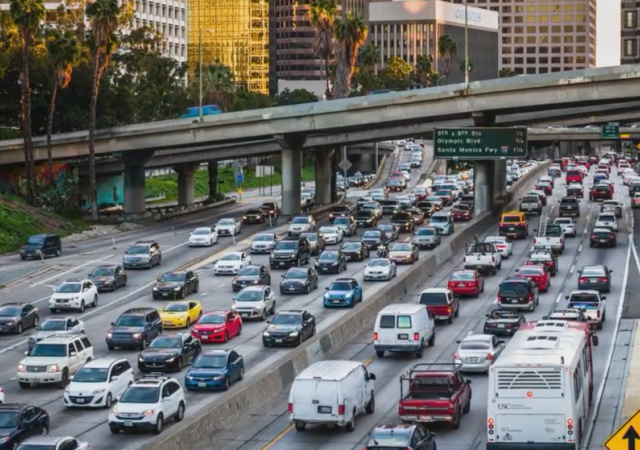
The Transportation Department has rolled back the Biden administration’s unrealistic fuel-efficiency standards to make cars more affordable with its new initiative, “Freedom Means Affordable Cars.”
The move resets the National Highway Traffic Safety Administration (NHTSA)’s Corporate Average Fuel Economy (CAFE) standards.
The Transportation Department claims the final initiative will:
- Give automakers the flexibility to manufacture cars the public wants to buy
- Reduce the average cost of a new vehicle by $1,300 for American families
- Save the American people $138 billion over the next five years
- Prevent more than 300,000 serious injuries and save 1,900 lives by encouraging new car sales
“Thanks to President Trump’s leadership, we have finally ended the illegal mandate that forced automakers to produce more expensive electric vehicles that American families didn’t want. While Joe Biden and Pete Buttigieg pushed a green agenda that made our roads less safe and drove up costs for hardworking Americans, this administration is delivering relief to families and reviving the beating heart of American manufacturing,” said U.S. Transportation Secretary Sean P. Duffy. “With our commonsense standards in place, we are making the American dream affordable again, putting safer cars on the road, and investing in the American autoworker.”
The Biden administration set fuel economy standards for light-duty vehicles to reach “an average of 50.4 mpg by model year 2031.” Biden’s handlers did this to push more electric vehicles, even though people didn’t want those vehicles. Leslie covered that topic so many times.
The Trump administration’s new standards hope to “achieve a fleet average fuel economy of 34.9 miles per gallon by model year 2031, up from 30.1 miles per gallon for model year 2024.”
“This rule restores integrity to the national fuel economy program, balancing vehicle affordability and energy conservation goals while improving safety on our roadways,” said NHTSA Administrator Jonathan Morrison. “Newer cars are safer cars. By reducing vehicle prices, more American families will be able to afford newer vehicles, and sensible standards allow automakers more freedom to design and produce vehicles consumers actually want. I’m proud of our fantastic team of expert engineers, economists, and lawyers for the tremendous job they’ve done finalizing this rule.”
People didn’t want electric vehicles. Automakers didn’t want to make electric vehicles their only option.
Toyota Motor CEO Akio Toyoda voiced his concerns in 2022, saying many in the auto industry agree with him.
The auto industry has been slashing electric-vehicle production since sales plunged and more people bought gas-powered vehicles.
Trump has been toying with this idea since he took office. In December 2025, Ford CEO praised Trump for starting the process.
Donations tax deductible
to the full extent allowed by law.






Comments
Now if I could find someone who would just sell me an affordable car with a naturally aspirated engine, a real transmission and no start stop garbage.
And no nanny-cam. This nonsense is apparently required now, and if one wears polarized sunglasses the systems go smack out of their minds.
Not nearly enough of a change. They should go down to Zero because we should have the “freedom” in a “free” country, to buy what we damn well want.
This won’t help cars become beautiful again. It’s still too much of a drag on design.
Gee, I just want a car which my non-dealer mechanic can fix, and which doesn’t have such complex engineering that it will need frequent fixing, and which somebody else can’t turn off remotely, and which stands a chance in a collision with an SUV or pickup truck, and which I can afford.
I don’t think these “new standards” will provide any of these things. But better than nothing, I suppose.
Most of what you’re looking for isn’t provided by or required by the government, nor should there be government-pronounced “standards” controlling your particulars.
By “provide” I mean “fail to require the opposite”, which is what the “standards” have been doing for decades.
I would also appreciate it if auto manufacturers would refrain from colluding among themselves and with the government to stiff the customers.
Conservatism is common sense/rationality + moral probity. That’s it.
What’s the lead time to design new automobiles?
What’s the chance automakers will dive into the pool with these new regulations, knowing they may very well evaporate under President Hairgel or President Below The Equator?
It’s still important to stake out policy ground and eviscerate the Obama/Biden mandates.
All I’m saying is don’t be surprised if the automakers don’t jump in with both feet.
We’re never going to see the Keystone Pipeline. At best we may or may not see “Keystone Lite.”
What we need is for Congress to act so that we have statutes to stop the goofy waiver authority for CA and other States. Do that and the industry can make, fund and execute long term plans v whip saw back and forth between Red v Blue occupation of WH/regulatory authority and vastly different policy preferences.
The industry must incur added production costs to meet CA’s (different) standards, and you know that they (rightly) pass the cost to the consumer. Is the burden on CA buyers alone, or is it spread out across the entire country and what does it cost individual car buyers?
California standards now apply to several other states that adopted them. Massachusetts, New York, and I believe Ill-annoy among others.
Is that even legal, given that the “special dispensation” was given ONLY to California?
California got the dispensation. Other states chose to adopt the standards. I don’t know how that works. But apparently it does.
Because California is such a huge market, their mandates and regulations spill over to the rest of the nation because it’s cheaper for producers to only have one standard. Fortunately, some industries, like firearms, refuse to play the California game. I can’t think of anything worse than allowing California to dictate what the rest of the nation can purchase.
My preferred solution is to allow CA and other States to adopt and enforce whatever mandated they wish for products (in this case automobiles) which are wholly:
1. Manufactured within the State
2. By a company legally domiciled in the State
3. Sold by a dealer within the State
4. Purchased by a consumer residing in the State
For products that meet all of those thresholds no one should have much objection to State regulation …but if there’s even one failure of any of those tests then the State can pound sand. Set it as a Federal statute and preemption does the rest.
Very mixed feelings based on rental cars in Europe that had smaller engines than the same U.S. models and *much* better fuel economy. I could imagine a requirement to make those engines available here, at least if it didn’t raise costs.
I have 3 vehicles: a ’13 Ram diesel that gets 12.5 mpg in town and 20 on the freeway if I drive 60 mph; a Toyota RAV-4 that gets 22/30; a Chevy Bolt EV that gets 145 mpg-e in town and 123-138 on the freeway depending whether I drive 65 mph or 60 mph.
Fuel cost/mile at current diesel, gas, and electricity prices in our area: Ram, 47.3 cents; Toyota, 22.9 cents; Chevy Bolt, 2.7 cents.
This is NOT a smug promotion of EVs. Each of my vehicles has a role to play. I am against gov’t EV subsidies, and against penalties or prohibitions on less fuel efficient vehicles or engines. That said, on the ICEV front, maybe require that smaller European-size engines be available here in the same vehicle for those who might be willing to accept less power for better fuel economy.
Example: Last time in the UK, I rented a Nissan Juke with an engine that got 20% better fuel economy than the same Juke sold here. Maybe too much of a hassle to require the competing versions here.
The fuel efficiency gains are happening, but they should be manufacturer-led and market-oriented, not imposed by ill-conceived, heavy-handed and deleterious government diktats.
Examples — Mazda, building on its excellent engineering heritage, is constantly improving internal combustion engine efficiency. Toyota, in partnership with Mazda and other Japanese manufacturers, is mastering hybrid motor systems, yoking the best aspect of IC engines and electric motors, in a single vehicle.
This innovation and these improvements are happening because that’s what the best, most engineering-minded car companies do, as a matter of course; not because the U.S. federal government demanded it.
I’m not opposed to EVs but I’ll never own one because I live in a very rural area, 25 miles from the nearest charging station and in order to charge it at home, I”d have to buy and install additional solar capacity and storage that otherwise is not needed. There would be no money savings for me.
If you have an electric dryer plugged into a 240 volt circuit, and if your laundry room shares a wall with your garage, you can safely rig up charging the EV for <$250. I can tell you how to do it and why it will work and be safe if you want me to. If you are not grid tied and cannot store ~35 kWh from your panels to use overnight, and/or don't have a 240v circuit, then I don't know how to help.
Do those costs also include miles per gallon of electrons, or are those “free?”
Part of the reason our small cars get such crappy gas mileage compared to those overseas is that ours have been Naderized into massive little bunkers, and emissioned into impotence.
I don’t understand your question. My electrons cost 10.8 cents / kWh. Right now, my EV has gone 132.9 miles on 31.5 kWh. To get the equivalent mpg, I use the energy in a gallon of gasoline (33.7 kWh) minus the electricity used to refine a gallon of gas (0.78 kWh). This equals 32.98 kWh. This charge, so far, the EV is getting 139 mpg-e. I might add that, by deducting the implied electricity content in gasoline I reduce the mpg-e a little bit — in this case, from 142 to 139. I refuse to overstate or understate numbers.
Our vehicles get lower gas mileage because, on a fleet-wide average, they are heavier than the European fleet, and have bigger engines. I have nothing against it in the aggregate, but note that at least some models sold in both places get 15-20% better fuel economy in Europe because the engines are smaller. But there’s a tradeoff: slower acceleration.
Not much an issue over there because Europeans as a whole, the superhighways there notwithstanding do more of their driving at slower speeds than we do. In theory, I’d like to see Americans be able to get the smaller engines if they wanted them, but I can readily see the other side. So it’s not some virtue thing with me.
And fuel is not the only ongoing cost of of a vehicle. My own Dodge flatbed gets 12mpg on average but also has the aggressive suspension and tire tread to handle the rough gravel roads of rural OK, that love to turn into pothole minefields after any significant rain.
Any fuel dollars I might save with a smaller-engined, lighter vehicle would be eaten up and then some by constant new tires and suspension repairs.
I agree with about your truck given how you use it. If you had, say, a half-ton truck instead, it wouldn’t make sense. My Ram 3500 made sense when I bought it. Today, a smaller truck would. But given its age (13 years) and its dents and busted sunroof, and that it’s paid off, I will keep it.
All that said, these days I use it mainly (as in 99%) on paved roads, and any hauling or towing is rare. And it needs oil changes, filters, and other fluids that are hardly cheap. Within the past week, I drove the truck 25 miles on an errand. At 12.5 mpg, it cost me two gallons of diesel at $7.09 per. I also drove the EV on the same errand. I used 4 kWh of juice at 10.8 cents per. So: $14.20 vs. 44 cents in round numbers for fuel.
I’d be kinda sorta nuts to drive the truck. Only did it then because I had to replace the batteries after 7 years, and because I did it myself I wanted to sure everything was right. Had an errand, so why not? I’ll be sure to drive it 20 or so miles every month, and when winter comes I’ll mount the studded tires for even short rides on our roads in hard packed snow or ice.
The EV is a compact Chevy Bolt. Can’t haul much more than groceries. And I would never take on a road trip. What, and spend an hour every 200 or so miles at a charger? But drives of 175 miles in winter to 235 miles in summer? You bet. Three weeks ago, I drove it 196 miles. Used 46 kWh for $5. It was a trip that I used to make in the truck. It would have cost $82. Right now, I pay 6%-%7 of the diesel cost if I can take the EV. None of this is politics. It’s money.
How bout eliminating All goals and mandated. Eliminate All epa rules.