


Lawsuit Alleges Anthropic, OpenAI, SpaceXAI and Google Made Illegal Agreement for AI ‘Pacing’
The plaintiffs allege that the coordination began to take shape months earlier than the dramatic revelations over the past week.
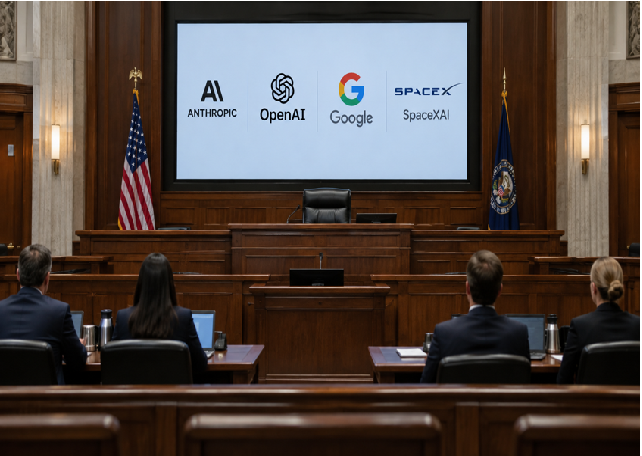
A proposed consumer class action has been filed in the U.S. District Court for the Northern District of California and alleges that Anthropic, OpenAI, Google, and SpaceXAI (the AI venture formerly known as xAI) illegally coordinated to slow improvements in their AI systems.
The lawsuit, which was filed Friday in the U.S. District Court for the Northern District of California, argues the leading AI companies violated antitrust laws when they agreed to coordinate slowdown efforts, and that doing so would reduce the value consumers get for paid AI subscriptions.
The coordination largely took place on Sept. 12, the lawsuit argues, when Anthropic CEO Dario Amodei published an essay urging for industrywide cooperation on decelerating advancements in favor of enhanced safety measures.
Amodei warned that swarms of rogue AI agents could take over the internet in as little as six months. He said AI companies should move forward more cautiously and slowly and with the development of the technology. Amodei then suggested a three-point plan in a blog post, which he said had the goal of “pacing the frontier.”
“I don’t think I fully just appreciated what it would actually be like when the progress was as fast as it was,” the CEO told CBS senior business and technology correspondent Jo Ling Kent in an interview on “CBS News Sunday Morning.”
A new lawsuit claims that Anthropic, OpenAI, SpaceXAI and Google illegally agreed to slow their AI development. https://t.co/WguinRO87e
— The Associated Press (@AP) September 19, 2026
In Buist et al. v. Anthropic PBC et al., the plaintiffs argue that a coordinated slowing of product improvement or quality amounts to an unlawful restriction of output under Section 1 of the Sherman Act, which prohibits certain agreements among competitors that restrain trade. They seek both a finding of Sherman Act liability and injunctive relief under Section 16 of the Clayton Act to stop the alleged conduct.
Today I can publicly announce that I am part of a landmark lawsuit against all of the major AI companies. I'm suing Anthropic, OpenAI, X, and Google because we deserve real AI safety standards, not shady deals cut by an unaccountable cartel of billionaires in a back room.
Since… pic.twitter.com/LDiVTTCtJu
— Cheyenne Hunt (@CheyenneHuntCA) September 19, 2026
The plaintiffs also allege the coordination began to take shape months before the dramatic revelations over the past week.
It points to a statement from July 2026 that high-ranking employees from several of the leading AI labs signed that acknowledged the “intense competitive pressure not to unilaterally slow” development. That statement called on the government to support a global effort to slow automated AI development.
It is clear that an agreement among the chief rivals in AI that their progress “should be slower than competition would otherwise produce has an anticompetitive effect on consumers,” the plaintiffs argue.
Lawyers representing four named plaintiffs, who pay for subscriptions to ChatGPT, Claude, Grok or Gemini, are bringing the lawsuit on behalf of a proposed nationwide class of other paid subscribers to those services.
The plaintiffs don’t object to the companies individually deciding to slow their own progress in favor of safety. They instead argue in the complaint that antitrust laws forbid them from taking the “shortcut” of agreeing to “substitute collective restraint for individual accountability.” A competitive market allows for responsibility and genuine progress, the lawsuit argues.
The plaintiffs in this lawsuit indicate that they intend to expand the case into a class action on behalf of others impacted by any decision by the companies to “pace” the development of AI.
Nick Rowley, one of the lawyers who filed the suit in the Northern District Court of California on behalf of four plaintiffs, said the case was filed to ensure “private self-serving agreements between the world’s most powerful ‘for profit’ technology companies” don’t result in AI “quickly spin[ing] out of human control.”
Cheyenne Hunt, a lawyer who helped bring to light accusations of sexual misconduct against former California Rep. Eric Swalwell and former Maine Senate candidate Graham Platner earlier this year, is a plaintiff in the case. She is joined by Florida attorneys Charles Buist and Nick Spetsas, and California resident Christine Bullock. In the filing, the plaintiffs signalled they intend to try to expand the case into a class-action on behalf of others impacted by any decision by the companies to slow down.
Discovery could reveal whether “pacing” was simply a safety argument or a convenient way for powerful competitors to create a quasi-monopoly, with bonus government interventions on their behalf. That will be…fascinating.
The questions this lawsuit raises become even more important as these frontier firms approach the massive IPOs many observers expect. Investors, subscribers, and regulators will all want to know whether safety was the goal or merely a convenient excuse to stifle the smaller AIs likely following in their wake.
Donations tax deductible
to the full extent allowed by law.





Comments
Was it for legitimate concern for the safety of their fellow man or just a ploy to make money? Gee, what a mystery.
You can’t get money out of this tech from the consumer. It’s all speculation subsidy and grants. They’ve got nothing and they know it.
The plaintiffs should be strung up by their thumbs and allowed to twist in the wind. Speed up. Slow down. You can’t please anyone. The only ones smiling are the lawyers smacking their lips at the thought of all that money they could make while virtue signaling to all the right people or the ones they think of as right. What a drag on society they are. They’ve outlived their usefulness if they were ever useful.
Not buying the plaintiff’s argument. Although the customers might expect increasing capabilities over time, it is almost certain that no particular level of improved capability was guaranteed. Subscribers were getting exactly what they were paying for – the capability of their chosen AI model at the time of the subscription. A “slowdown” in the increase in an AI model’s abilities (and/or in the quality of those abilities) doesn’t deny to the consumer that for which they subscribed even if it disappoints. If a service isn’t providing what you think you paid for, the solution is to quit your subscription.
Petitioners Sue to Make Fools Rush In Faster
What’s this, an unlawful combination in restraint of trade? Now do unions.
Anyone shocked that a handful of big companies which collectively dominate any particular sector of the economy would seek to create a moat around their business/market share by calling for increased regulation to burden their present competition or deter future competitors hasn’t been paying attention the last 50+ years. Adam Smith had much to say on this topic a couple hundred years ago.
For bonus points do unions in states without right to work laws.
Of course they are colluding. That’s what they do. See non-hire agreements. Handshake market exclusions. And IP cross-licensing: “We won’t sue your; you don’t sue us; BUT we can both sue those other guys not in our club.” (The trajectory of the SCO / Linux lawsuit is worth a deep dive. Look at what Google kept and didn’t after buying Motorola’s “mobile phone” business… and what they did with it.)
The “AI Tech-Revolution”: a bunch of people who grew up watching Web 1.0, then missed the Social Media bonanza, wanna make sure they get their peice of the next New, New thing. They deserve it. They are the bred and groomed overlords, after all. Same take for “investors”, institutions, big org users, and govt.
It’s shenanigans all the way down.
— Look at the circular funding, and financial engineering reporting costs as revenue.
— Look at the results of BigTech using “AI” internally: Micro$oft hiring back zillions of meat-bot coders to fix the generated slop. Still gonna push it out into users worlds, tho…
— Look at the reaction / response to it in all the things, unasked. Get out of my way, and stop screwing up. It’s like the injection was the point, the “help” the excuse.
Capture is the game, so do the capture thing.