


Chicago Cardinal, Catholic Nuns Sue Illinois Over Assisted Suicide Law
Mother Julie Marie: “The elderly people who come to our homes are looking for a place where they will be cherished and cared for until natural death. They should be free to choose that kind of care without having assisted suicide inserted into it by the state.”
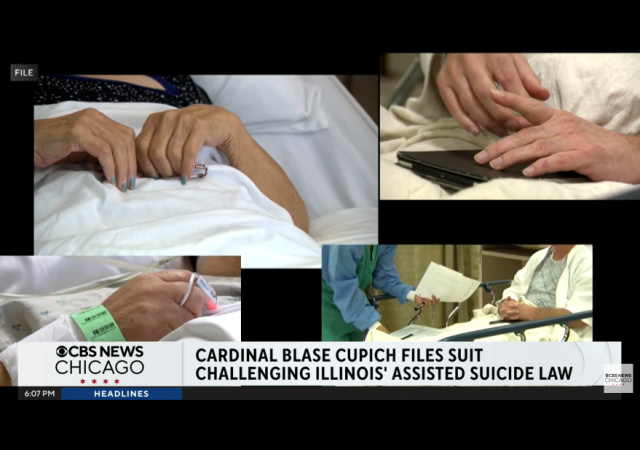
The Becket Fund announced that Cardinal Blase J. Cupich, archbishop of Chicago, two orders of Catholic nuns, and an Illinois pharmacist filed a lawsuit against Illinois over the state’s assisted suicide law.
It’s identical to New York’s. The Becket Fund is also helping nuns to challenge New York’s suicide counseling mandate.
The orders are the Carmelite Sisters for the Aged and Infirm and the Little Sisters of the Poor.
“Our residents come to us at one of the most vulnerable moments of their lives,” said Mother Mary Rose Heery, O. Carm., Prioress General of the Carmelite Sisters for the Aged and Infirm. “Our vocation is to give witness to them, through everything we do, that their lives remain precious and that they will never be abandoned. Illinois cannot ask us to replace that promise with help ending their lives.”
The lawsuit asks the court to block the law before it takes effect on September 12.
Healthcare providers face fines and penalties if they refuse to take part in assisted suicide.
From the emailed press release:
For nearly 175 years, Catholic healthcare ministries have been a refuge for the sick, elderly, and dying across Illinois. Today, that work includes Catholic hospitals treating millions of patients each year, the elder-care ministries of the Carmelite Sisters for the Aged and Infirm and the Little Sisters of the Poor, and the efforts of the many faithful Catholics working in health care, like small-town community pharmacist Luke Vander Bleek. All of them serve patients according to their Catholic faith, which calls them to heal and protect human life, not end it.
That means they cannot prescribe or dispense lethal drugs, direct or refer patients to obtain them, or help facilitate a patient’s suicide in any way. Yet Illinois’ End-of-Life Options for Terminally Ill Patients Act (EOLOA) forces them to do exactly that. Healthcare providers who object to participating in assisted suicide must still inform patients about their “right” to kill themselves, help them qualify for lethal drugs, and pass them along to someone willing to help them obtain those drugs—effectively punching the patient’s ticket for death. And pharmacists like Vander Bleek must fill prescriptions they know will be used for suicide or refer patients to another pharmacy that will.
EOLOA also forces healthcare providers to refrain from speaking any life-affirming messages against suicide.
The lawsuit claims the law violates the First Amendment in five ways:
- First, the First Amendment’s protected sphere of church autonomy requires the government to respect and stay out of matters of governance within religious institutions, such as how the Catholic Church chooses to implement its beliefs on the sanctity of human life and the decision of religious communities to form themselves around those same principles.
- Second, its protection of the free exercise of religion prohibits the government from burdening the sincere religious beliefs of Plaintiffs and the patients they serve unless the state is furthering an interest of the highest order and using the least restrictive means to do so—an exceedingly high bar Defendants cannot meet.
- Third, its protections against religious gerrymanders prohibit the government from enacting legal burdens that fall uniquely on religious adherents—such as those who object to providing assisted suicide.
- Fourth, its protections against compelled speech prevent the government from forcing Catholic doctors and nurses to speak the government’s preferred, supportive message of assisted suicide.
- Fifth, its protections for freedom of association allow the Catholic Church, its various communities, and the patients they serve, to organize themselves into likeminded communities with the same values and beliefs—the mission of which is to live faithfully according to those beliefs, for however long or short a time.
The plaintiffs say the Court could invalidate EOLOA because it also violates the Americans with Disabilities Act, the Equal Protection Clause, and the Supremacy Clause.
“I became a pharmacist because I wanted to help people heal, never to hasten their deaths,” stated Luke Vander Bleek, pharmacist and owner of Fitzgerald Pharmacy in Morrison, Illinois. “But now Illinois wants my pharmacy to dispense prescriptions for suicide in violation of my Catholic beliefs. The state shouldn’t force me to choose between serving my neighbors and following my conscience.”
The two orders take in anyone of any faith or no faith. They do not discriminate.
“The elderly people who come to our homes are looking for a place where they will be cherished and cared for until natural death,” said Mother Julie Marie, Mother Provincial of the Chicago Province of the Little Sisters of the Poor. “They should be free to choose that kind of care without having assisted suicide inserted into it by the state. We simply want to continue giving them the loving home they came to us for.”
But Catholics also choose these orders because they’re, well, Catholic. So not only is the law forcing the nuns to violate their religious beliefs, but also the patients who choose to live out their lives with these nuns.
Catholics know the nuns and facilities won’t pressure them into assisted suicide. The nuns won’t pressure the patient’s family to convince the patient to end their life.
There is no opt-out option:
The many Illinois nurse practitioners, doctors, mental health professionals, pharmacists, hospitals, and care homes with religious or moral objections to participating in assisted suicide will have nowhere to go, because Illinois’ purported “opt-out” still requires religious care providers like the Carmelite Sisters and the Little Sisters to directly participate in and materially assist the same medicalized suicides to which they object. The Catholic patients who do not want to be offered the chance to kill themselves at their lowest moment will be left out in the cold.
Donations tax deductible
to the full extent allowed by law.





Comments
If you feel helpless in thwarting such immorality I might suggest that the proper alignment of that feeling should be on the part of the government, not the citizen.
This is what you get when government slips its leash, meets all year long, sets itself up as arbiter of what moral and permissible. Invariably, it gets it wrong and leaves people of faith exhausted and depressed at the state of the world.
We have this atrocity in Illinois, and the legal butchering of children right up until the moment of birth in Massachusetts, not to mention the creeping threshold of what’s permissible in assisted suicide in Canada.
The Catholic Church hasn’t always been perfect (far from it) but it is completely in the right here. The teachings of Pope John Paul II on suffering as he faced his own demise are particularly relevant here.
Shame on Illinois for this law.
How does something that until not so long ago was a crime, now become mandatory? There ought to be a range for how radically laws can change. You can ban things that were lawful, or make mandatory things that were lawful. You can legalize things that were crimes, or make optional things that were mandatory. But to swing from criminal to mandatory or vice versa? That just seems too much for a legislature to do on a whim.
In this case it’s SPECIFICALLY to attack Catholic and similar groups who do not support suicide. The “progressives” are evil, and want to force others to commit evil.
And remember that well before the new crop of democrat radicals started corrupting politics, their sick progressive ancestors were advocating for assisted suicide. Those earlier pieces of progressive garbage were almost mild compared to the new versions corrupting the democrat party. It’s unthinkable to empower this party but, unfortunately, democrat voters don’t really think. They’re driven primarily by envy with a big helping of ignorance, flavored with some misguided “feelings.”
“How does something that until not so long ago was a crime, now become mandatory?”
Ask the merchants who lived through Jim Crow. They were shuttled from a society where it was illegal to serve blacks to a society where it was illegal not to serve them, without ever passing through an actual FREE society in which they could serve them or not, as they chose.
The bigger problem is the demand that businesses adhere to what is morally reprehensible – assisted suicide, etc
any government that would compel a religious organization (of very long standing in this case) to assist (and be therefore complicit) in the death of any individual due to age, infirmity, etc. is completely in the wrong
that a church body should even have to bring a suit to prevent such a thing is unconscionable–would defy them and dare them to try and collect any fine or mete out any punishment
It is altogether impossible for a man of thinking mind to contemplate the recent movements of the
legislature in New York without a feeling of grave and anxious misgiving. When the State, in its modern,
self-confident wisdom, took upon itself to decree that the terminally ill might demand the means of their own
destruction, it doubtlessly congratulated itself upon a fine piece of progressive benevolence. But the makers of
laws in Albany, as is the wont of politicians who look only to the immediate comfort of the world, quite
overlooked the fact that there are institutional consciences older and more stubborn than any modern assembly.
By the provisions of this new Medical Aid in Dying Act, as it is smoothly called, no small amount of
coercion has been brought to bear upon those whose lifelong business it is to tend the sick and dying. It is all
very well for the State to declare that a doctor or a nurse may decline to administer the fatal potion; but when
the law insists that these same pious caretakers must counsel their patients upon the advantages of
self-destruction, and hand them over by formal referral to practitioners of death, the State ceases to be a
protector and becomes a persecutor. It is this very intolerable conscription that has justified, and indeed
necessitated, the lawsuit recently brought before the federal courts by the Cardinal, the Bishop of
Rockville Centre, and those devoted sisterhoods—the Carmelites, the Dominicans, and the Little Sisters
of the Poor.
To understand the absolute rectitude of their resistance, one must look not to the arguments of the
politicians, but to the deep, unalterable well of Catholic doctrine. In the eyes of the Church, the matter of a man
taking his own life is no mere error of judgment, nor a pardonable weakness of the flesh. It is nothing less than
the sin against the Holy Spirit, an act of ultimate defiance and despair that cannot be forgiven, for it leaves no
space for repentance on this side of the grave.
To the mind of the modern legislator, a death is merely a medical event, to be managed with minimum
fuss and maximum dispatch. But to the Cardinal and the good Sisters, the soul of the dying man is in the most
awful peril. Should a patient, under the roof of a Catholic institution, succumb to this temptation, he does not
merely close his eyes to worldly suffering; he plunges himself, by the unbending tenets of their faith, into
hellfire for all eternity. How, then, can it be expected that a sister of mercy, whose whole life is a prayer for
the salvation of her flock, should assist, even by a nod or a written referral, in sealing a soul’s everlasting
damnation?
Furthermore, the penalty in this world is scarcely less terrible to the Catholic mind than the doom in the
next. For him who dies by his own hand, there can be no funeral rites, no holy incantations, and no burial on
holy ground. To be cast out from the churchyard, to lie in unblessed earth apart from the faithful departed, is a
fate from which every devout heart recoils with horror.
When the State of New York demands that these holy women become accomplices to an act that carries
such monstrous spiritual consequences, it demands what is morally impossible. If the law insists upon its
crushing fines and the threat of professional ruin, the nuns have no choice but to appeal to a higher law. For the
present, a merciful judge has granted a temporary shield, but the great battle between the fleeting decrees of
Albany and the eternal mandates of Rome is now joined, and no man can say where the tide of modern skepticism will leave us.
I do not disagree, in principle, with you or others here. However, lengthy as your post was, you and others are not focusing upon the argument at hand, and that argument is one of suffering.
Should the state have a compelling interest to prevent or mitigate suffering where it can?
That is the issue you need to address….
Where is the line drawn? If the state has a compelling interest in preventing or mitigating suffering, is that physical? Is it mental? Would you give the state limitless power to treat all citizens as infants?
I would propose that culture draws such a line, and since the country is bereft of a single dominant culture, that certainly complicates matters such as principles, morals and ethics.
That leads us to another question. Does the Catholic Church, in the capacity described here, needlessly prolong suffering. Some would probably say yes.
These are not my positions.
These are questions you need consider when addressing this issue
No, religious freedom. Any nun capitulating to the pressure or any patient committing suicide will, as a matter of canon law, be excommunicated from the Catholic Church. In the case of the patient, all hope of salvation is extinguished at the moment of death. He will be damned to everlasting perdition. The nun might have some chance of salvation if she repents.
FWIW – I am not a fan of “religious Freedom”. I happen to be agnostic. that being said, I am very much opposed to forcing people to perform acts that are morally reprehensible, including abortion, assisted suicide, etc. My personal morals and ethic tie in very closely with the christian faith (even though I am agnostic).
the case should be won on defending against committing a crime ie committing or being an accompliss to murder.
I do not disagree with you.
But it does not answer the question of whether the state should have a compelling interest in preventing or mitigating suffering
“Should the state have a compelling interest to prevent or mitigate suffering where it can?”
Most laws are based on the interest and obligation the state has to try to prevent people from suffering from the actions of others. Those actions are not vaguely defined but are clearly outlined in statute along with the legal punishment associated with them.
But what about suffering that is not caused by the actions of others but from things like cancer or Alzheimers or severe injury what is the state’s role? It has been forgotten that protection of life is one of the main justifications for the existence of governments. The suffering argument is what has been used to make abortion acceptable and legal. That it is now being used to legalize euthanasia is not a surprise. The state must not be swayed because what starts as a so called reasonable call for mercy to prevent suffering always becomes an outright war on the defenseless because now “suffering” includes concepts like inconvenience in its definition.
In short no the state does not have a compelling interest to mitigate or prevent suffering unless such comes from the action of others and such actions can be clearly defined and put into law. To expand that would a. threaten many innocent lives and b. main a huge expansion of government involvement in our day to day lives.
”….protection of life is one of the main justifications for the existence of governments.”
I think that point is arguable.
How can the government protect something it can not even define.
Be that as it may, Websters defines protection as shielding or guarding from injury, damage or destruction.
Surely, suffering is a logical extension.
It does not follow that government would have a compelling interest in one but not the other.
You wrote, “…protection as shielding or guarding from injury, damage or destruction.” I don’t debate that definition. What I debate is how that definition would be put into actual law in order to prevent or mitigate suffering that comes not from the clear actions of one person wanting to harm another but from the misfortunes (for lack of a better word) of life itself.
Who decides that? In private matters it often gets messed up royally. Think hospital ethics boards. Government actors would likely to far worse.
Many times arguments in favor of “mercy” killing are based on whether a person’s “quality of life” is threatened.
“I am suffering from the pain of terminal cancer. I don’t want to live like this.” A connection between severe pain and a person’s lacking the quality of life they want can be understood. Even so what duty would the state have in the matter? Certainly not one compelling euthanasia.
But we also come across arguments for euthanasia such a these,
“My child has a severe handicap and he is suffering because he will never be able to live a normal life.”
Now the plea is not based on physical suffering but on another person’s subjective definition of a “normal life”.
If that becomes an accepted reason for euthanasia it will eventually be expanded to include the impact the child not ever having a normal life has on her family’s quality of life. “My child has a severe handicap and the burden of caring for him has become too much for me.”
In regards to the above just whose suffering would the state be preventing or mitigating if they intervene? And just how far should “quality of life” be stretched to associate it with suffering? Should that association only be a private one or does it become a question of public good? Eugenics and euthanasia do go hand in hand.
I will write it again. The protection of life is one of the main justifications for existence of governments. I will add governments do not exist to assure everyone has a quality of life that guarantees they never suffer.
“Flood insurance.”
Proof that if you subsidize idiocy, you get more of it
I am sorry you think me an idiot. I certainly have no such thoughts about you.
PS. In my old job I had to meet with ISO and go over our city’s participation in the NFIP in order to determine our community rating. That was a lot of paperwork We did very well. I also did the base flood elevation certificates. (They might be called something else now) to show that the house was built above the BFE.
I find it hard to believe that someone would choose to be cared for by Catholics without the knowledge they will not support suicide. They don’t make a secret of their position.
Soylent Green
COVID nightmare rules, now this.
The healthcare/government complex is in sore need of a haircut.
Down to about the shoulders.
Leave a Comment