


U.S. Sea Drone Captures Video of Chinese Warship in Philippines’ Exclusive Economic Zone
As China’s maritime antics continue, Senators urge sanctions on China’s fishing fleet.
I have been regularly following China’s maritime antics, and there have been recent developments that are utterly fascinating.
The Chinese fishing fleet has been hauling catches from the ecologically sensitive area around the Galapagos Islands, plundering Argentinian waters, and discharging sufficient sewage into the seas that it was visible via satellite.
In another report, I noted that China’s trawlers are central to its maritime gray‑zone campaign around Taiwan, using civilian‑flagged fishing vessels for intimidation, ramming incidents, and blocking operations near reefs and shoals claimed by Southeast Asian states. China’s fleet is also on Japan’s radar, and Japan has offered assistance to South American countries to prevent further incursions by Chinese fishermen.
Earlier this year, Japanese authorities seized a Chinese fishing vessel operating near Nagasaki and arrested its captain after the boat allegedly refused to stop for an inspection in the nation’s exclusive economic zone.
Now China’s navy appears to be operating in the Philippines exclusive economic zone.
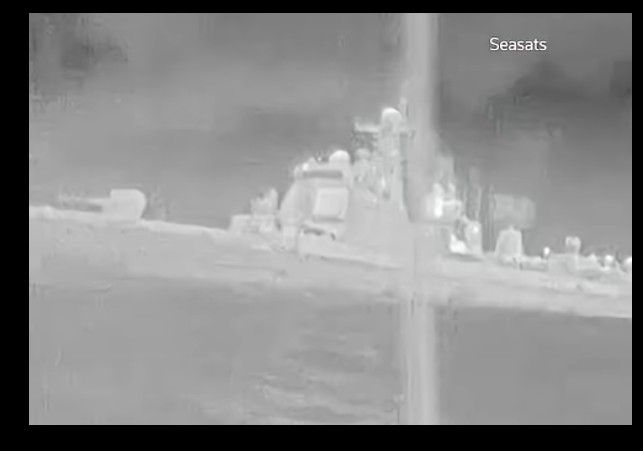
A small California-based drone maker says one of its sea vessels sailed close enough to a Chinese warship operating in the Philippines’ exclusive economic zone to capture what it believes is the first footage of its kind recorded by a private U.S. firm.
It shared the video taken on June 16 with Reuters, which has independently verified its authenticity.
Seasats, a six-year-old producer of autonomous surface vessels, said its Lightfish drone approached a People’s Liberation Army Navy ship off Luzon Island in waters where Beijing’s military presence has become a persistent source of regional tension.
The Philippine Coast Guard reported an increased presence of Chinese maritime forces, including warships, in the area last year compared to 2024.
Seasats, a San Diego startup, indicated that its drone, the Lightfish USV [Unmanned Surface Vessel], was “conducting a commercial operation to prove the feasibility of autonomous operations in the Taiwan Strait.”
The company believes the footage is the first of its kind recorded by a private U.S. firm.
The 12-foot skiff, the Lightfish, has the ability to communicate the coordinates of China’s ghost fleet, track weather, signal submarines, and spot smugglers and illegal fishing operations.
The Lightfish is the smallest vessel in the company’s lineup and can be launched from the back of a pickup truck, Reuters reported. Its designed to operate for months at a time.
“We’re able to go out and film and get up close and record all this data off of a Chinese ship,” Seasats CEO Mike Flanigan said.
It appears USVs may be a significant help in tracking and hopefully ending China’s abuses when it comes to global maritime resources. The cost and flexibility of these systems open up an array of possibilities for both military and economic defense.
- The 11-foot-long, 3-foot-wide lightweight USV is designed primarily for maritime ISR and sensing. Despite its small size and low cost (around $250,000), the solar- and backup generator-powered Lightfish can be at sea for up to six months in Sea State 6+.
- The startup has snagged a joint $24M contract with the Navy and Marines under the APFIT program to accelerate production of the Lightfish in January, which followed an $89M-ceiling SBIR Phase 3 IDIQ with the Navy to deliver the USVs to the Marine Corps last October.
- It’s also completed some pretty insane journeys, including a 7,500-mile trans-Pacific voyage from San Diego to Japan last year. The Lightfish snapped a very up-close and personal picture of a Chinese destroyer northwest of Guam on that trip.
Meanwhile, U.S. senators are calling on the Treasury Department to expand sanctions targeting China’s distant-water fishing fleet.
In a letter sent to Treasury Secretary Scott Bessent, Sen. Todd Young, R-Ind., and eight Senate colleagues urged the administration to sanction 29 Chinese support vessels, including refrigerated cargo ships, fuel tankers, and floating service bases, along with their owners. The lawmakers contend those vessels are the logistical backbone of China’s distant-water fleet, allowing fishing vessels to remain at sea for extended periods while avoiding ports where sanctions and enforcement actions are more effective.
“China’s distant water fishing fleet continues to disrupt global and regional fishing economies,” Young said in a statement. “Through overfishing and illegal incursions into foreign waters, China seeks to undermine the global fishing industry until there is nothing left. The United States must take steps to combat these activities and promote American fishing practices, which remain the gold standard for sustainable fishing.”
The letter was also signed by Sens. Ted Cruz, R-Texas; Dan Sullivan, R-Alaska; Andy Kim, D-N.J.; Tom Cotton, R-Ark.; Chris Coons, D-Del.; Roger Wicker, R-Miss.; Rick Scott, R-Fla.; and Marsha Blackburn, R-Tenn.
The scale of China’s maritime antics is not deniable: industrial-scale fishing, gray-zone coercion, and now overt naval presence are converging into what appears to be a coordinated strategy of maritime dominance.
The emergence of low-cost U.S. unmanned systems like Lightfish suggests the era of unchallenged Chinese “dark fleet” operations may be nearing its end, provided policymakers have the will to act on the data they generate.
It’s heartening to see that the continuing risk to both the global ecology and economy is not being ignored, and there may be effective ways to counter China’s fleet in whatever form it takes.
Donations tax deductible
to the full extent allowed by law.







Comments
Since the Chinese military fleet is not commanded by Ravenous Bugblatter Beasts, we must conclude that they don’t CARE if we see them. Because they’re pretty big and hard to miss.
Sink them, surreptitiously of course.
Oh so sorry. Your ship sunk.
Russian military prowess was all the rage during the Cold War. Turns out they’re rather inept. I suspect all communist militaries are inferior.. China wasn’t even demonstrably effective against India. I wonder if Taiwan would actually come out the victor if the Chinese ever took real aggressive action?
Most communist regimes do not train or equip their militaries well. They throw masses at a military problem and could not care less about the casualties.