


Supreme Court Pauses Block on Trump’s Mail-In Ballot Executive Order
The states sued too early. The states and DC’s claims are way too speculative.
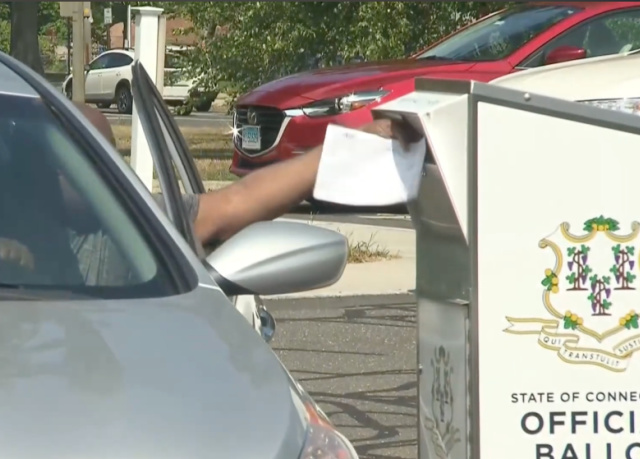
The Supreme Court has paused a lower court’s ruling that blocked parts of President Donald Trump’s executive order limiting mail-in ballots with a 6-3 vote.
This ruling does not have anything to do with the new USPS mail-ballot rules. Another injunction still blocks those rules.
The majority agreed that the administration will likely “succeed on the merits of its jurisdictional argument, that the injunction is causing it irreparable harm, and that the equities do not favor leaving the injunction in place while the Government’s appeal is pending.”
The ruling affects three key parts of the executive order:
First, §2(a) orders the Secretary of Homeland Security to “take appropriate action to” create and send “State Citizenship List[s]” to each State. Ibid. These Lists will catalog the residents of each State who are U. S. citizens and “who will be above the age of 18 at the time of an upcoming Federal election.” Ibid. States are not required to use the Lists, and the Secretary may compile and transmit them only “[t]o the extent feasible and consistent with applicable law.” Id., at 17125–17126.
Second, §2(b) requires the Attorney General to “prioritize the investigation and, as appropriate, the prosecution of State and local officials or any others” who issue federal ballots to ineligible voters. Id., at 17126.
Third, §3(b) directs the Postal Service to “initiate a proposed rulemaking” that includes several “[p]roposed provisions.” Ibid. One such provision is that outbound ballot envelopes must contain a unique barcode to facilitate tracking. Ibid. The Order does not demand that any proposed provision appear in the final rule. Id., at 17126–17127.
The District of Columbia and 23 states sued (yes, all Democratic led) in the District of Massachusetts, arguing the executive order “unconstitutionally infringes on their authority to administer elections.”
Well, SCOTUS reminded the states that the executive order does not harm them.
“This internal directive does not regulate the States’ voter registration processes,” the majority wrote. “Nor does it impinge on the States’ authority ‘to create and enforce a legal code’ for elections.”
In fact, it seems the states sued too early regarding the first part (eliminated citations):
The true “source of any injury” to the States would be the downstream action that the Secretary “might take in the future” to implement §2(a). Emphasis on might. Section 2(a) can be implemented only “[t]o the extent feasible and consistent with applicable law.” And as the Court explained in another case involving a Presidential directive with a similar qualifier: “Any prediction how the Executive Branch might eventually implement” §2(a) while balancing feasibility and lawfulness “is ‘no more than conjecture’ at this time.” The Secretary’s “eventual action will reflect both legal and practical constraints, making any prediction about future injury just that—a prediction.”
Section §2(a) also does not create election rules. The section simply tells the DHS Secretary to take action when appropriate.
Section §2(b) tells the Attorney General to prioritize investigations and prosecution of those who violate federal laws, which is consistent with the President’s Article II power. It also contains already existing statutes for the DOJ to enforce.
Section §3 only tells the USPS “to issue a notice of proposed rulemaking.” Let’s go back to the states suing too early. Might. The rule might affect the states later. Might.
But section §3 does no such thing because it is not even a proposed or final rule. It’s just a notice (eliminated citations):
The States cannot preemptively concretize their injury by expending funds before the Postal Service finalizes a rule. Spending money to hedge against a “speculative threat” does not constitute an Article III injury. Though it may sometimes be “a reasonable reaction” to “incu[r] certain costs” in advance of a final rule, those costs cannot establish standing when the final rule remains a “hypothetical future harm that is not certainly impending.” Federal courts review final rules, not proposed rules—and certainly not antecedent internal directives to propose a rule. If the Postal Service’s final rule harms the States, they may challenge that rule.
Can the administration implement the executive order before the 2026 midterms?
I doubt it. More court orders could delay implementation even more.
Donations tax deductible
to the full extent allowed by law.




Comments
Hot take: Mail-in ballots are a license to cheat. Abolish them altogether. Bring back election ‘day’. In-person. One day, plus absentee ballots with valid excuse.
I think many of us have seen a lot of anecdotal evidence during the previous decade for that conclusion (stuffed ballot drop boxes, 3 a.m. ballot dumps, blocked observers during counts, mail-ins accepted days after election ‘day’, etc.), particularly during the 2020 coup…er, uh…election.
I was an election judge in Missouri for 11 years. 2020 was my last election because I was disgusted with not only the obvious fraud around the nation, but with the concept of ‘election season’. IE: early voting, no-excuse absentee voting, mail-in voting, and the above mentioned ballots accepted after election ‘day’.
Why the heck should I arise at 4 a.m on election day to arrive at the polls by 5 a.m. in order to have them open at 6 a.m., man a post for 13 hours straight, then dismantle the poll at 7 p.m., and maybe get home by 9 p.m. during an ‘election season’ that is 15-29 days long in some states??
Mail-in ballots are a license to cheat. Abolish them altogether. Bring back election ‘day’. In-person. One day, plus absentee ballots with valid excuse. Full stop.
Will it happen? Probably not. We’re a nation of political pvssies.
Like your comment.
Why should ANY State return results until ALL states return results. I
f not one election day to vote, then one election day to return results.
sigh… forgot preview… “….return results.” If not….
The president has no power to do any of what you propose.
Congress does, but only for congressional elections. It has no power over presidential, state, or local elections. And of course getting such a proposal through Congress is itself a fraught proposition.
I’ve searched LB1901’s comment high and low, and can’t find where he specified the President is empowered to and should implement his proposals. Why don’t you respond to the substance of his comment rather than raising a complete red herring?
Since we are discussing an executive order, i.e. the President’s attempt to achieve some of his goals by his own direct action, it makes sense to focus on things we think the president ought to do, which is necessarily limited to those he can do.
Milhouse is a leftist hack who while Biden was president not once argued he had overstepped his presidential powers… which Biden did daily… he only clutches his hrmmm save democracy pearls when a Republican holds the presidency
Caseoftheblues is an outright fecking liar, a filthy piece of human refuse who is so far from integrity he doesn’t even know what it means, and he thinks ethics are Greeks and Italians.
Justice Milhouse has spoken 🤣🤣
Yes, I understand your comment explains literally how our government functions.
But long ago, in a galaxy far, far away, there was not an election season, or ballots counted after election day, and other nefarious things. Those were willed into power by devious people.
I was simply speaking in theory about the way things ought to be according to me, and that those nefarious things can be willed out of power by righteous people.
If we weren’t such political pvssies.
It appears that the USSC disagrees with you. Fancy that.
The USSC is saying that the President and his team can certainly make rules; states can’t challenge the rules until issued, and then the usual review will determine whether the rules violate states’ rights to conduct elections (no doubt a Hawaiian judge will intervene).
The post office is a federal affair — constituted by the Congress under Article I, Section 8, and administered by the executive, with most activity today under a government regulated corporation. Congress provides the executive with authority to enforce the rules and make regulations (as in for every other federal activity). So President Trump and team have every right to review those regulations and issue new ones.
The argument that the new regulations enhance ballot security, and thus the validity of elections, is a compelling argument in a federal court, particularly if the administration can demonstrate that the current rules lead to significant fraud (that certainly won’t be hard to prove). One might argue that states’ rights to conduct elections are superior to this, but so far that hasn’t worked for them. As the USSC notes, that issue isn’t yet ripe.
Finally, Article I, section 4 provides the federal government extensive power over the election of federal officials. As states have chosen to bundle their state elections at the same time and places, right down to using the same ballot sheet, it becomes clear that whatever the Congress and President determine is right and proper for those federal elections must be carried over. States could avoid this by doing their state-specific elections on a different day with a different ballot sheet (Chicago/Cook County does this, local elections are in February). But to claim that the ballot sheet is simply a state affair and can’t be regulated by Congress, when the elections are admixed on the same ballot, is a losing argument for you.
No, it doesn’t. You are not telling the truth.
It said the President can propose rules, that he can plan for rules, that he can say all kinds of sh*t, but a court can’t intervene until he actually does something.
SCOTUS was very careful to say that it was not endorsing the President’s plans, or saying that he had the authority to do any of it, but merely pointing out that he hasn’t yet done anything, so there’s nothing to challenge. That’s all.
This has little or nothing to do with the Post Office. Trump’s order proposes forcing the states to check their rolls against the lists he will provide, and he has no such authority.
No, it isn’t. If the president doesn’t have the authority to do something then his purpose and intentions are irrelevant.
No, it doesn’t. It gives Congress the right to make laws for congressional elections. If and when Congress does so, then of course the federal government can enforce them. But even Congress has no authority over presidential elections, let alone state and local ones.
That is nonsense. It does not follow at all. The president has no authority over elections whatsoever. Congress has authority to make laws for congressional elections, but not for any others, including presidential. The states can do whatever they like with those elections, including holding them on the same day as congressional elections. Congress could mandate that congressional elections must be held on separate ballots that don’t have any other races, so the states would have to issue each voter two ballots, but it hasn’t done so and is unlikely ever to do so. And it can’t mandate that other elections can’t be held on the same day.
It’s the plain and obvious truth. Look at the constitution and you won’t find any authority given to Congress over any election except congressional ones.
(Even there the initial presumption is that the states will make the rules and Congress will keep out of it; only if Congress chooses to make its own rules will they override state ones. Congress did so choose, but it didn’t have to.)
Great to read your comments…so refreshing, your Honor!
Mail in ballots and Drop boxes have never been legal, often labeled Absentee ballots in Lunatic states they most certainly are not, Absentee ballots require a valid ID, a Notary Public as a witness and 2 other witnesses.
We’ll see what subterfuge deep blue sh*tholes come up with now to get around the not-exactly conservative Supreme Court.
But of course. The Democrats will cheat harder one way or another. That’s a given.
I love it! Throw “standing” back into the cheaters’ faces.
requires the Attorney General to “prioritize the investigation and, as appropriate, the prosecution of State and local officials or any others” who issue federal ballots to ineligible voters
I love this part.
Time to make heads of lefty cities and states accountable…. and terrified.
Please note that almost 2 weeks after a “storm” Gary Indiana still does not have power…
It is quite a leap to go from your comment to this discussion. I think I know what you are implying but I would prefer to have you say it before I attempt to respond. There’s no point in my speculating about what I think you are speculating about.
Thanks.
Then I will, they are trying to use the power outage in Black Folk, IN as an excuse for votes still having not yet been counted.
If Gary wants power restored they should rein in the ne’erdowells that have shot up power company service trucks
Were the trucks white by chance?
IMO the Trump Admin is being very cautiously clever with their proposed actions not to overstep their authority and to provide to the States material assistance needed to comply. In essence the Feds are gonna give the States a list of US Citizens within the State compiled from multiple Federal databases as reference. Probably gonna send them a list of illegal aliens and other ineligible persons like dead Citizens from SSA data or moved out of State from IRS or Postal data alongside that. The States can then simply compare their voter registration list with the information provided, identity any inconsistencies, work with the impacted registrants to correct errors/omission and remove the ineligible from their list.
I’d suggest adding a grant of funds to assist States in order to moot arguments about imposing financial costs. Arguments about a ‘late start’ or too close to election as a result of the intransigent States seeking and being granted a stay of the Administration’s providing assistance to them are entirely bogus. They shouldn’t be granted a reprieve b/c of their legal maneuvering to delay the Administration finalizing a rule.
Whatever else happens the USPS shouldn’t be required to be forced into the role of an unwilling participant in furthering a conspiracy to facilitate election fraud by mailing ballots to mass numbers of unlawfully registered and/or ineligible voters for Federal offices b/c Secretary of States/election officials refuse to use the tools the Administration is handing them to meet their duty to ‘maintain accurate voter registration lists’. If the States can choose passivity in meeting their obligations the USPS and the Administration can equally choose to actively pursue their own obligations, using their own powers particularly that of the POTUS to ‘take care’ that the laws are faithfully executed.
States that are conscientious about maintaining their rolls’ integrity will doubtless do so. States that have no interest in doing so won’t, and the president can’t force them.
If a state doesn’t want to do this on principle, because it likes fraud, even Congress can’t really force it. Certainly the president can’t.
You are again raising a complete non-sequitur as you did with your first comment. The USPS is not required to accept for mailing any item that doesn’t meet postal regulations, including addressing regulations.
Milhouse,
Agreed that POTUS can’t force them to do/refrain from doing any particular action. Just as he can’t ‘force’ anyone to obey any particular statute or regulation. Many people/entities violate statutes every day. That isn’t news.
That’s the clever part. By providing the tools to perform their duty and meet their statutory obligation to ‘maintain accurate voter registration rolls’ that makes it all the more clear the leadership of the intransigent States is unwilling to perform their statutory duty. Of course that’s ultimately for juries to decide. Additionally their intransigence certainly strengthens arguments for USPS in refusing to participate in their deliberate, at best malfeasance, at worst criminal conspiracy to facilitate unlawful/ineligible voting.
In sum the States can do whatever they are ‘big enough to do’ within the scope of their authority but so can the Administration. Neither can require the other to perform a particular action absent a particular statutory requirement …but failing to adhere to statutes can ultimately result in prosecution.
The Blue States will probably use the list of illegal aliens and other ineligible persons like dead Citizens from SSA data or moved out of State from IRS or Postal data to add to their voter rolls as those names are not already on the rolls.
When/if they do choose to commit such a criminal action (if more than one its a conspiracy) they can ask the US Attorney who will inform them of their charges soon after a kinetic pre dawn raid on their homes. Golly gee whiz gotta seize all these CPU and files. Jeepers Congress might not be inclined to vote to allow the seating of Senators and Reps from States who engage in such brazen elections fraud/malfeasance from this year’s midterms. Oh well they’ll have another shot in two years and not before b/c obviously until the ongoing investigation is cleared up and the State leadership including intransigent Governors who opposed ICE, are pro illegal aliens, refused to cooperate with Feds to clean up their voter registration lists …clearly can’t allow these Governors to simply appoint replacements and seat the appointees nor trust the results of any special elections called to fill the ‘vacancies’ …which arguably ain’t ‘vacant’ b/c a winner of the ‘election’ exists but was refused seating.
” More court orders could delay implementation even more.”
That’s the essence and core point behind the Democrats’ lawfare. Watch for even more Democrat full-court presses before the midterms. The 2026 midterms are among the most important midterm election cycles in US history.
I live in a vote by mail state and always take my ballot to where they are counted. I don’t trust the USPS to get my ballot across town. I still favor in person voting and hoping the law will change to allow this again.