


Senate Committee Holds Fauci in Contempt of Congress
Sen. Rand Paul (R-KY), the chairman of the committee, brought the resolution after Fauci invoked the Fifth Amendment during his hearing.
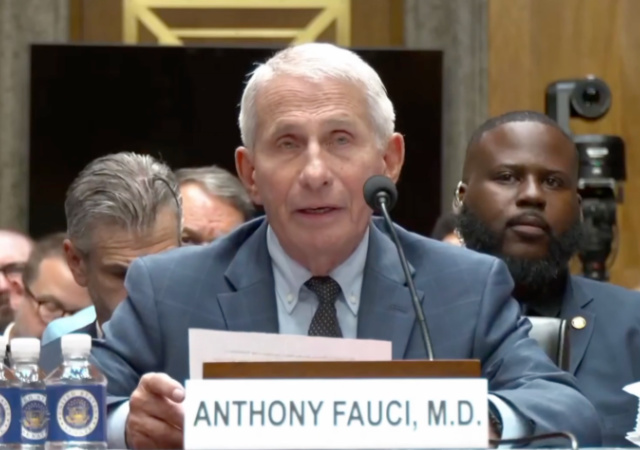
The Senate Homeland Security & Government Accountability Committee voted 8-7 to hold Dr. Anthony Fauci in contempt of Congress.
The committee will send the referral for criminal charges to the DOJ.
Sen. Rand Paul (R-KY), the chairman of the committee, brought the resolution after Fauci invoked the Fifth Amendment during his hearing.
Senate Homeland Security Committee Votes to hold Dr. Anthony Fauci in Contempt of Congress, 8-7. pic.twitter.com/I3AVzUH8CC
— CSPAN (@cspan) August 6, 2026
According to Fox News, investigators have Fauci’s cellphone:
And in the background, a copy of Fauci’s pandemic-era cellphone is now in the possession of Senate Republican investigators.
Fox News Digital confirmed that the Robert F. Kennedy Jr.-led Department of Health and Human Services (HHS) sent over a copy of the phone to the Senate Homeland Security Permanent Subcommittee on Investigations chaired by Sen. Ron Johnson, R-Wis.
It’s unclear if Paul or Johnson will access the phone.
House Oversight Committee Chairman James Comer wants to question even more, but did not offer any information.
Donations tax deductible
to the full extent allowed by law.





Comments
Amen.
But stay tuned.
Can someone explain why his pardon means he can’t invoke the 5th? Surely he’s still exposed to potential prosecution by the states, and indeed Florida’s AG has been threatening to prosecute him if he can find anything to charge him with. So why couldn’t he reasonably say that he can’t answer the committee’s questions, because a truthful answer might tend to incriminate him in Florida, or some other state that wishes to charge him?
“The claim and exercise of a Constitutional right cannot be converted into a crime.”
Miller v. U.S., 230 F.2d. 486, 489
Fauci critics are relying on two SCOTUS decisions that authorized contempt of Congress charges in this situation, Brown v. Walker (1896) and Burdick v. United States (1915). Both predate Miller (1951), meaning Miller has superseded Brown and Burdick and is the controlling case because the latter two cases can’t be reconciled with Miller’s clear and unambiguous statement. Brown and Burdick are also inconsistent with another later decision, Miranda v. Arizona (1966).
Also note that Biden’s pardon of Fauci (https://www.justice.gov/pardon/media/1385746/dl?inline) literally states the pardon is “unconditional.” There are no conditions attached to acceptance of the pardon. That would include the condition that the person receiving the pardon must surrender any of his rights in return.
2 USC 192 (https://www.law.cornell.edu/uscode/text/2/192) requires the person testifying before Congress to “answer” all questions. I believe witnesses who refuse to testify invoke the 5th Amendment in response to every question in order to fulfill the requirements of the section. Nothing in 2 USC 192 says the answers must be responsive to the questions asked (which must be related to the subject matter of the inquiry), only that a reply must be given.
I don’t understand what your point here is. I am asking a simple question. The committee seems to think that Fauci’s pardon means he is no longer protected by the 5th amendment, and thus his refusal to testify is contemptuous. But it ignores the live possibility of state prosecution. Surely if it wants to remove his 5A protection it should first grant him immunity from state prosecution for his testimony. Why does it think that without such immunity he still has to testify?
Can Congress grant immunity to state prosecution?
And does the 5th apply? Said amendment states no person “… shall be compelled in any criminal case to be a witness against himself …” but it says nothing about being compelled to testify before Congress which is not a criminal proceeding.
If 5th Amendment refusal to respond is deemed lawful then all Republicans appearing before Democrat panels can simply answer every question with the 5th and refuse to respond.
Ultimately it comes down to does the 5th – ‘I refuse to answer …,’ constitute a refusal to answer?
Yes, Congress can grant immunity from state prosecution for testimony given to it, or to any entity it nominates. That’s the only way it can compel testimony, so it has that power. E Howard Hunt cited the relevant case: Murphy v Waterfront.
And yes, the 5th applies, because compelling someone to testify to Congress, where that testimony can then be used to convict him of a crime, is the same as compelling him to testify at his criminal trial.
Republicans appearing before Democrat panels certainly can simply answer every question with the 5th and refuse to respond, and they often do. But that is why Congressional committees have the power to grant immunity, so as to compel people to testify. If the committee wanted to force Fauci to tell the truth, it should have offered him immunity, and I don’t understand why it didn’t.
“Why does it think that without such immunity he still has to testify?”
Good old fashioned bullying and never mind all this law stuff.
I think you are right about 5A covering Fauci. Congress can’t provide immunity from state prosecutions, so Fauci will walk. Like all Constitutional protections, 5A sometimes exacts a fearful price.
The difficulty with your citing MILLER is that this opinion was written by the Fifth Circuit not SCOTUS, so it does not overrule /supersede either BROWN or BURDICK. It might have persuaded SCOTUS to overrule itself, but MILLER was never appealed to SCOTUS
That’s his problem, not theirs
No, it’s their problem, because it allows him to take the fifth. And thus it makes this contempt citation invalid. Unless you can explain the senate’s reasoning.
There are serious law professors who address this. Look it up. There has to be a serious and viable state threat, not a theoretical and implausible one. A Florida politician grandstanding is not sufficient.
What grandstanding? What makes state charges more “theoretical and implausible” than federal charges? How do you know, and how can the senate committee know, that the true answers to their questions won’t incriminate him in Florida or some other red state, or even in a district in a blue state with a Republican DA?
Why don’t you cite these serious law professors so we can judge their arguments?
Murphy vs Waterfront makes it clear that information gleaned as a result of federal immunity cannot be used against a defendant in a state case. The state can still prosecute , but it must gather its evidence independently.
Murphy vs Waterfront is precisely what I was referring to, so I’m surprised you cite it since it makes the opposite point from the one you’re trying to make.
Yes, the senate committee can immunize him from state prosecution for what he tells it. But it didn’t do that. It didn’t even offer. And without such immunity he can’t be compelled to testify.
Tell me why I’m wrong. What am I not seeing?
“Yes, the senate committee can immunize him from state prosecution for what he tells it.”
What constitutional text, or court case allows this? it would seem to trample on federalism.
Actually I just looked up Murphy v Waterfront and found that I had slightly misremembered it. It doesn’t deal directly with this case, but with the opposite case — it bars federal prosecution based on testimony compelled by a state.
But it cites Adams v Maryland for the proposition we’re discussing now, and says:
Because apparently some Judge in 1896 ruled in a case that if your are given a Presidential Pardon for crimes committed you lose your 5th Amendment rights because you can’t incriminate yourself for crimes you been forgiven for. Or some such reasoning.
Here’s the case:
Brown v. Walker, 161 U.S. 591 (1896)
Nope. That was a specific statute that gave witnesses to the ICC full immunity from federal and state prosecution. That’s why they could be compelled to testify. Fauci has no protection from state prosecution. Anything he tells the committee that exposes a crime against any state will expose him to prosecution in that state. So Brown v Walker says he doesn’t have to testify.
Could this referral be used to challenge the “auto-pen” pardon? Article II vests the pardon power solely in “the President”, not in a staffer with the auto-pen. It doesn’t matter if it’s successful, as the process is the punishment, or so I’ve heard.
If the committee wanted to preclude his use of the 5th, it should have given him immunity from state charges for anything he might admit to. It can do that, but it didn’t.
Why on earth would they want to give Foochi immunity from state charges? He deserves to be prosecuted for his alleged crimes.
Giving a witness immunity is the standard method of making him testify. Without immunity he can’t be compelled to testify against himself.
Do you have a cite for the claim that Congress can grant someone immunity from state charges? https://www.law.cornell.edu/wex/immunity_from_prosecution
E Howard Hunt cited it above. Murphy v Waterfront.
See above, it’s actually Adams v Maryland, as cited in Murphy v Waterfront.
The problem here being that it’s highly likely Congress can’t grant someone immunity from State prosecution, and that anything he says before Congress can be used by a State AG.
Also, immunity would be unlikely to include perjury, otherwise the witness can lie his ass off and would be untouchable. Fauci, under any conditions, would likely still be exposed to perjury, which is a charge that can be sustained even when the witness believes a statement to be true. There’s just no upside to giving testimony when you’re already in the best possible position (having a pardon against federal prosecution).
If that were the case then grants of immunity would be completely useless to defeat the fifth amendment. No matter what Congress did, a witness could always plead the fifth to protect himself from state prosecution. Therefore Congress must have the power to immunize a witness from state prosecution as well as federal, and so SCOTUS found in Murphy v Waterfront.
Of course it wouldn’t include perjury. (Well, it would include past perjury, just like any other past crime, but it wouldn’t include perjury in the current hearing).
Why would he need immunity from perjury charges?! The whole point of giving him immunity is to force him to tell the truth. Once he has immunity from all state charges based on his testimony, all he has to do to protect himself is tell the truth! With immunity, why should he not?
No, it can’t. Perjury is the crime of willfully and knowingly making a false statement about a material fact while under oath. If the witness believes his statement to be true it is not perjury. Even if he lies on purpose, if the subject of the lie is immaterial to the case, it’s not perjury.
If the committee gave him immunity from state prosecution as well, then he would have no protection and would have to testify.
What I don’t understand is why they think he had to testify even without such immunity.
WTF, they have no such power.
What do you mean? You just cited the case that says they do! Murphy v Waterfront.
As per above, it’s actually Adams v Maryland, as cited in Murphy.
8-7, party line vote? Fauci was an operative of the Democrat party from the outset. He is now one of the faces of that party. They are our enemies.
He has the absolute right to invoke the 5th. On everything, even if no state prosecution threats existed, and including the red folder type questions, inasmuch as the hearing itself was about him. People are confusing negotiated plea deals with grants of immunity.
(And inasmuch as Congress is not a law enforcement body, I for one am getting sick of all the useless hearings, which are held to create campaign video clips.)
The hearing was not “useless.” I learned many new facts about what Fauci had been up to that had not been previously exposed. The public deserves to know what extent he was responsible for intruding on people’s lives for years. And the public got a chance to see what a rat bastard he is by refusing to answer any and all questions. Without the hearing, the DOJ would not be getting involved. Let hope the DOJ does what it should.
DOJ can’t do anything because of the pardon. But the states can.
They most certainly can prosecute contempt of congress
But there was no contempt, because the lack of immunity from state prosecution entitles him to refuse to testify. The senate saying it’s contempt doesn’t make it so. The senate can’t override the constitution.
No information held by the Congressers couldn’t have been released in other ways. And extremely little of it wasn’t already known or reasonably surmised.
Congress is not a law enforcement body, but it is an oversight body. It has a clear mandate to inquire into what the executive branch has been doing.
Fauci is out of office and any needed oversight could be got by asking current officials what they have discovered about his and his minions’ doings, which is where the Congressers’ information came from in the first place.
While it’s true that Fauci is no longer in office and that current officials can provide some information, it’s not accurate to imply that current officials alone can provide testimony or evidence for the person who actually made those decisions.
What about what they haven’t discovered? The committee is entitled to question Fauci, under penalty of perjury, about all his doings, whether his successors know about them or not. But only if they immunize him from state prosecution.
No. If there were no threat of state prosecution then he would have no right to withhold his testimony. The fifth amendment protects a person from being compelled to expose himself to criminal charges; as soon as those are off the table he has no excuse not to testify truthfully, and failure to do so is a crime. It doesn’t matter what the hearing is about.
And no, people are not confusing anything.
Criminal charges were not all off the table inasmuch as lying to Congress would be grounds for criminal charges and telling the truth still would expose him to potential civil damages. (An arguably gotcha purpose of the hearings.)
It was not a gotcha, but was a legitimate congressional oversight into pandemic decision-making.
So let him not lie. The constitution doesn’t protect a person from the consequences of his deliberate decision to lie under oath! It only protects him from having to tell the truth when that truth will expose him to criminal charges. Congress was not compelling him to lie, and therefore the fifth doesn’t protect him from that.
True, but irrelevant. There is no right to refuse to testify on the grounds that it will expose one to civil lawsuits.
Police tell suspects “You have a right to remain silent.” I don’t believe any form of compelled testimony is constitutional. The citizen/suspect has a right to surrender any of his rights, and therefore has a right to bargain away his right to remain silent. But the state is constrained by the Fifth Amendment’s “due (judicial) process of law” requirement. Imposing immunity on a witness in order to strip him of a constitutionally-guaranteed right (in this case, the right to remain silent, which is found partly in the 5th Amendment and, as I would argue, in the First Amendment as well) does not provide the “process” guaranteed in the Fifth Amendmeht.
You can believe whatever you like, but you’re very clearly wrong. On the contrary, one of the fundamental rights we have, and that the 9th amendment protects, is the right to compel testimony! Which is the exact opposite of your claim.
On the contrary, the 9th protects the right to compel testimony, not a right to refuse it!
The ninth amendment is not some magic toy that you can invoke to support any right you imagine. Any time you claim the 9th protects some right or other the onus is on you to prove it.
That’s why Robert Bork infamously said the 9th’s meaning cannot be divined and is thus useless, as if it had been covered by an inkblot.
He was wrong; there are many rights that we know are protected by the 9th, because they were universally accepted in the late 18th century. To prove something is protected by the 9th one need only prove that in the late 18th century that right was not controversial. That it was thought too obvious to bother including in the Bill of Rights.
And we know, from everything written around that period, that one of those rights was the right to compel testimony.
The Fifth Amendment specifies “criminal case” to prevent abuses by the state. This specificity does not imply that a general right to remain silent does not exist, or that any form of compelled testimony is constitutionally sound. The amendment doesn’t say you have a right to not be tortured for testimony that would be used against someone else, but clearly we have that right. The amendment means the state can’t compel testimony in a way that is most likely to serve critical interests of the state. This shouldn’t be interpreted to mean that testimony can be compelled by the state for uses that serve the state in less critical ways. It’s an example meant to say “the state can’t do this, no way, no how, no matter what, not even to convict a person for the most heinous crimes.” If testimony can’t even be compelled in this situation, why would anyone think compelled testimony is OK to reach lesser ends?
Also, the legal argument (that the right to remain silent at all times, under all conditions doesn’t exist because it’s not found in the 5th Amendment) is disabused by the Ninth Amendment, which states that the enumeration of any specific rights cannot be used as a basis for a legal argument that other, additional rights do not exist. I’m sure you agree we can’t be tortured to give testimony against another party. That right isn’t found in the Fifth Amendment. But its absence doesn’t prevent you from agreeing with the statement. Where do you find that right? I find it in the Ninth Amendment.
How does Fauci taking the 5th 111 times differ from Steve Bannon and Peter Navarro invoking executive privilege to avoid testifying? Seems to me it amounts to essentially the same thing.
Fauci invoked a constitutionally-guaranteed right. The others invoked a procedural privilege (executive privilege). Rights belong to everyone, “privilege” is called that for a reason – in order to claim one, you must be in a position of privilege, i.e. a position in which the claim can be made and considered valid. Congress and the courts rejected the claims of Navarro and Bannon. But they both refused to appear and refused to produce documents so their behavior with respect to Congress was different from Fauci’s. You can’t refuse a subpoena, but you can appear and assert your rights (as did Fauci) to remain silent, to refuse to bear witness against yourself, and to be secure in your person, papers, and effects.
That’s my opinion. If you don’t like it, I have others.
A privilege and a right are two completely different things.
And executive privilege belongs (in general) to the president of the day, not to past presidents. Biden waived the privilege.
All these arguments are basically irrelevant no matter what the correct interpretation may be.
Even if granted immunity Fauci would still lie and obfuscate and tap dance around the truth like the professional pathological liar he is. He may never see the inside of a jail cell, but he will definitely spend his remaining years hold up in lawyers conference rooms or courthouses, and spending millions on his defense.. Process is a definite form of punishment. It’ll have to do for now.
If he were granted immunity he would have no choice but to testify. And if he was caught lying he could be prosecuted for perjury.
Trump should issued himself a pardon for any and all crimes committed back to the day that he was born, and then watch as the left suddenly demands an end to preemptive pardons.
Heck, we might even be able to get a constitutional amendment passed at that point, as most of the left and right would support a ban on preemptive pardons.