


Supreme Court to Hear Case of Orthodox Jew Ordered to Get Permit to Host Prayers at Home
“If ‘free exercise’ means anything, the government cannot require you to seek a permit to pray in your home with friends.”
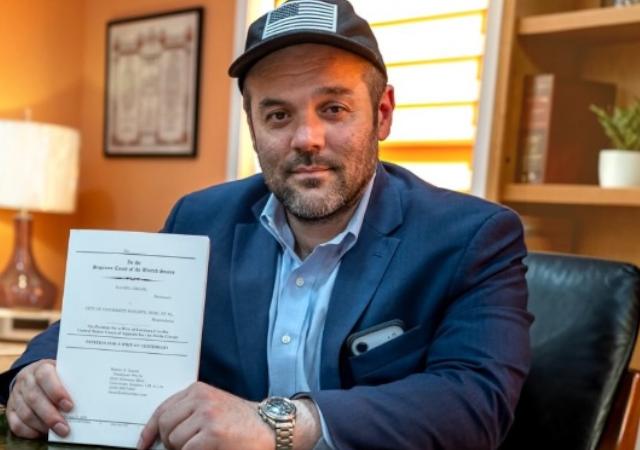
Amid all the drama surrounding birthright citizenship and transgender sports yesterday, the Supreme Court announced it will decide another question in a case with potential nationwide consequence: Whether an Orthodox Jew can proceed with his lawsuit against an Ohio city that forced him to obtain a permit to host a prayer group in his home.
The petitioner, Daniel Grand, is an observant Jew who lives with his family in University Heights, Ohio. According to his Orthodox Jewish faith, Grand is required to pray three times a day with a “minyan,” a quorum of ten adult males. Jewish law also forbids him from driving on the Sabbath.
Grand’s original lawsuit filed in the Ohio federal district was dismissed because Grand had failed to obtain a final decision on his permit application, a decision later affirmed by the Sixth Circuit Court of Appeals.
According to the court filings, that application seemed doomed from the start. In January 2021, Grand emailed a dozen friends, inviting them to pray at his house on the upcoming Sabbath. Shortly after, one of the neighbors informed the mayor, asking him to “put a stop to this.” Within a day, the city demanded he “cease-and-desist” from using his home as a place of religious assembly without first obtaining a permit.
Grand complied, canceling his planned minyan and applying for a permit.
The public hearing that followed was openly hostile, his lawyers say. Some neighbors sent letters opposing the permit, stating, “I am not Jewish and I do not want our neighborhood labeled as Jewish.”
Rather than continue a process that his lawyers say “seemed rigged against him” at a second hearing required by the city, Grand withdrew his permit application.
But backing down didn’t end the city’s hostilities toward Grand—if anything, they escalated. At a later public hearing, the mayor announced the cease-and-desist order remained in full force. He then urged Grand’s neighbors to surveil his home and “report” any “activities consistent with those in a house of assembly.” Police patrols drove past his house, the lawsuit contends, and the city prosecutor launched what his lawyers call baseless housing code investigations against him.
In 2022, Grand sued the City and several of its officials in federal court for violations of his First Amendment rights and the Religious Land Use and Institutionalized Persons Act (RLUIPA), among other federal and state laws.
Grand’s lawsuit was rejected in the lower federal courts on jurisdictional grounds—not on the merits of whether the city violated his rights. As his lawyers explain, the courts did not address the constitutionality of the city’s actions, concluding that his case was not “ripe” for review by a court.
In their Supreme Court filing, Grand’s lawyers reject the city’s argument that he has no recourse because he withdrew his application from the permit process, making the case “unripe” for judicial review.
That position reflects a disagreement among the circuit courts on whether a rule developed for property rights cases—requiring a final government decision before suing—should apply to religious freedom claims. Grand’s lawyers urge the Court to draw a sharp distinction: “An individual’s right to free exercise—unlike his right to be compensated in the event of a regulatory taking—does not depend on when zoning authorities issue a final decision.”
The practical stakes, they warn, extend far beyond Grand’s case:
This case is a playbook for government-sponsored religious discrimination. In three circuits, any municipality is free to interfere with a homeowner hosting a small bible study or prayer group. All it has to do is issue a cease-and-desist order directing the homeowner to seek a permit. No court can intervene until the resident has pursued the permit to finality—no matter how immediate, concrete, and heavy the free-exercise burden.
Grand, who filed the original petition with the Supreme Court himself, is now represented by the Alliance Defending Freedom and attorneys from Orrick, Herrington & Sutcliffe. “If ‘free exercise’ means anything,” they argue, “the government cannot require you to seek a permit to pray in your home with friends.” A ruling for Grand would not decide whether University Heights violated his rights—but it would let him finally make that case in court.
Featured image via X.
Donations tax deductible
to the full extent allowed by law.






Comments
The way people are freaking out you’d think he was blasting jet engine decibel calls to prayer five times a day.
Bet the complainers all vote democrat.
Can anybody steelman the opposing case here for me? Because I’m struggling to understand how this isn’t a clear violation of this man’s basic liberties. Too many cars parked out front? Was there a noise disturbance?
There couldn’t have been a noise disturbance, since it never happened. And cars parked out front would be unlikely, since the minyan was only planned to be held on a Sabbath, when people would not be driving. He wasn’t proposing to have weekday sessions as well, when parking might be a concern. But even if he were, it can’t be treated differently from someone who wants to have a party. Anyone is entitled to invite a dozen friends over for a party, and no one can stop it unless there is an actual noise problem. They can’t get the city to preemptively shut the party down!
A party isn’t every week.
The usual neighborly work-around for parties is invite the neighbors over as well.
How could a religiously observant Jew invite goyim to a Jewish religious ceremony?
Beþer to serve ham at the pest-service potluck!
“How could a religiously observant Jew invite goyim to a Jewish religious ceremony?”
By inviting them. As a baptized Methodist, I’ve been to many a mass, more then most Methodists, likely due to being married to a Roman Catholic, I’ve been to shul a few times with Jewish friends, back 50 years ago or so. Was around a lot of Jewish people in high school, not so many around where I’m at now. Been to many other non-Methodist Protestant services. Been invited to and declined LDS invites. Along with Hare Krishna invites. Sharing religion isn’t all that unusual.
Why not? Of course they could. But how would it help? Why would the neighbors be interested in attending?
Now if you invite them to a Shabbos meal, that might create some goodwill if they’re nice people, but these neighbors clearly are not.
1. This wasn’t going to be every week either. He invited his friends to come make a minyan that week.
2. Many people do have parties every week. There’s nothing the neighbors can legally do to stop it, unless a pattern emerges of regular and verified noise violations.
Kettle logic. Frequency matters or it doesn’t. Pick one.
Or frequency doesn’t matter either way.
It’s not “kettle logic”, which is a stupid term. It’s argument in the alternative, which is a solid method that has been accepted for literally thousands of years.
You’re the one who says frequency matters. Well, first of all this wasn’t proposed to be a weekly event, but supposing it had been, or it had turned into one, that’s not grounds for objection. Parties make noise, so suppose instead that he decided to have a weekly poker night with his friends. Could anyone conceivably object to that?! And that would involve parking, and yet no one would accept that it was any of the neighbors’ business. So how is this different?
The issue is simple. Make this person Muslim and see how the officials react. Not saying a call to prayer outside… just a religious gathering. I would guess it would be treated “differently”.
No, making him Moslem would make it worse. I don’t know where people get this idea that Moslems get a free ride in America. They don’t. People who are hostile to Judaism, unless they’re Jewish themselves, or unless their hostility is based on leftist politics, which is rare, are even more hostile to Islam. And they’re usually hostile to Christianity as well, or at least to more unusual forms of it.
Why couldn’t it easily be?
Many folks regularly have a party on the weekend.
Used to work for a business franchise owner (Pizza stores) who held parties EVERY DAY – after store close. All manager level employees had a running invite to show up after close (between 11pm and 2am depending on the store) – and it was the rare manager who didn’t usually go (brown-nosing the boss would pay off, not brown-nosing the boss the opposite). Never went myself, but I understood they could get pretty wild. And by pretty wild I mean when the husband next door was murdered the store owner was a suspect since he was screwing the wife next door at those parties.
A party can be every day in your house.
It’s up to YOU –not the government, not your neighbors. YOU
And ANYTHING that officially infringes on that is wrong.
Unless you’re charging for it and it’s actually a business out of your home. There have been cases…
And the infringement here if allowed to continue, can easily cross over to Christians trying to have a quiet weekly Bible study in their own homes, or a small worship service, and those tend to not be very loud, or at least not loud enough to require noise complaints, but of course an atheist might not like the fact that one is happening in the neighborhood near him or her, and if this kind of law is allowed to continue, then it could well be used against those Christians trying to peacefully practice the same as they have for decades.
Traffic and disturbance in a residential neighborhood. Religion doesn’t trump that.
What traffic or disturbance? Neither was in evidence.
And yes, religion does trump that, courtesy of RLUIPA.
What’s to prevent me from having my own religion for anything. RLUIPA isn’t an absolute. Religion is in the legal habit of claiming legal rights because of the civil rights law having taken away freedom of association, but that’s a mistake in the civil rights law, not a priority of religion.
You seem to already have your own religion. None of us know what it is.
Your wasting your time Hardin. We already know what a Jew-hating misfuck you are.
RLIUPA is not a moral argument, that you can debate. It’s literally the law of the land. You can argue that it’s a bad law; but it remains the law.
Nothing prevents you from forming your own religion. L. Ron Hubbard founded Scientology and was very successful.
I say, “Go for it.”
The purpose for having a gathering a private home shouldn’t concern anyone unless it is explicitly illegal.
Yep. Plain and simple.
Nothing prevents you from forming your own religion. L. Ron Hubbard founded Scientology and was very successful.
I say, “Go for it.”
Zero traffic and disturbance in evidence.
No permit is required to have 10 people over to your home in most neighborhoods. Most neighborhoods have laws on open containers and noise and disorderly conduct. Not the case here.
If they drove instead of walked, most neighborhoods where I am have rules only insofar as you park on the street.
Speaking of evidence, the article did report evidence of religious bigotry. Which is not a basis for restricting anything.
Man’s home is his castle. And freedom of religion is a first amendment right.
Traffic from people who aren’t going to drive there.
And noise? How loud do you think they’re going to pray?
‘Traffic and disturbance”?
It’s Orthodox Jews FGS – they WALK to Minyan and pray at normal voice levels at worst.
No church bells, no loudspeaker Call to Prayer.
OTOT the opponents explicitly stated one reseat was they didn’t want to have Jews in the neighborhood.
If you look at the Sixth Circuit Court of Appeals decision linked in the third paragraph of the post above, it states on p.2 that the gentleman:
“emailed around twelve of his neighbors, inviting them to three prayer
sessions “for the inauguration of the Shomayah Tefilah Beis Hakeneset” at “[t]he Daniel J. Grand Residence.” R.88-2. The invitation referred to the event as a “shul,” which in Hebrew refers to a synagogue or a house where prayer groups are held. R.88. Grand introduced the Rabbi, Rabbi Rosskam, for the event and asked guests to “spread the word” and “consider bring[ing] someone with you.””
That sounds like quite a bit more than just a simple prayer gathering. It sounds like he was trying to start a shul in his home, and that he was actively trying to grow said shul. .
Okay, suppose that is so. It’s still a simple prayer gathering. If he’s hosting it in his living room then it obviously has severe limits on its size. How’s that different from starting, e.g., a small chess club with weekly meetings of a dozen or so players in a private home? Still not the neighbors’ business, but in the case of religion it’s explicitly protected by RLUIPA.
One does not need to “suppose”, it’s right there in the pdf.
He invited twelve men, asked them to “spread the word” and suggested each one bring a friend, so he was ok with at least 24. As for size limitations, anyone who has ever been to an Orthodox shul or shtiebl knows that you can pack a heck of a lot of people in a very small space.
If the goal was simply to be able to pray at home and be able to say the parts of the Tefilah that require a minyan, he only needed eight men, which with himself and the Rabbi would give him a minyan of ten. He reached out to twelve, so that would give him four spares.
I am not saying the venture is not legal and protected, but it is more than a little facetious to claim it was just a “simple prayer gathering” when the gentleman’s e-mail was forthright about inaugurating a shul in his home.
“I am not Jewish and I do not want our neighborhood labeled as Jewish.”
This is basically the real reason there’s opposition to such things. Or, perhaps more commonly, it’s “I am Jewish and don’t want to be associated with those kind of Jews, I don’t want them moving into my neighborhood, I don’t want to be confronted by their example of how a Jew is supposed to live.”
Suppose a black or Muslim moved in. Would the neighbor write to the mayor objecting to that because he/she doesn’t want the neighborhood known as black or Muslim?
Well, not in those terms.
These local tyrants are everywhere .
In my town, officials told a church to shutdown a soup kitchen because “it wasn’t something a church would do”.
Soup kitchen brings in soup kitchen customers.
And you have to put up with that. It’s the law. If they cause a problem you can address the problem, but you can’t shut down an inherently religious activity.
The “issue isn’t ripe” argument should fail instantly. The question before the court would not actually be moot if the permit were approved. The question is whether the city can require a permit for practicing one’s religion in one’s home.
Granting the permit and declaring the case moot would leave that fundamental question unanswered.
Noise, traffic, safety of the premises, are all issues to be addressed seperately
I wouldn’t even grant the state authority over noise, traffic, or safety. If government has shown a single propensity, it’s the propensity to abuse its authority. In this particular situation, the city would just use those issues to harass Grand, as a way to discourage him from conducting his religious services (as his understanding of his religious beliefs requires of him). The state cannot use even legitimate, lawful means to reach unconstitutional ends. If the means results in an abridgment of rights, the abridgement is unconstitutional, statutory authority to use the means notwithstanding.
And yet if there really is a noise, traffic, or safety problem, then the city has to address it, and therefore must have the authority to do so. So we can’t just take that authority away holus bolus. The city must be able to address those problems, but only if and when they occur or can reasonably be anticipated, and only in a reasonable way that’s commensurate with how it treats those same problems when religion is not involved.
“If government has shown a single propensity, it’s the propensity to abuse its authority.”
James O’Keefe:
Here is what Rick exposed: the university president, in a faculty meeting, explaining how the school would keep roughly $7 million in taxpayer grant money by changing the words in their documents — so it looked like they were complying with the state’s rules when they were not. “Change some words so they’re not being scraped… allows us to do our work.”
Not change the conduct. Just change the words, so the public couldn’t tell.
When our report went out, the president emailed the entire campus and attacked the whistleblower. Days later, Rick was terminated.
But this week, the people he exposed showed their hand…
Rick was just served with a court-ordered protection injunction — filed by another Florida Tech professor. A judge signed off. And just like that, Rick was ordered to surrender his firearms and appear in court. The catch? A protection order is supposed to require a threat. Rick never threatened anyone. He says he has never even spoken to the man.
This is not about safety. It is retaliation — weaponizing the courts to punish a man for telling the truth, and to warn everyone watching: speak up, and we will come for your job, your money, your name, even your rights.
Let the local DA (or the FL AG, if the DA is unwilling) file perjury charges against the professor who obtained the protection order.
Once the complaint was withdrawn there was no controversy and thus no case. Courts in America must rule on actual controversies and cases. You can’t walk into court with a “what if” case and expect a ruling.
You can expect to be summarily dismissed, as you should be.
What complaint was withdrawn? Are you talking about the cease and desist letter? When was it withdrawn?
And even if it was withdrawn, perhaps by the new city administration, there’s still the matter of damages for the time that it was in effect.
At least four supreme court justices thought there is a valid case or controversy that it can hear.
The “issue isn’t ripe” argument, in addition, has a bad history. When the 60’s Civil Rights struggle was at its height, both John and Bobby Kennedy used that argument to justify their reluctance to force the issue.
The supposed premise was that gradual improvement in Negro (“Black”, etc. were not the preferred term ATT) Civil Rights was in process and inevitable so MLK et Alia should just be patient and wait so as to keep Civil Order.
Should be a 9-0 decision, in favor of the Petitioner (Mr. Grand); let’s see what happens.
At any rate, whatever the final SCOTUS tally is, I don’t see how the petitioner can lose this appeal, given how brazen the violation of First Amendment religious rights is, in this case — the ripeness argument seems to be an evasion tactic used by feckless courts to avoid ruling on the merits.
Indeed, as his reply brief states, if Grand had obtained the required permit to convert his home into a building permitted for religious practice, he would have had to move out of his home, as it wouldn’t be able to be used as a residence — that’s why Grand withdrew his application, and that’s how absurdly Kafkaesque the fact pattern is, in this case.
The people in this town are really something, especially the sorry excuse for a mayor (who is no longer the mayor by the way), You would think it was the 1920s, I can’t see them losing before the supreme court in this issue but who knows these days.
What I would like to do is invite a bunch of Somalis to move to this town. This would give the bigoted residents something real to fret about,
Reading the Petitioner’s reply brief, the undercurrent of anti-Jew animus and prejudice expressed by the University Heights Mayor, city officials and neighbors is unmistakable and is dismaying to contemplate, in 21st-century America.
The point of the spear is Judaism but next will be Christianity. I can almost hear the officials saying “The Saturday people, then the Sunday people”. As for “The Friday People”…they don’t dare.
And, that prejudicial progression makes sense, given that Christianity directly emerged from Judaism, and that theological and historical provenance is a plain reality, despite certain bigoted Christians’ stupid and irrational attempts to divorce/disassociate Christianity from Judaism.
Well, that has already started. Remember the cake baker in CO and the photographer. BTW, I thought we had freedom of association – where did that go?
Freedom of association went out with civil rights law, in a huge mistake. It should apply in monopoly (de jure or de facto) markets. Now you have to argue for freedom of association in the guise of religion, a consequence of bad law.
AFAIK it’s not as common nowadays, but when I was a Catholic kid my elder sis often went to twice weekly home gatherings to pray at community Rosary meetings. Sometimes she’d bring along me or another sibling.
This is not just a one-faith issue, at-home religious meetings like ptayer meets and bible study are entirely normal – and protected.
Cleveland area.
The sordid history of COVID emboldened the tyrants.
The Mayor during this debacle, Michael Dylan Brennan, is a straight up antisemitic asshole.
https://carrollnews.org/237987/community/mayor-brennan-addresses-election-controversy/
I hope the Supremes issue a death sentence for him. I’ve seen pond scum I’d rather associate with.
He’s now representing Ohio at the 250th fair.
“I am not Jewish and I do not want our neighborhood labeled as Jewish.”
-sigh- Here comes the neighborhood!
There are major Orthodox synagogues over there already. Some people like to pray in small intimate settings. Such services bring no crowds and create no noise.
There are major Orthodox synagogues close by already. Some people like to pray in small intimate settings. Such services bring no crowds and create no noise.
Indeed, godaven.com shows about 10 shuls within 0.75 miles of Grand’s address, in a wide variety of styles.
In that case what do you suppose the neighbor meant by not wanting the neighborhood to be “labeled as Jewish”? Going by that map it already looks pretty Jewish; how would the addition of one more house minyan enhance that reputation?
There are major Orthodox synagogues close by already. Some people like to pray in small intimate settings. Such services bring no crowds and create no noise.
Local planning and zoning regulations can have designated use approval for religious use. Parking requirement, ADA access, fire code, etc. Converting from residential to religious ues can trigger all kinds of code compliance issues. Its common problem. How many “friends” can home owner host , and how often, before it become new and different non-residential use?
The current mayor of University Heights is Michelle Weiss, the first orthodox Jewish woman to be a mayor in the US. She took office in January. She is a Republican.
Her city council is not.
The previous mayor, the one who caused all this, was a Democrat. After losing to Weiss, he tried to ban her from being in city buildings. He tried to forbid city employees from talking to her.
It sounds very much like the voters of University Heights have picked a side in this.
Once the complaint was withdrawn there was no controversy and thus no case. Courts in America must rule on actual controversies and cases. You can’t walk into court with a “what if” case and expect a ruling.
You can expect to be summarily dismissed, as you should be.
Had the city and the neighbors then kept their mouths shut and the Mayor hadn’t blatantly said that the original ruling was still in order, you might be right. But they continued the issue.
And I might add, especially telling a public hearing that they did not want their neighborhood to be considered a ‘Jewish’ neighborhood. Blatant antisemitism. The mayor and certain other public officials have opened the door to this lawsuit
This is a 9-0 case. Plenty of folks have religious gatherings at home, some on a weekly basis. My wife is an Opus Dei (a conservative Catholic sect) and they do it all the time. Nobody ever dreamed it required a permit from the city.
Presumably when your wife e-mailed her friends to organize her Opus Dei get-together, she did not claim to be starting a church in her home. However, in this case, (as per p. 2 of the Sixth Circuit Court of Appeal decision linked in paragraph 3 above) the gentleman had actually:
“emailed around twelve of his neighbors, inviting them to three prayer sessions “for the inauguration of the Shomayah Tefilah Beis Hakeneset” at “[t]he Daniel J. Grand Residence.” R.88-2. The invitation referred to the event as a “shul,” “
What’s the difference? A prayer meeting is a prayer meeting, whether you call it a “church” or not.
I think the Roman Catholic Church may have some rules about what can be labelled a “church”. You probably have to get permission from the local bishop or something. Whereas calling it a “meeting” doesn’t need anyone’s permission. No one’s permission is required to call something a “shul”; it doesn’t even have to meet regularly. I’m aware of some “shuls” that only operate once or twice a year, in some vacation spot, usually in someone’s hotel room or in a public area of the hotel.
The Beit Kneset that the gentleman was inaugurating in his home was going to operate at least weekly, and at least three times each Shabbat. (The invitation was for three prayer services; this is also in the pdf). Since the same restrictions that prevent the gentleman from driving on Shabbat also apply on a chag (holiday), he could make the same argument for needing these meetings three times a day on holidays (and five times on Yom Kippur) and it would all be perfectly legal since each service is just a “prayer gathering”.
However, it would not be very neighborly, and I can see why some neighbors would object. In the same way that one might object if his Catholic neighbor decided to henceforth host twenty four worshippers at her house seven times a day, for Matins, Lauds, Prime, Terce, Sext, None, Vespers and Compline,
Lastly, a shul in a public area of an hotel that caters to an Orthodox clientele is one thing, but a shul in a public area of a regular hotel is chutzpadik/rude, and other guests would be perfectly justified in complaining about such a takeover of the common space, which is there for everyone’s enjoyment.
Was he required to obtain a permit to host a Passover Seder as well? Nuts.
I would certainly be suing the dude who made the comment in a public hearing saying they didn’t want people to think that it was a Jewish neighborhood.
Sue him for what? He didn’t break any laws. This is America, where he’s allowed to be an antisemite. It’s the mayor who broke the law by acting on his antisemitic complaint.