


Starship Flight 13 Success Sets Stage for First Orbital Attempt by SpaceX
Mission achieved goals of deploying Starlink V3 satellites and relighting a single engine in space.
Last week, the 13th test launch of the SpaceX Starship was aborted seconds before takeoff.
CEO Elon Musk indicated that his team planned to launch as soon as practically possible.
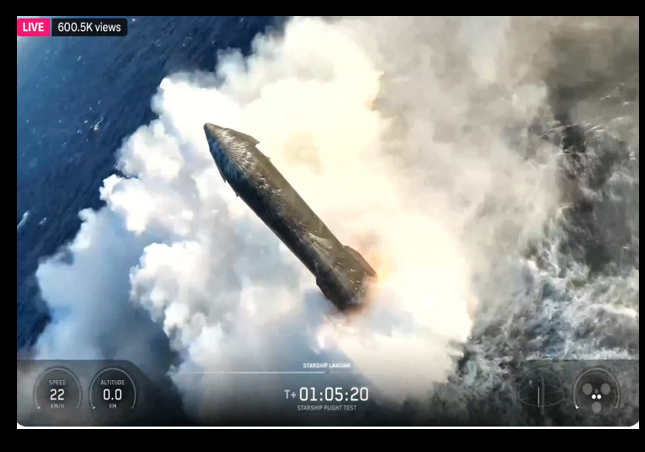
This Friday, test number 13 proved to be lucky, successfully launching and then splashing down “softly” into the Indian Ocean while the SpaceX team cheered, “USA”.
The July 24 test launch, Space’s Starship Flight 13 mission, sent a towering rocket the size of a 40-story skyscraper into space from South Texas, returned its massive Booster to Earth, and then — in a feat perhaps none saw coming — gently landed its Starship upper stage in the Indian Ocean, where it tipped over to float belly up on the sea.
“Starship is intact, floating in the ocean and transmitting telemetry!” SpaceX CEO Elon Musk wrote on X.
“That is a first,” SpaceX spokesperson Dan Huot added in live commentary as a drone beamed stunning views of Starship bobbing in the waves. “That is the softest splashdown we have ever had with Starship in the Indian Ocean.”
The splashdown capped what appeared to be a mostly successful test flight of SpaceX’s biggest Starship ever. With a mighty roar, Starship Flight 13 lifted off from SpaceX’s Starbase, Texas launch site at 6:51 p.m. EDT (2251 GMT) on a test flight that lasted just over one hour.
SpaceX's Starship rocket just performed a flip maneuver and precisely splashed down on target in the Indian Ocean next to a few buoys with @Starlink on them. The softest splashdown we've seen yet.
SpaceX employees ended the stream chanting "USA! USA! USA!"🇺🇸 pic.twitter.com/vgG8xjcpdk
— Sawyer Merritt (@SawyerMerritt) July 24, 2026
This particular mission achieved its planned goals of deploying 20 of SpaceX’s new Starlink V3 satellites and relighting a single engine in space.
The 20 Starlink V3 satellites were a demonstration test of the latest version of the company’s internet satellites. SpaceX said teams were able to make contact with all 20 before they reentered the atmosphere shortly into the flight.
SpaceX said that once operational, future Starship launches will have the capacity to deliver 60 of these V3 Starlink satellites to orbit — a massive increase in the 29 typically delivered on current Falcon 9 launches.
The liftoff came a week after four of the 33 Raptor engines on the Super Heavy booster failed to start, causing a rare post-ignition abort. The cause: issues with the engine’s turbopumps, according to SpaceX. This prompted teams to replace six of the engines out of caution.
SpaceX eventually plans to land and reuse both the Super Heavy booster and the Starship. The Version 3 Super Heavy has experienced engines issues on both the May 22 and July 24 flight, but the V3 Starship has proven to be a step in the right direction for SpaceX’s ambitions.
Deployment of 20 @Starlink V3 satellites complete. Today's test will provide critical data as we prepare to expand our Starlink constellation pic.twitter.com/jWKLwXGlsk
— SpaceX (@SpaceX) July 24, 2026
The Starlinks carried cameras that allowed SpaceX to observe its spacecraft during flight.
After being ejected from the Starship’s Pez-like dispenser, the Starlinks had just 20 minutes to communicate via lasers and radio before reentering. SpaceX said its engineers made contact and even downloaded data from each one. With more than 10,000 Starlinks currently providing internet, SpaceX boasts the world’s largest satellite constellation.
Six of the newly launched Starlinks carried cameras that photographed Starship’s heat shield at flight’s end, beaming back amazingly crisp shots even as the spacecraft bobbed in the ocean. The heat shield was also equipped with sensors to measure the extreme pressure placed on the spacecraft during launch. Most of the heat shield’s thermal tiles were black, but some were deliberately painted white to simulate missing tiles, part of an experiment to test the shield’s robustness.
“We got all the heat shield data we needed and then some!” Musk said on X.
SpaceX Starship Heat Shield Comparison Between Flights 10-13.
It’s getting better every time. This is what progress looks like. 🦾 pic.twitter.com/2BzANY9BoL
— Nic Cruz Patane (@niccruzpatane) July 25, 2026
SpaceX is already gearing up for the 14th test flight of Starship. Hardware testing for the vehicle, using Ship 41, began in late June. The current plans are for this flight to feature the program’s first orbital attempt and a catch of the Ship upper stage.
Ship 41 underwent two cryogenic proof tests on June 30, 2026.
After 13 suborbital test flights, this might be the first orbital flight of Starship (previously code-named BFR and ITS). According to Elon Musk, this would also be the first catch of a Ship.
The launch date is currently targeted for Q3 2026 (UTC).
$SPCX: Starship nailed the flip and splashdown in the Indian Ocean during yesterday's Test #13.
Starship Test Flight 14 should include a catch attempt.
What a time to be alive. pic.twitter.com/aY4BYp8vHj
— Space Investor (@SpaceInvestor_D) July 25, 2026
If the 14th test flight is successful, it would mark yet another giant leap in the company’s rapid-iteration approach that legacy aerospace bureaucrats still can’t seem to wrap their heads around. As NASA Administrator Jared Isaacman rightly noted, when Starship comes fully online, it will be nothing short of game-changing for America’s return to deep space.
I am looking forward to the test.
Pretty clear from this shot that @SpaceX knows where we are going! Congrats on getting Flight 13 underway. Excited for what will be learned from this mission. When Starship comes online, its capabilities will be game-changing, not least of which will be ensuring we never give up… https://t.co/aTSUCqUPcB
— NASA Administrator Jared Isaacman (@NASAAdmin) July 24, 2026
Donations tax deductible
to the full extent allowed by law.







Comments
It was a pretty awesome launch. So much power.
What I don’t understand is why they didn’t attempt to land/catch either the heavy booster or starship. The starship did land very softly in the ocean but it then caught fire or so it seemed.
Very steady progress. Not as fast as they projected but still; quite good. May it will serve to give a push to NASA and Bezos competing efforts. Nothing like competition to drive progress.
Right. They caught one last year back at the launch pad with those giant claws. Now THAT was impressive. But a soft landing in the Indian ocean? Meh.
I’m sure there’s more to the test
than the landing. The team sure seemed to like it.
The first stage had a successful burn back but failed to ignite enough engines to correctly slow it for landing … splash… BOOM. Not a good idea for the launch pad. The pad explosion some time back took that pad off line with rebuild needed. As for Starship…. this was a great sub-orbital flight… glorious with a soft landing so smooth the ship eased slowly into the ocean. Now a full assessment of the tiles can be made from the intact craft.. From the looks of it… amazing. These flights are so complicated but must be …eventually…. bullet proof. Kick the tires. light the fires and GO! The flight dynamics are so potent…. only true testing can find the flaws. With these Raptor 3 engines, liftoff is so fast. Until one can stand along side one of these beasts, the true scale is hard to fathom. Go Baby Go!!
Reminder.. the fully loaded Saturn 5 Apollo booster had the potential of a small nuclear weapon and Heavy is bigger, badder and way more powerful… hence the pad explosion was BIG. Watch the Blue Origin explosion to see what a “small” disassembly looks like.
Impressive! I guess it is a process–launch some lose one, learn and launch again until you arrive at today and then on to 14.
Not a fan of his cars at all, but the SpaceX has some real cool stuff. Loved the team shouting out USA the most.
Leave a Comment