


SpaceX’s 13th Starship Test Aborted Less than a Second before Liftoff
CEO Elon Musk saying SpaceX will likely try to launch again early next week
Back in May, I reported that SpaceX had launched its twelfth Starship test flight and its first V3 vehicle from Starbase in Texas.
The flight was very successful and ended with a planned destructive splashdown in the Indian Ocean about an hour after liftoff. The 13th test was slated to follow as soon as practically possible.
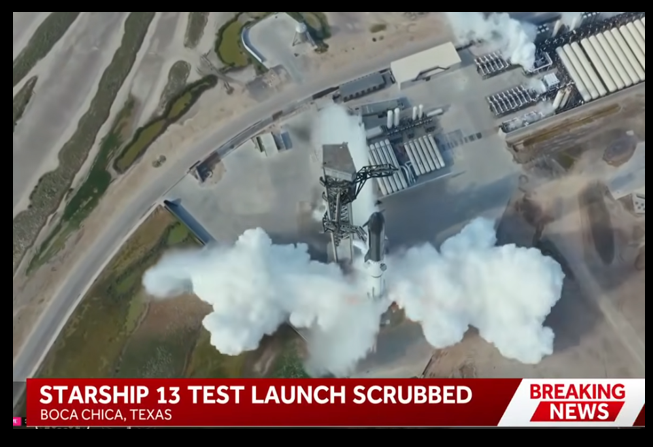
The launch almost happened this week, but the test was aborted less than a second before liftoff.
SpaceX’s (SPCX.O) Starship rocket triggered a last-second abort before liftoff for its 13th flight test from Texas on Thursday as some of its 33 engines failed to start, with CEO Elon Musk saying it will likely try to launch again early next week.
Shares of SpaceX, which went public last month, fell about 3% in aftermarket trading following the scrubbed launch. The stock ended at $131.11 on Thursday, closing below its IPO price of $135 for the first time since listing.
“Some of the engines didn’t start, triggering an automatic launch abort,” Musk said in a post on X, without disclosing the number of engines on the Super Heavy rocket that did not start. “To be confident of a good flight, 2 Raptors will be removed & replaced. Most probable launch timing is early next week.”
The launch abort came less than a second before Starship’s planned liftoff from Starbase, SpaceX’s company town in south Texas, at 5:45 p.m. CT (2245 GMT). The rocket’s engines ignited but cut off shortly after.
The 13th Starship launch attempt was scrubbed after a booster warning triggered a hold, stated SpaceX. https://t.co/xvq7I6ksbC
— Spectrum News 13 (@MyNews13) July 16, 2026
The next test will be similar to that conducted on #12, but with some changes to both the spacecraft and the payload.
Flight 13 will fly a similar suborbital profile as Flight 12, incorporating changes in response to issues seen on Flight 12. That included the failure of the Super Heavy booster to perform a controlled splashdown in the Gulf of Mexico and the loss of one of six engines in the Starship upper stage during its ascent.
One notable change for Flight 13 is Starship’s payload. While some previous flights carried mass simulators of next-generation Starlink V3 satellites, this mission is carrying 20 functioning Starlink V3 satellites that will be deployed once Starship is in space.
The satellites, placed on the same suborbital trajectory as Starship, will be put through about 20 minutes of tests before reentry. That includes deployment of solar arrays and antennas and communications tests with both ground stations and other Starlink satellites.
“Before we operationalize these satellites, we want to put them in a flight-like environment,” SpaceX’s Tyler Lionquist said on the launch webcast. The brief flight will allow engineers to “speed run” those deployment and communications tests. “This is all part of SpaceX’s iterative process to technology advancement.”
To be confident of a good flight, 2 Raptors will be removed & replaced. Most probable launch timing is early next week.
— Elon Musk (@elonmusk) July 17, 2026
SpaceX employees shared their perspectives on the failed launch attempt.
Director of Starship engineering Shana Diez said on X that the Thursday launch scrub was the first time a fully stacked Starship rocket lit its engines and then aborted.
“While similar to a wet dress rehearsal,” she said, referring to a practice run of a rocket launch, “there is a lot going on and any first time operation comes with additional risk.”
“This is how we learn safely and implement mitigations for all scenarios,” said Jessie Anderson, a Starship production engineer who sometimes hosts the company’s launch live streams.
For folks following along, today was the first time we lit engines on a full stack Starship then aborted and detanked. While similar to a wet dress rehearsal there is a lot going on and any first time operation comes with additional risk.
Our operators and operations teams plan…
— Shana Diez (@ShanaDiez) July 17, 2026
Taking in the sequence of events, the last-second abort is not a failure but evidence that SpaceX’s safety systems are doing exactly what they are designed to do.
The company’s iterative approach, now paired with real payload testing, continues to push Starship closer to operational reality despite the inevitable setbacks that come with cutting-edge engineering.
BREAKING: SpaceX is now targeting Monday, July 20, for the launch of Starship Flight 13 pic.twitter.com/qR8mAYTG6I
— Dima Zeniuk (@DimaZeniuk) July 17, 2026
Here’s hoping the next launch attempt is successful, and we take another meaningful step toward a truly spacefaring future.
Donations tax deductible
to the full extent allowed by law.






Comments
On another note, vice president Vance has a new baby boy
Congratulations
Hey, better one second before than one second after.
Sounds like a good book title.
SpaceX was a terrible stock buy for anyone who did it.
I hope the company succeeds, but it was really about raising capital to invest in R&D more than turning a profit.
Time will tell. It’s too early to say that it’s a bad investment. Historically, only about a third of IPOs trade above their initial price within five years. Some do though: if you’d bought TLN or NNE a few years ago, you’d be up 500-700%.
I’m too old to really make any money off SpaceX but was thinking of buying some for my nieces.
It’s rocket science. Failures are going to happen and I’m glad one did. It means this failure mode was tested and passed. Better now then to have it fail when the rocket is full of passengers crew and cargo,
It’s time to stop calling them starships.
True dat. It’s even hard to call what we do “exploring space.” It’s more like our backyard. Space is unfathomably big. It’s almost a certainty that any portion of it that we do manage to “explore” will be vanishingly small, even if we should explore the entire galaxy.
So what’s your point? Don’t explore because we can’t explore it all?
Naw, just don’t bloviate.
Like all that “end of history” twaddle from the ’90s.
an authentic split-second decision with no casualties
https://www.youtube.com/watch?v=DlXb3zSLdFY&t=3s
SpaceX sells an empty chamber at the tip of a rocket, 17 feet across and 34 feet high. What goes inside it decides what the company is worth.
A ton of someone else’s cargo earns SpaceX $4 million, once. A ton of Starlink satellites earns $13 million over five years. A ton of AI chips could earn $50 million. That one number, return per ton, explains everything: why SpaceX launches its own satellites on three out of every four flights, why it looks more like a 19th century railroad than an airline, and why Starship is now the most important number in the company.
Covered in this video: Falcon 9 launch economics, Starlink unit economics, the railroad land grants of the 1800s, why airlines became a cautionary tale, the shipping container revolution, AI data centers in orbit, and what Starship changes.
Many of my old cars had engines that might or might not start when they were supposed to.