


Successful Starship V3 Test Launch Marks Another Step Toward a Spacefaring Future
The SpaceX team were obviously pleased with the result, chanting, “USA! USA! USA!”
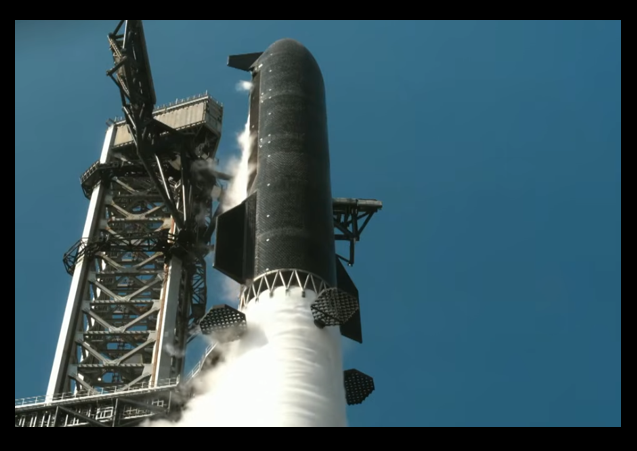
When I last wrote about the SpaceX Starship project, the space company had launched its 11th Starship rocket from Texas and landed it in the Indian Ocean.
I noted it was the last flight before the company begins test-launching a new version of the giant rocket outfitted with more features for moon and Mars missions.
On Friday, SpaceX launched its twelfth Starship test flight, and first V3 vehicle, from Starbase in Texas. The flight was very successful and ended with a planned destructive splashdown in the Indian Ocean about an hour after liftoff.
SpaceX launched a revamped Super Heavy-Starship rocket Friday on a flight to test more powerful engines, enhanced control systems and a host of other upgrades needed to streamline operations and improve safety and reliability.
One of the Super Heavy first stage’s 33 methane-fueled Raptor 3 engines shut down early during the climb out of the lower atmosphere and additional engines failed to run properly during an attempt to fly the stage back to its planned splashdown point off the Texas Gulf Coast.
The Starship upper stage was equipped with six third-generation Raptor engines, and one of three optimized for operating in a vacuum shut down early during the climb to space. The flight computer kept the other five engines longer than originally planned to make up for the shortfall, putting the craft on an acceptable sub-orbital trajectory.
It was not immediately known what might have triggered the premature engine shutdowns, but once in space, the Starship appeared to perform well, deploying 22 Starlink internet satellite simulators from an upgraded Pez-like dispenser.
🚨JUST NOW: SpaceX has SUCCESSFULLY launched VERSION 3 of Starship from Starbase, TX
As the largest Starship EVER, V3 is a MAJOR evolutionary upgrade from V2, focused on higher performance, reliability, and FULL reusability
CONGRATS @elonmusk, SpaceX, and AMERICA🇺🇸 pic.twitter.com/QibQ9xhQYb
— Nick Sortor (@nicksortor) May 22, 2026
This achievement is well timed. The test flight of Starship V3 was a key event for SpaceX ahead of its public market debut, following the company’s disclosure of its IPO prospectus earlier this week.
The Superheavy first stage that powers the initial ascent of Starship failed immediately after its separation. Anomalies then occurred during an engine relight sequence, destroying a significant part of the Superheavy aft and resulting in a loss of control.
After flying at a speed of Mach 7, Starship lit two of its engines before splashing down vertically in the Indian Ocean. It then tipped over and exploded after the nose of the rocket hit the water, an expected outcome.
SpaceX said in its IPO filing on Wednesday that Starship “is designed to deliver 100 metric tons to Earth’s orbit in a fully reusable configuration while enabling rapid turnaround times akin to commercial aviation.” It’s the 12th test flight for Starship.
The largest rocket ever built or flown, Starship is also key to SpaceX’s ability to bolster its Starlink wireless internet service business. The company said it plans to launch more satellites into orbit to add to its constellation, and provide stronger wireless internet to customers even in dense urban areas.
The SpaceX team was obviously pleased with the result and took a moment ahead of Memorial Day weekend to acknowledge the country that made the achievement possible.
SpaceX team chanting: "USA! USA! USA! USA!"
🇺🇸🚀 pic.twitter.com/3iQctERDWB
— Sawyer Merritt (@SawyerMerritt) May 22, 2026
It must be noted that a former SpaceX employee was less than happy about this development.
PATRIOTISM? Former SpaceX software engineer Erin Ishimoticha attacked SpaceX engineers for chanting “USA” during a Starship or Starlink livestream, calling it nationalist dogwhistles. What is wrong with people? https://t.co/Dpqqx6VZQs pic.twitter.com/iUEjRlxKlC
— @amuse (@amuse) May 23, 2026
With humans due to return to the moon in as little as two years, astronauts will need to begin familiarizing themselves with the spacecraft that will take them to the surface.
As a reminder, the Artemis mission that will include a lunar landing of a crew, pairs the SpaceX launch vehicle with a Blue Origins lunar lander. Astronauts have begun their training on this vehicle.
Fortunately, a full-scale replica of one of the two commercial lunar landers under development for NASA’s Artemis program is now available for training purposes. The U.S. space agency announced that a crew cabin prototype of Blue Origin’s Blue Moon lander has “landed” at the Johnson Space Center in Texas.
The full-size mockup is due to serve as an invaluable training tool as NASA works toward the next crewed mission under its Artemis campaign.
Blue Origin lunar lander cabin mock-up arrives as NASA's Artemis face delays https://t.co/3CVACjPkw2. 🚀🌟💫🌒
— HERVE (@HERVE73950491) May 12, 2026
To wrap up this review, Professor Glenn Reynolds projects what these developments will mean in the future, as we begin down the path to becoming a Kardashev II civilization.
The Kardashev scale was initially created by Soviet astronomer Nicolas Kardashev as a way of ranking civilizations by resources. A Kardashev I civilization has control of all the resources of a planet. (We aren’t there yet, we’re probably about a Kardashev 0.7). A Kardashev II civilization controls the resources of a solar system. A Kardashev III civilization, which we can’t really even imagine, would control the resources of a galaxy.
We aren’t even a Kardashev I yet, but Starship v.3 is an indication that we’re on the path to Kardashev II. That’s a promised land I won’t live to see — and neither will Elon, or probably anyone alive at the moment — but we are heading there, and will be there in a jiffy by human-historical standards. A huge accomplishment, made possible by a lot of hard work, smarts, and creativity. Ad Astra, per ardua!
In conclusion, we are on a path from test flights to a truly spacefaring civilization….all thanks to American ingenuity and our can-do spirit.
Donations tax deductible
to the full extent allowed by law.






Comments
Congrats SpaceX,
USA USA Erin. Glad your gone. I wonder why?
“calling it nationalist dogwhistles.”
What’s mine is mine. What’s yours belongs to everybody.