

Musk’s X.AI Sues to Stop Minnesota’s AI ‘Nudification’ Ban
X.AI says the Minnesota law is overly broad, exacting steep fines for deep fakes that need not be sexual or even suggestive.
Elon Musk’s X.AI (xAI) has filed a First Amendment challenge to a new Minnesota law prohibiting access to so-called “nudification technology”—AI tools that digitally strip clothing from real people’s photos or videos to make them appear nude, without their consent.
Aimed at protecting families and children from AI-driven sexual abuse imagery, the first-of-its-kind law (HF 1606) passed earlier this year with virtually unanimous support from Minnesota lawmakers.
It’s hard to argue with a law opposing AI-generated nude images of victims without their consent, especially when most of those victims are women and children, according to the bill’s author. Musk’s lawyers don’t challenge the state’s interest in protecting them. In fact, they say xAI prohibits its own users from generating non-consensual, sexualized AI images.
But Minnesota’s broad ban goes too far, the lawsuit states, imposing draconian penalties on companies for providing a service that allows users to create images and videos that arguably don’t contain any “nudity.”
The Minnesota law punishes AI platforms that let users “nudify” images—that is, alter photos of real people to depict an “intimate part.” However—and herein lies the problem—“intimate part” isn’t defined in the law itself; it’s borrowed by way of reference from Minnesota’s criminal sexual-contact statute, defined there as “the primary genital area, groin, inner thigh, buttocks, or breast of a human being.”
That definition was designed for a law criminalizing nonconsensual touching—not AI imaging, the complaint argues. It therefore sweeps in ordinary, non-sexual depictions such as men without shirts, people in shorts or swimsuits, and other body parts routinely displayed in public—images that would not ordinarily be regarded as “nudity.”
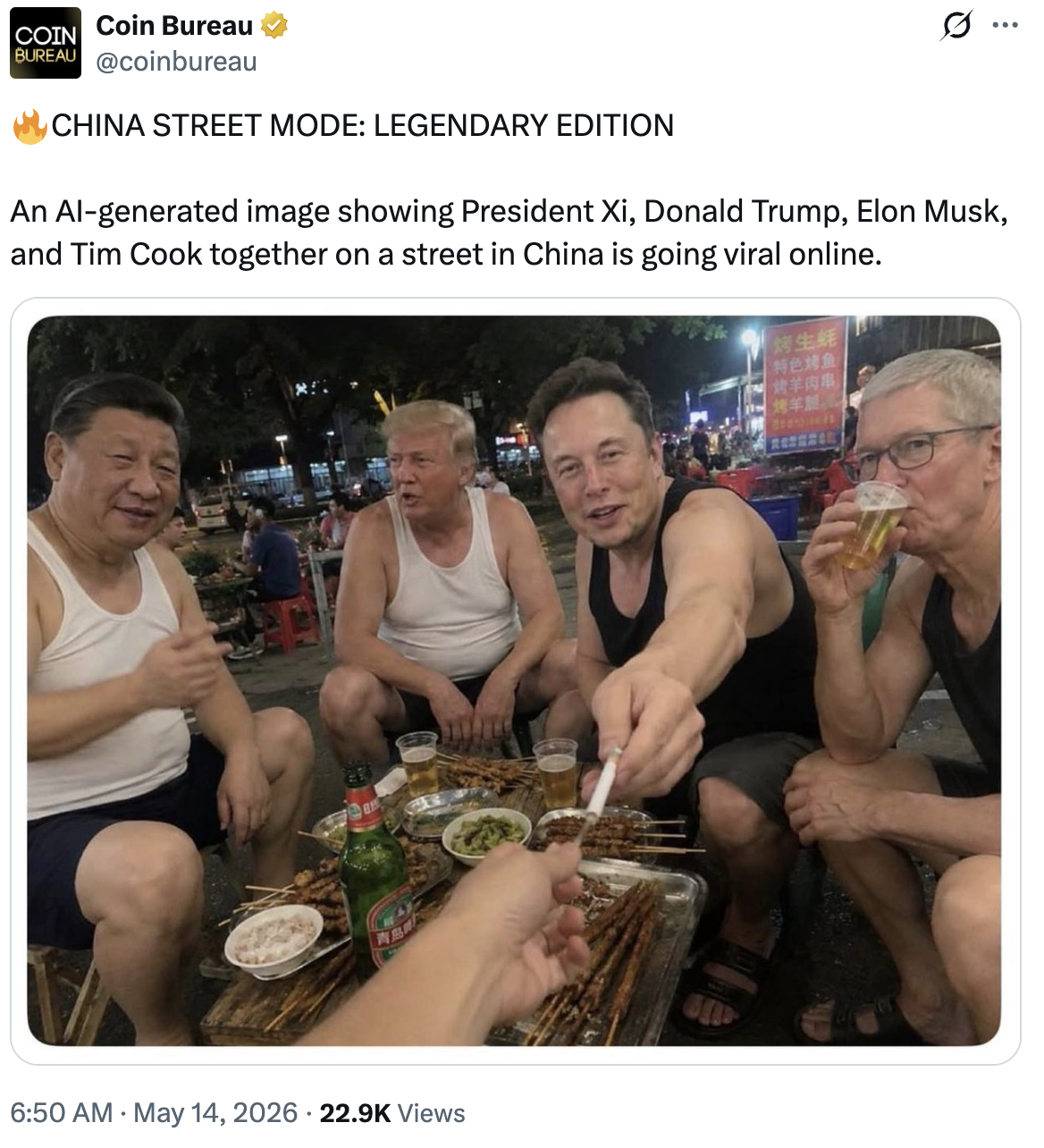
For example, the complaint says this image would be banned because President Trump’s inner thigh is exposed:
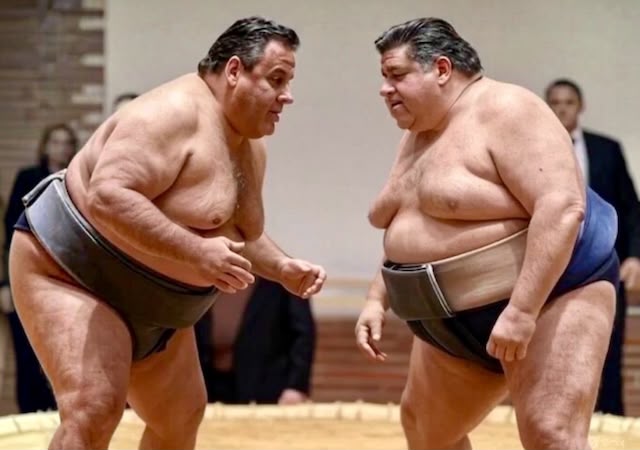
Another example depicts a sumo wrestling match between two political heavyweights—former New Jersey Gov. Chris Christie and Illinois Gov. J.B. Pritzker:
No one would call these men “naked”—yet the statute would bar this image too, xAI’s lawyers say.
Under the Minnesota ban’s broad terms, a provider is liable even if the people depicted consented or created the “nudified” image themselves, according to the complaint—and even if the image is never shared. They are liable, too, even if the company has a system in place to prevent the generation of nude images, the lawsuit says.
Minnesota’s law “makes service owners strictly liable every time a user succeeds in making an image the statute defines as ‘nudification’”—to the staggering tune of $500,000 per image.
On top of all this, the law allows victims to bring private lawsuits carrying treble damages, punitive damages, and attorney fees.
Faced with these whopping fines, providers may have “no choice” but to change their services in Minnesota.
In their lawsuit filed Monday in the U.S. District Court in Minnesota, xAI claims the Minnesota ban violates the First Amendment by overly restricting speech based on content.
They ask the court to declare the law unconstitutional and block its enforcement, with an emergency motion now pending to enjoin the ban before it goes into effect on August 1.
Donations tax deductible
to the full extent allowed by law.



Comments
The law must be precise and avoid all euphemisms. It should only employ scientific terms. For example, does it cover tallywackers and hoohahs?
All kidding aside, I do believe that ANY “AI” created image, clip, article, or leftist evidence against a conservative be LABELED with an “AI” logo that is clearly visible at all times! Some of those AI clips are so BELIEVABLE that people could be convicted based on them. Yeah, I know people can be convicted based on leftist lies, corrupt juries, and even MORE corrupt “judges”, but “AI” is here and it’s only going to grow more powerful and more BELIEVABLE!
yet the statute would bar this image too
YIKES! Well, maybe it should. Or, at least, require eye bleach be administered immediately after viewing. /shudder/
It incentivizes me to exercise. But if anyone wants to nudify me, I request they do a little AI work on my body too.
I wasn’t sure if the lede image was a Tim Walz wet dream, or the Olympics finals for Hungry Hungry Hippos.
I would bet that the created image would be FLATTERING compare to REALITY!
Seems that a ban on all IPs associated with Minnesota would work. Simply get ISPs to ban ALL connections to anything generative from MN IP addresses. Oh, and all VPNs. Cut them off from the internet, since they evidently can’t handle it. Do it for the children. If it saves even one life.
X.Ai doesn’t care about the law, that can easily be changed to define intimate areas more narrowly. What X.Ai wants eliminated is the ability for the public to sue them. Hell no. The company provides the ability for those deep fakes to be created and therefore should be held accountable by anyone who is harmed by those photos.
The public can tell the difference between reality and a cartoon. But not when it comes to pictures. Everything we know about the world we see in pictures, videos or what we read in print. We observe only a tiny fraction of events first hand. AI photos can literally change the shape of our reality.
“The company provides the ability for those deep fakes to be created and therefore should be held accountable by anyone who is harmed by those photos.”
The manufacturer provides people the ability to commit violence and therefore should be held accountable by anyone who is harmed by their guns.
Collectivist authoritarian 🐂 💩.
Do better.
SaaS = Software as a Service
If it’s on their servers then xAI can’t just declare “Users fault! We had nothing to do with it.”
The creation of nude images with AI is no more magic than the creation of firearms with 3-D printers. States that are demanding that 3-D printers somehow detect that what they’re printing is a firearm part are stupid. I strongly suggest the same limitation applies to AI tools.
SaaS is not like printing something on your own 3-D printer.
SaaS is analogous to ordering something from a commercial print farm or machinist.
And therefore? If someone runs a public 3d printer, where you can upload anything, have it printed for you, and you collect it, with no human intervention, should they be held liable if someone prints a gun?! (That’s even if we were to falsely assume that printing a gun itself is not protected by the 2A.)
Milhouse,
There’s a difference between selling a centrifuge and centrifuging something they send you, but not checking to see if it’s uranium.
“It’s for the children” is a Trojan horse being used to push totalitarianism. No thanks.
Parents, do your job and PARENT.
The only way Democrats can conceive of to keep children safe is always to reduce the rights of adults to the rights of children. The actual solution is that it isn’t their damn job to keep our children safe in the first place — it’s ours.
Technology will not save us from our depravity.
Minnesota
niceugh!Where is Milhouse today? A lawsuit like this is right up his opinion alley.
He’s waiting on his orders and research teams to find some leftist spin to discredit Mr. Musk and somehow tie it all to PRESIDENT TRUMP! Give him time!
Go impale yourself on a tetanus-bearing rusty implement, you worthless piece of slandering filth.
See below. I think that not only is X.ai’s argument correct, it doesn’t go nearly far enough. X.ai may agree with the principle behind this law, and only argue that it’s drafted poorly, and can be fixed with more precise language. I think the principle itself is wrong, and the law can’t be fixed.
Typical Communist sh*thole: whatever is not mandatory is illegal.
Even without the overbroadness argument, the entire law is unconstitutional.
The Supreme Court has recognized an exception to the freedom of speech for actual pr0n that was produced using real children; that exception does not include virtual pr0n, which was produced without harming any actual children. The entire basis for allowing the government to ban such material is that an actual crime was committed, and would not have been had there been no market for the final product. Where there is no underlying crime, there can be no exception for the product.
This clearly doesn’t fall under that exception. So which exception does it fall under? SCOTUS has also been clear that the list of exceptions to the freedom of speech is probably complete, and it’s unlikely that any new ones will be discovered. Now it may be that it will decide it was hasty, and that one more exception exists that it hadn’t thought of before, but how likely is that?
You’re arguing that when there is no victim, there is no crime.
Although a principled and preferable policy foundation, US law is sadly far beyond that.
No, it has nothing to do with that.
In recognizing this exception to the freedom of speech, SCOTUS explained that the reason is that allowing such speech to circulate would give it commercial value, and thus create an incentive for creating it; since creating it inherently involves a crime, allowing a market for it inherently causes more crimes to be committed. Therefore the government can ban it.
In other words its exemption from the first amendment rests entirely on actual crimes being necessarily committed in its creation. Without that very tight coupling between the speech and a crime, it would be protected and government couldn’t ban it. Thus any similar speech that doesn’t involve any crime is protected and can’t be banned.