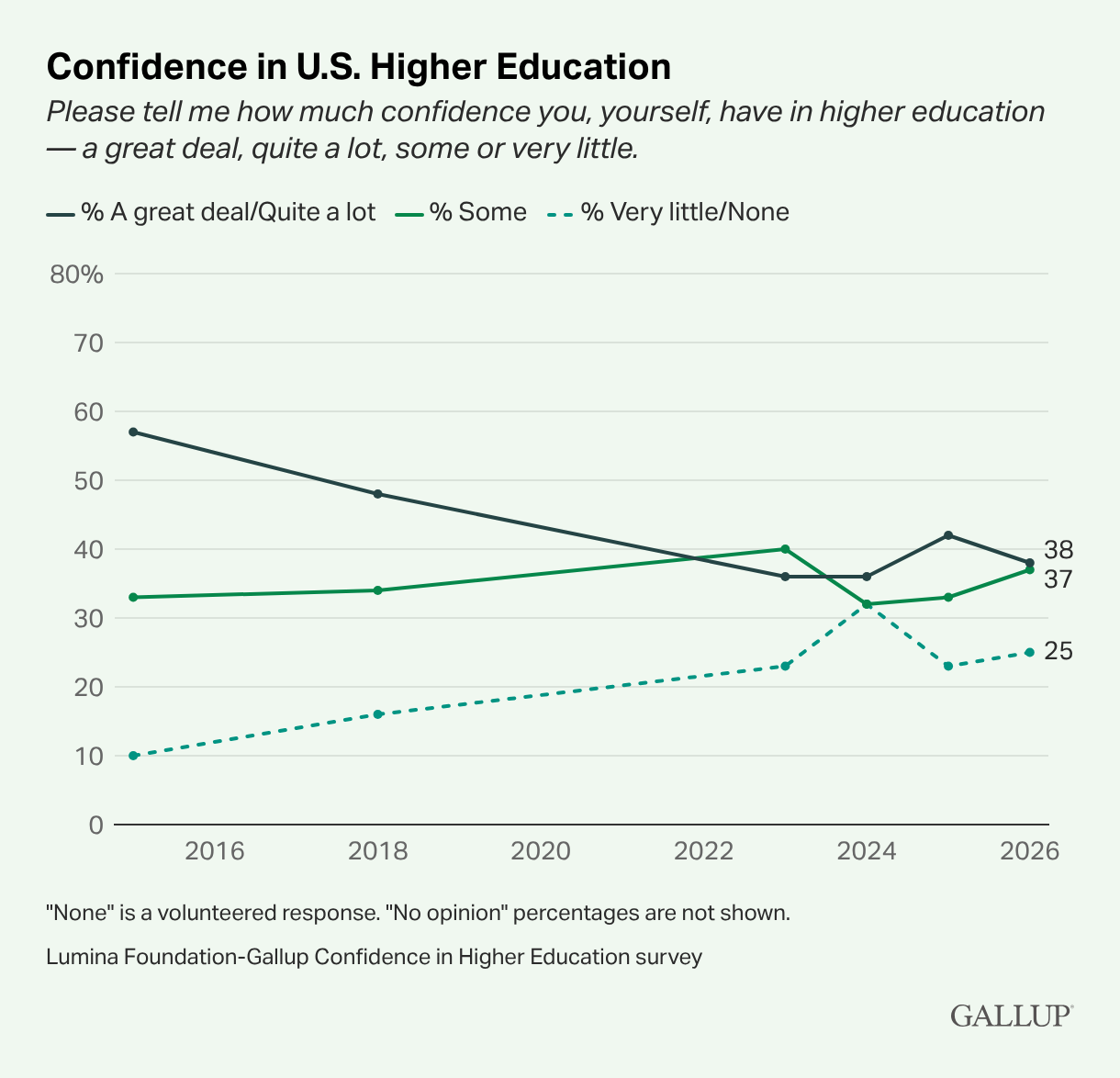
A new Gallup poll has found that Americans’ confidence in the country’s higher education system has dropped significantly from last year. This year, 38% of U.S. adults say they have “a great deal” or “quite a lot” of confidence in higher education, compared with 42% in 2025. The drop in confidence signals a 19% drop since the poll began in 2015.
Additionally, 37% of Americans say they have “some” confidence in higher education while 25% say they have “very little” or “none.”
The poll found that among respondents who lacked confidence in higher education, the most commonly cited reason was the idea that politics is forced on students. 31% of respondents who were dissatisfied with the university system said that it was due to “perceived political agendas on college campuses.”
The American university system has been racked by controversies over the last year, including several concerning left-wing political ideologies. Following the Trump administration’s executive order, “Ending Radical And Wasteful Government DEI Programs And Preferencing,” which sought to limit Diversity, Equity, and Inclusion (DEI) initiatives, several of the nation’s top universities have continued efforts to maintain or implement such programs.
The University of Utah, North Carolina A&T State, the University of Kentucky, Ohio State, Arizona State, and the University of Virginia were all caught on undercover videos this past year admitting to pushing DEI despite federal and state directives.
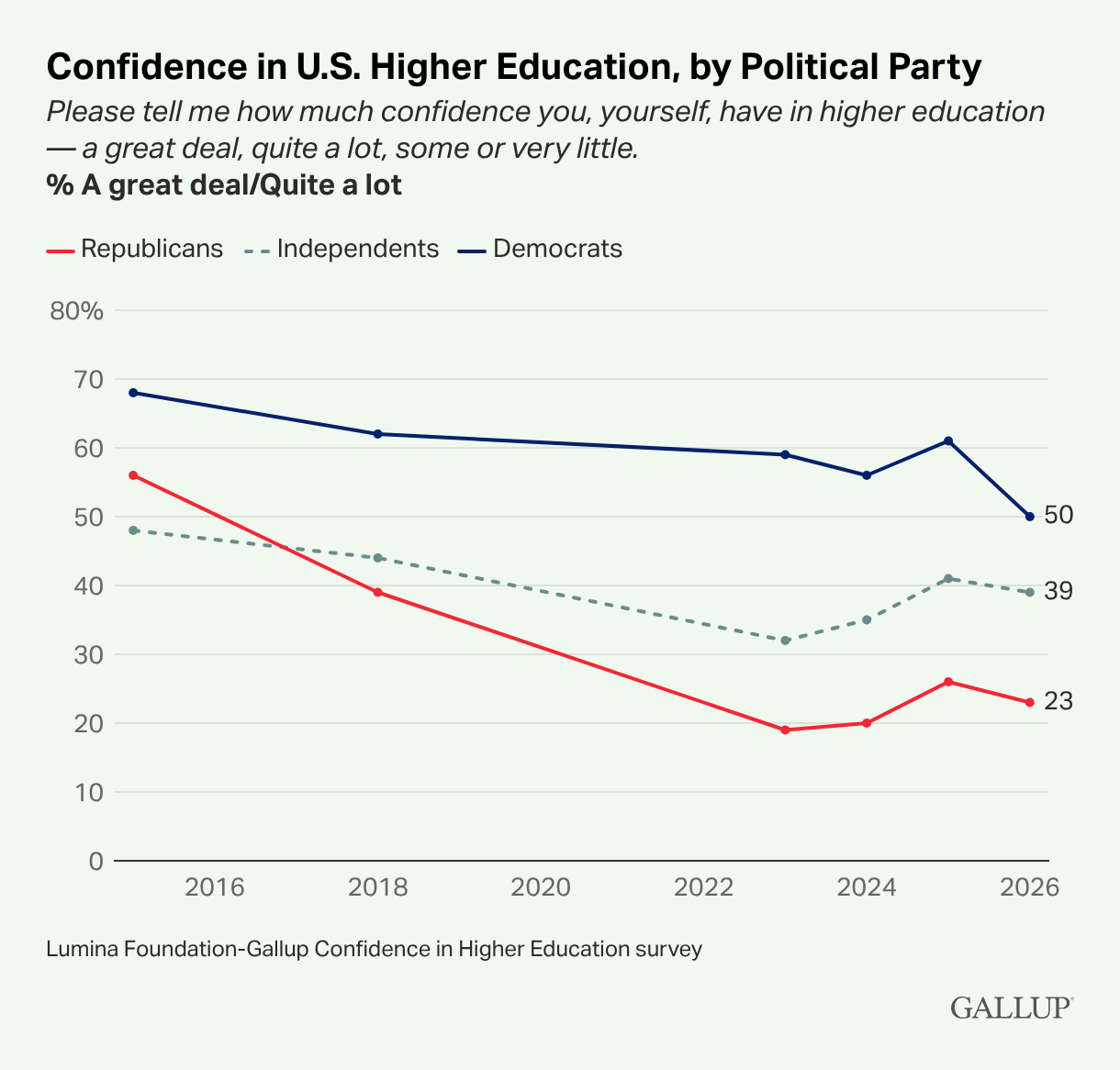
According to the Gallup poll, Democrats have the highest approval rating of the university system at 50%, while their Republican counterparts remain wholly discontented at 23%. This statistic supports the notion that American university systems are wholly biased towards left-wing political ideologies.
CriticalRace.org has covered hundreds of institutions over the past year, finding that many universities continue to rebrand DEI initiatives to sidestep government directives. This was recently highlighted in a new report that found universities are now using terms such as “belonging,” “access,” “opportunity,” and “engagement” to replace DEI-related language. The report argues that these changes may allow institutions to continue similar initiatives under new names rather than fully discontinue them.
CLICK HERE FOR FULL VERSION OF THIS STORY