


DOJ Sues Colorado Over In-State Tuition for Illegals After Equal Protection Project Complaint
“For three decades Congress has made clear that states cannot provide education benefits to illegal aliens unless those same benefits are available to all American citizens.”
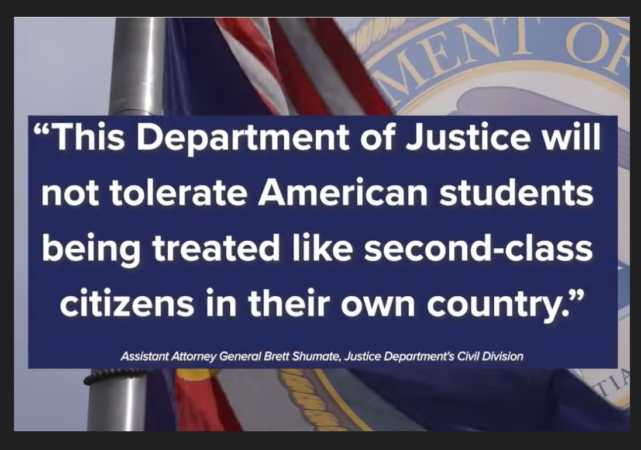
Earlier this year, the Equal Protection Project (EPP) submitted a complaint and request for investigation urging the U.S. Department of Justice to investigate Colorado’s Advancing Students for a Stronger Tomorrow (ASSET) Act and related financial aid programs. EPP argued that Colorado’s policies violate 8 U.S.C. § 1623(a), which prohibits states from providing postsecondary education benefits to aliens not lawfully present in the United States on the basis of state residence unless the same benefits are available to all U.S. citizens regardless of where they reside.
Yesterday, July 23, 2026, DOJ filed a lawsuit challenging Colorado’s law that grants in-state tuition and other postsecondary education benefits to illegal aliens while denying those same benefits to U.S. citizens from other states, arguing the State’s tuition and financial aid laws are preempted by federal law.
The Department of Justice Sues Colorado for Providing In-State Tuition to Illegal Aliens
“For three decades Congress has made clear that states cannot provide education benefits to illegal aliens unless those same benefits are available to all American citizens,” said… pic.twitter.com/DcPQuzTQgT
— U.S. Department of Justice (@TheJusticeDept) July 23, 2026
The complaint alleges that Colorado unlawfully extends resident tuition rates and numerous state-funded financial aid programs to illegal aliens while requiring U.S. citizens from other states to pay substantially higher tuition and remain ineligible for the same benefits. In addition to challenging Colorado’s in-state tuition law, the lawsuit targets several financial aid programs that incorporate the same residency-based eligibility criteria, including the Colorado Application for State Financial Aid (CASFA), the College Opportunity Fund, the Colorado Opportunity Scholarship Initiative, and university scholarship programs tied to Colorado’s residency classifications.
According to the Department of Justice, these provisions violate the Supremacy Clause because Congress expressly prohibited states from providing residency-based postsecondary education benefits to aliens not lawfully present in the United States unless those same benefits are made available to all U.S. citizens regardless of residency. The complaint seeks declaratory and injunctive relief preventing Colorado from continuing to enforce the challenged laws.
The complaint explains the legal basis for the lawsuit as follows:
“These statutes constitute blatant unequal treatment favoring illegal aliens over U.S. citizens. Worse, such preferential treatment is squarely prohibited and preempted by Congress. Specifically, federal law mandates that “an alien who is not lawfully present in the United States shall not be eligible on the basis of residence within a State . . . for any postsecondary education benefit unless a citizen or national of the United States is eligible for such a benefit . . . without regard to whether the citizen or national is such a resident.” 8 U.S.C. § 1623(a).”
The Department’s lawsuit reflects its broader effort to enforce federal restrictions on state benefits for illegal aliens. Announcing the lawsuit, Associate Attorney General Stanley E. Woodward Jr. stated: “For three decades Congress has made clear that states cannot provide education benefits to illegal aliens unless those same benefits are available to all American citizens.” He added that Colorado is “violating federal law and subsidizing education for illegal aliens at the taxpayers’ expense.”
Earlier this year, the Equal Protection Project urged the Department of Justice to investigate Colorado’s ASSET Act and related financial aid programs, arguing that the State was providing residency-based postsecondary education benefits to illegal aliens in violation of 8 U.S.C. § 1623(a). The Department of Justice has now filed suit seeking to invalidate those policies under the same federal statute.
Reminder: we are a small organization going up against powerful and wealthy government and private institutions devoted to DEI discrimination. Donations are greatly needed and appreciated.
==================
Donations tax deductible
to the full extent allowed by law.






Comments
The state roster is largely made up of the usual insurrectiony suspects, and we all understand how Colorado, Virginia, and Minnesota got turned. But what in the world happened to Kansas to foul it up so much?
Agriculture lobby?
Kansas has always had issues. Usually a solid red State but they will still regularly elect communists to the governor’s office and then figure out why they didn’t like it the last time. Also, one of the highest rates out migration for red state. I grew up in Kansas and ultimately fled to Missouri because it has much less in the way of issues
Texas had the same law and was following it for 30 years until just recently.
This is Super!!! I wish I had known about this code section 25 years ago!
It wouldn’t have helped you get a lower rate. It merely would have required the illegal aliens to get a higher rate. And you wouldn’t have had standing to sue.
1 – Obama turns (takes, forces) student loans be handled to feds; vetting by private sector stops.
2 – Obama also implies that many/all should go to college. Wrong
3 – Universities see this as a cash flow – “Yeah, let’s raise tuition, etc.” They did.
4 – Students borrow all they can or more than necessary; how many will repay the loans? looking rather bleak now.
5 – Students get/are given degrees in programs with little or no market value.
6 – Students spoiled? Expected someone else to pay back or ?????
7 – Add DIE to the equation – what’s the answer.? Blaming parents is not the total answer – these kids were not taught financial responsibility.
8 – Student debt is now $1,860,000,000,000+
Who will pay it???
Nice summation of a huge problem.
Better yet form a class of out of State Students illegally charged higher tuition and sue for the difference over in State tuition plus damages going back to passage of the Statute. Then file civil rights charges v the administrators all the way back as.well. Maybe even criminal charges, at minimum the administrators lied on the annual certification required by Dept ED that they ‘don’t engage in discrimination’ that keeps them eligible for Federal Funding. When Univ lose eligibility for Federal funding for a few years while couple dozen administrators get frog marched to prison and the Univ System is on the hook for actual and punitive civil damages ….I suspect that’s the moment the rest of big ED/academia stops pretending not to notice and starts cheerful, willing compliance.
I was paying out of state tuition rates for a dependent at a Colorado college five years ago. A class action suit may be effective.
No, it would not, because the law did not entitle you to a lower rate.
That is the best strategy. The universities need to pay back the difference, with interest.
You can’t. Those students have no standing. The law doesn’t entitle them to the lower rate, it merely says if you don’t give them the lower rate then you can’t give it to in-state illegal aliens.
There’s no civil right being violated.
This is not discrimination. Citizens, legal aliens, and illegal aliens are all being treated exactly the same. The problem is that the law requires discrimination. So the colleges’ declaration that they’re not discriminating was completely truthful — they aren’t, even when the law requires them to.
They do the same crap in California!
The DOJ is correct on the law, but statements like:
and“These statutes constitute blatant unequal treatment favoring illegal aliens over U.S. citizens. […] preferential treatment are dishonest bullshit. Colorado is absolutely not treating American students like second-class citizens, nor is it guilty of unequal treatment or of favoring aliens over citizens. It is treating aliens (whether legal or not) exactly the same as citizens. It says to all of them, if you live here you get the lower rate, if you don’t live here you get the higher rate.
That is not unequal treatment, it’s precisely equal and fair. The only problem with it it’s illegal. Congress has banned such equal treatment, and requires states to discriminate against illegal aliens. Many states have been ignoring this law for the last 30 years, and it’s high time they were called to task on it. If they disagree with the law, let them lobby Congress to change it. But falsely accusing them of something they’re just not doing is wrong.
And what’s the point? Just say openly, this is the law and we’re enforcing it.
The DOJ is correct on the law, but statements like:
and
are dishonest bulldust. Colorado is absolutely not treating American students like second-class citizens, nor is it guilty of unequal treatment or of favoring aliens over citizens. On the contrary, it is treating aliens (whether legal or not) exactly the same as citizens. It says to all of them, if you live here you get the lower rate, if you don’t live here you get the higher rate.
That is not unequal treatment, it’s precisely equal and fair. The only problem with it is that it’s illegal. Congress has banned such equal treatment, and requires states to discriminate against illegal aliens. Many states have been ignoring this law for the last 30 years, and it’s high time they were called to task on it. If they disagree with the law, let them lobby Congress to change it. But falsely accusing them of something they’re just not doing is wrong.
And what’s the point? Just say openly, this is the law and we’re enforcing it.