


Canadian Wildfire Smoke Spreads Across U.S., Triggering Air Quality Alerts
Recurring wildfire smoke raises questions about Canadian forest management.
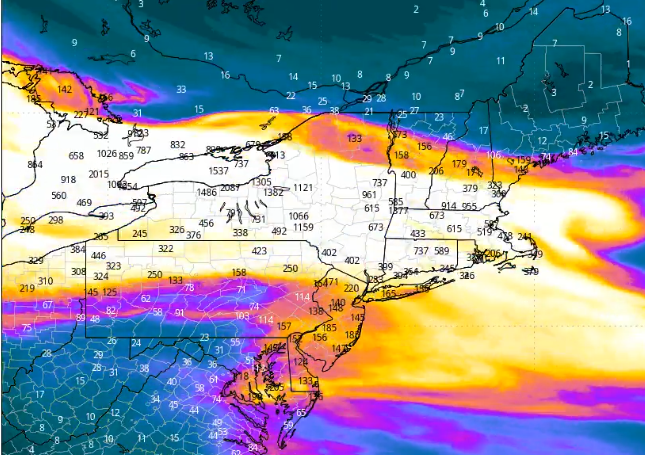
Just like heat domes, smoke from Canadian wildfires appears to be a regular feature of American summers.
For the past several years, we have covered the smoke emanating from blazes in Canada’s mismanaged forests. Furthermore, a number of the fires were investigated for potential arson.
Now, over 800 wildfires are being reported across Canada, with smoke affecting air quality in New York.
More than 830 wildfires were burning in Canada on Wednesday, along with more than a dozen in northern Minnesota, forcing mandatory evacuations and spreading unhealthy smoke down to the Lower 48.
Some of the largest wildfires are burning in west-central Ontario, consuming thick forests and releasing an incredible amount of smoke.
The wind is now directing that smoke into the U.S., creating dangerous air quality for millions across the upper Midwest and Northeast on Wednesday and through the end of the week.
On Wednesday afternoon, air quality had reached unhealthy levels in New York City and the Eastern Lake Ontario region, the Central New York region and parts of Western New York, according to air monitoring site AirNow.
There are currently 838 wildfires burning across Canada. More than 100 are in northwestern Ontario, sending thick smoke to the Great Lakes and Northeast U.S. pic.twitter.com/nJS5QaJvqY
— Collin Gross (@CollinGrossWx) July 15, 2026
I’ve so had it with Canada. Every time our air quality goes above 75 we should addd 5% to the Trump tariff. https://t.co/Ct6b7iC22A
— Inez Stepman ⚪️🔴⚪️ (@InezFeltscher) July 15, 2026
Air quality in the Midwest is also being adversely impacted, and two of the fires have crossed over into U.S. territory.
Two of the largest blazes — the Bear Trap and Thumb fires — have crossed the border into Canada, officials said.
“Fire management anticipate another very high fire danger day today with increased fire activity and fire growth,” the agency said.
Already this week, state authorities around the Great Lakes have issued alerts for poor air quality. In northeastern Minnesota, the state’s pollution control agency said that the air quality would likely remain “very unhealthy for everyone” through Thursday. Just across the border in southern Ontario, Environment Canada issued an orange-level alert on Tuesday for air quality and urged people to avoid spending time outside.
Smell smoke this morning? Its coming from a wildfire outbreak in Ontario. While it should not impact air quality much today, smoke at the surface could increase Wednesday into Thursday, potentially reducing visibilities and air quality. High temperatures may also be limited. pic.twitter.com/6QdV5965nt
— NWS New York NY (@NWSNewYorkNY) July 14, 2026
Meanwhile, in Canada, a wild video is making rounds showing a freight train surrounded by huge flames from the roaring Canadian wildfires near Armstrong, Ontario.
The video, which was taken inside the train, shows raging flames around it. A crew member can be seen also capturing the incident on their cellphone.
The train car was stopped in Armstrong, Ont., which is north of Thunder Bay. A CN Rail spokesperson told Global News all employees in the area were evacuated overnight Monday.
“CN has temporarily suspended rail operations near Armstrong, ON as a precaution due to wildfire activity in the area. As a safety measure, CN employees in the area and residents of the Town of Armstrong were evacuated overnight,” the spokesperson said in an email.
🔥 ON FIRE: Wild video shows a freight train surrounded by huge flames from the roaring Canadian wildfires near Armstrong, Ontario. According to local sources, three Canadian National Railway Company (CN Rail) trains were halted on their tracks because of the fires in the area. pic.twitter.com/8DluFdM1Gp
— FOX Weather (@foxweather) July 15, 2026
However, there may be an upside to the smoke. As meteorologist Chris Martz notes, the smoke layer may take the edge off the heat.
The Canadians need to get their wildfire situation under control.
This is now the third year in a row that we are having to deal with these smoke plumes being blown downwind, reducing air quality in the northeast.
The one good thing is that it should help keep a lid on temperatures the next two days as forecast highs range 95–100°F on model guidance. But with the smoke layer, shortwave flux will be reduced, so highs will be in the low-mid-90s.
The Canadians need to get their wildfire situation under control.
This is now the third year in a row that we are having to deal with these smoke plumes being blown downwind, reducing air quality in the northeast.
The one good thing is that it should help keep a lid on… pic.twitter.com/ZqA4ckDPmN
— Chris Martz (@ChrisMartzWX) July 15, 2026
Back in 1992, a review examined how prescribed burns have been a natural and effective forest management tool in Canada and argued for their expanded, science‑based use to reduce fuel loads, support healthy forests, and maintain ecosystem function.
Published in The Forestry Chronicle, the authors show that prescribed burning can be cost‑effective and ecologically compatible with many management objectives. The authors concluded that continued and adaptive use of prescribed fire, integrated with responsible timber harvesting and clearcut‑area treatments, is essential for long‑term forest resilience and should remain a core tool in Canadian forest policy and operations.
Perhaps Canada should revisit this 1992 paper, which shows controlled burns and sound forest management practices are effective in preventing massive wildfires. https://t.co/cSqFailjPt pic.twitter.com/PTpEYeCGd2
— Leslie Eastman ☥ (@Mutnodjmet) July 15, 2026
There are many things that seemed to have worked better in 1992, especially in Canada. Perhaps it is time to return to more traditional approaches rather than bitterly clinging to eco-activism and climate cultism.
Donations tax deductible
to the full extent allowed by law.






Comments
https://x.com/rduke0071/status/2077732175038857418
https://x.com/rduke0071/status/2077732573992599572/photo/1
Two things spread like wildfire:
1. Actual wildfire (it burns out of control)
2. Democrat socialism (people out of control)
The sun looked like a pink ball yesterday in CT.
Here in Southeastern CT, when we keft a store around 5pm after a quick shopping trip, you could smell the burning wood, just as if you were sitting downwind of a campfire. The AQI was over 150, and my asthmatic daughter was not happy at all. Driving east on 184, the rolling hills only a few miles off were hard to see.
At least today the AQI is under 100, and the sky is a much more normal grey, not yesterday’s disturbing pinkish greyish yellow.
Yesterday afternoon it was as dark here as it was during the recent solar eclipse. And contrary to what that meteorologist (is one of their core competencies being constantly wrong or is it my imagination?) it was still hot & humid. On a scale of 1 to 10, it was a 1.
And while humans may be mismanaging forests, Mother Nature certainly isn’t. She’s making sure that all the dead timber, etc. is consumed.
Don’t mess with Mother Nature. She wants you dead, and she always succeeds.
The sky was a dark yellowish orange yesterday in my locale. And yep, it was dark here too like when we had that solar eclipse. A bit brighter today, but the air still smells acrid. Still hot and humid. Thanks Canada.
How much CO2 is Canada adding to the atmosphere?
No matter how much, it’ll still be the United States’ fault
/sarc/
Still, with one possible exception, all the US states being discommoded by this disaster highly deserve it.
“We’re gonna need more solar farms!”
My town’s outdoor pools are closed now due to air quality issues.
When the air quality improves enough, the pools will open.
But by then the water quality will be in the toilet.
Literally.
# 51 needs to start acting like an adult and not a child.
I see what you did there. LOL!
Canada just used up all of its carbon credits for the next 300 years. Can’t recoup the loss by banning cars…. even horses break wind. When left unmanaged, fire kills all of the trees rather than clear the undergrowth… leading to major erosion and loss of top soil. Selective blindness to reality.
I have friends in northern Wisconsin that told me the air was full of dust and almost un breathable from the fires
Have some friends camping in their RV up in Door County, and they said the AQI was almost 300 yesterday afternoon.
When he texted me last night he said the AQI at Ellison Bay was currently 195. I told him that would probably kill me as I have severe asthma.
Trump should invade. The Canucks wouldn’t even be able to see the Marines with all the smoke.
I don’t know about you but I don’t want a lot of their population. Their nutjobs are worse than ours.
Actually, Trump should use his best French accent to say to Canada that, in response to the smoke, “We fart in your general direction!”
We need to send them a bill for all the smoke and dust they sent our way. It was pretty heavy in Massachusetts although it was high up and thankfully it didn’t rain.
Ahhhh it did cool the temp down by about 5-7 degrees so that was nice.
Thirty years of radical environmental activism and this is the result.
How to “prescribe burn” millions and millions of acres of forest? Ounce of prevention, pound of cure?
I got trolled hard by Texans over the Carr and Camp wildfires. And then the Smokehouse Creek wildfire happened and those very same trolls then demanded Special Exemptions for tree branches falling across energized power lines during wind storms.
Notice how the Mayor of Paris or whatever Parisian official has nothing to offer in the way of criticism, regarding the Canadian fires’ contribution to “climate change” and the European heat wave — fellow leftists are exempt from opprobrium.
Here’s the opening paragraph of Google Gemini’s patently absurd, thoroughly leftist framing in response to my query, “It seems axiomatic that the extent of ongoing Canadian wildfires indicate a gross mismanagement of Canadian forests:”
“Ongoing Canadian wildfires are primarily driven by human-caused climate change rather than gross mismanagement. Rising temperatures, prolonged droughts, and earlier snowmelt create highly flammable conditions across Canada’s vast, remote boreal forest.”
This Canadian anti-Americanism is getting out of hand.
I can’t get behind this sentiment. The U.S. is not in control of its federal forest management either and we make lots of our own smoke that travels into Canada. Perc.org has been working for years on solutions to improve US forest health on both public and private lands but it’s a long slow process. Have you noticed the number of wildfires burning in the U.S. the past few years? If you live in the West, you’ve probably experienced the smoke from domestic wildfires. Sanction a country all you want, there’s no short-term solution and no country can control where wildfire smoke goes.