


Supreme Court Allows Trump to Fire Agency Leaders, Exempting Federal Reserve for Now
SCOTUS rejected Trump’s arguments regarding his firing of Lisa Cook, a Federal Reserve governor appointed by President Joe Biden, sending the case back to a lower court.
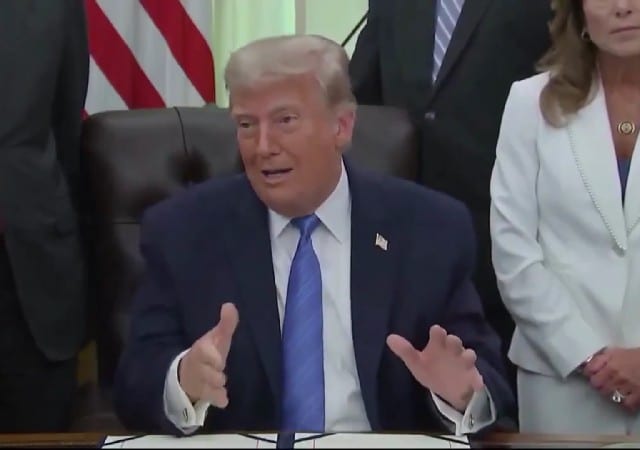
The Supreme Court ruled on two cases involving agency leaders, including the Federal Trade Commission (FTC) and the Federal Reserve.
Federal Reserve
SCOTUS voted 5-4 to deny the administration a stay and sent a lawsuit over President Donald Trump’s firing of Lisa Cook, a Federal Reserve governor appointed by President Joe Biden, back to a lower court.
The decision means Cook can remain in her post as litigation continues.
Cook claims “that the attempted removal was not ‘for cause,’ as required by statute, and that the President had in any event failed to comply with the statute’s (and the Constitution’s) requirement that she receive pretermination process.”
Trump attempted to fire Cook after the Director of the Federal Housing Finance Agency accused her of mortgage fraud.
Trump claimed that Article II and the Federal Reserve Act of 1913 grant him the privilege to make the move.
SCOTUS rejected Trump’s argument, denying him a stay.
The Federal Reserve has a “for cause” protection when it comes to removing a leader.
Courts have ruled that “for cause” means proven misconduct, not allegations.
Cook has only faced allegations of mortgage fraud.
FTC
SCOTUS ruled 6-3 to end a precedent that the president set in Humphrey’s Executor v. United States from 1935.
Therefore, Trump had the authority to fire FTC Commissioner Rebecca Slaughter.
Humphrey’s held that “The Federal Trade Commission Act fixes the terms of the Commissioners and provides that any Commissioner may be removed by the President for inefficiency, neglect of duty, or malfeasance in office.”
“Humphrey’s framework has not withstood the test of time,” wrote the majority. “From the start, Humphrey’s was tethered to a highly circumscribed view of the FTC’s role. Humphrey’s by its terms applied only to agencies that occupy ‘no place in the executive department,’ are ‘independent of executive authority,’ and exercise ‘no part of the executive power.’”
I’m glad that SCOTUS pointed out that independent agencies are not independent:
Slaughter relies on reliance. She argues that Congress has relied upon Humphrey’s to create agencies that are “insulated from presidential control.” Brief for Respondent 15. But that is precisely the problem. Despite what Humphrey’s may say, independent agencies are not “independent” in the sense that they are free of the President and thus responsive “only to the people of the United States.” 295 U. S., at 625. Placing the power to administer laws in officers who enjoy “freedom from Presidential oversight (and protection)” does not deliver us to a promised land of technocratic governance—it often results only in an “increased subservience to congressional direction.” FCC v. Fox Television Stations, Inc., 556 U. S. 502, 523 (plurality opinion). Pp. 21–25.
The FTC falls under the authority of the executive branch. It is only “independent” because a cabinet secretary does not oversee the agency.
So where does the FTC fall? The majority explained (emphasis mine):
With these principles in mind, the FTC’s for-cause removal provision violates the separation of powers. In its present form, the FTC enforces and administers some 80 statutes covering almost every facet of the Nation’s economy, and the tasks it undertakes are “the very essence of ‘execution’ of the law.” Bowsher v. Synar, 478 U. S. 714, 733. The FTC has the power to promulgate substantive rules carrying the force of law, investigate businesses and enforce statutes through inhouse adjudications, and file civil suits on behalf of the United States in federal court. The FTC unquestionably exercises executive power and must therefore be controlled by the Chief Executive. Pp. 25–27.
“All the Court does today is recognize what has been clear for a century—that those who fall within the President’s ‘general administrative control’ must be removable by the President at will,” the majority wrote.
Donations tax deductible
to the full extent allowed by law.






Comments
If Cook did commit mortgage fraud, the the next step is for the DOJ to prosecute her and send her away
yes and the sooner the better.
Insane that they haven’t been vigorously prosecuting that case all along.
The mortgage fraud case is entirely separate from her lawsuit about being fired without proper notification.
She could be in jail by now.
The idea of the Federal Reserve is that the President doesn’t get to pump up the money supply just before elections, because the Fed chairman won’t do that. Conflict of interest with respect to the money supply avoided, the other interest being inflation prevention.
Maybe that was part of the original pie in the sky idea but it hasn’t panned out consistently in my lifetime.
Here’s a list of election years where Fed Reserve cut rates (increased liquidity) in a Presidential election year: ’76, ’84, ’96, ’08, ’20, ’24.
Even prior to that in post WWII era the Fed and Treasury cooperated to manipulate bond supply/rates and interest rates. In ’51 the Fed basically gave in to Truman and played to support short term bonds (buying them) to artificially suppress interest rates on the short end to accommodate the Treasury issuing bonds to.support Korean War. CPI was running over 20% at the time. This allowed the Treasury to lower interest rates than a ‘free market’ would have set to finance rollover of WWII debt and issuance of new debt. There’s a good deal of speculation that were gonna see something similar to that ’51 Treasury Fed Accord under the new Chairman. I’m not 100% sure I agree but there’s enough smoke that I wouldn’t be shocked to see a fire.
Regulating the value of the currency is a legislative power that was explicitly delegated to Congress by the Constitution, so it is legitimate that the Fed’s primary function isn’t executive. However, the Fed does do some law enforcement as well.
Also the Fed is technically structured as a private corporation, though in a weird and unique way that no genuinely private company would ever be structured.
SCOTUS: “With these principles in mind, the FTC’s for-cause removal provision violates the separation of powers.”
I was going to make this very comment about the Fed chair. Additionally, if an officer can be appointed by a POTUS, the POTUS can fire that officer unless the Constitution says otherwise (e.g., SCOTUS justices). Nobody (sane) would argue the courts can require a POTUS to hire a particular person. Indeed, the Constitution infuses the presidency with the executive authority of the United States, and no other person. This means the POTUS could reserve to himself the responsibility of any executive position and not delegate his authority to others. Why would anyone think the courts can tell the POTUS he must keep someone in the employ of any executive agency or office when that person is not doing the job as the POTUS himself would do it? Hiring and firing decisions are executive decisions. When those decisions are made in the Executive branch, they are most certainly within the purview of the POTUS’ authority, or within the authority of those to whom he has delegated his authority.
“Corporate decisions are made by corporate executives. Corporate executives make corporate decisions.”
Zero
The problem for the argument of ‘independent’ Agencies is the Constitution itself. Any entity must fall under Art I Congress, Art II Executive or Art III Judiciary. There’s no provision for a catch all ‘other’ branch of govt. If they ain’t legislating Art I and they ain’t running a courtroom deciding cases Art III …then what they are doing must fall under the Executive in whom All Executive power is vested including hiring/firing or that agency/function isn’t authorized by the Constitution.
That’s not true. Nothing in the constitution says so.
How so? What if they ain’t executing anything?
In the 1930s the FTC was making rules (quasi-legislative) and deciding disputes (quasi-judicial) but not doing much in the way of actual enforcement (executive). Over the ensuing century it has gathered executive functions.
The “separation of powers” isn’t nearly as strict as it’s generally portrayed. Remember that there’s nothing in the constitution barring the Chief Justice from also being the Secretary of State. No one could possibly do both jobs for very long, but it can and has been done for a short period. And (at least according to Seth TIllman, who’s usually right about these things) there’s nothing barring the president from also being a congressman, though he’d have to be insane to try doing both jobs.
> That’s not true. Nothing in the constitution says so.
Yes it does. It says it in those three articles.
> In the 1930s the FTC was making rules (quasi-legislative) and deciding disputes (quasi-judicial) but not doing much in the way of actual enforcement (executive). Over the ensuing century it has gathered executive functions.
Right, all of those are executive powers, so it falls under the President.
That doesn’t follow, and indeed in Humphrey the court ruled that he couldn’t, because at the time the FTC was not an executive agency. Suppose Congress for some weird reason chose to allow the president to appoint the chairman of the Congressional Budget Office. I see no reason why it couldn’t make such a choice. But it could also say “but he can’t fire him”. He has no inherent power to fire that person, and the fact that he appointed him in the first place doesn’t give him that power. The CBO doesn’t work for him. Basically that’s what Humphrey found was true of the FTC at the time. Now SCOTUS has said that whatever was true in the 1930s, the FTC is now an executive agency and thus works for the president.
It very much does follow sorry!
We can save voting by making it a felony to be a broad, a cuck or a minority.
So, according to the Supreme Court, there is now a fourth branch of government: the Federal Reserve.
Nothing in the constitution says there are only three branches. But no, the Fed is not a branch of government all on its own. It is however a strange kind of entity and it’s not necessarily exercising executive power.
Show me the article in the Constitution that outlines the structure of the Federal Reserve. It’s not there. To say it’s there somewhere would be like the justice in Roe v Wade, who argued that abortion is allowed based on the penumbra of the Constitution. OTH, if you want to establish a 3rd Bank of the United States with a corporate charter, independent of the legislature and executive, you may be onto something.
Actually since the Constitutional lays out three branches and no other, that means it says there are only three.
The Fed is clearly an executive agency exercising executive power, and falls under the President.
It seems there’s 4-5 Justices determined to find a way to pretend that the Federal Reserve is somehow an “independent” agency, despite the court having issued multiple opinions in the past year in which they’ve explicitly noted that there are only 3, not 4, branches of government.
If Trump wanted to push they issue, he could re-fire Cook as an “at will” political appointee of the President, in light of this SCOTUS ruling striking down Humphrey’s Executor.
No President from now on (just like all Presidents prior to 1935) needs “cause” to fire any political appointee in any executive branch agency. They can simply dismiss them. Period. If they merely prefer someone else occupy the post, they can fire the current appointee with “As a political appointee of the President you serve at the pleasure of the President. Thankyou for your service. You are dismissed effective immediately”.
If I were in Trump’s shoes right now, though, I wouldn’t want to press SCOTUS on the Fed. I’d wait until I got at least one more, and preferably two, more of my picks on the Court – and I’d make sure both were crystal clear on the fact that there is not now, nor has there ever been, anything “independent” about the federal reserve.
Better to wait and win than to get a loss that then plagues the country for 91 years like Humphreys Executor did prior to being, at long last, overturned.
Unlike the Pope, SCOTUS opinions are most definitely NOT infallible on even on matters directly involving Constitutional Law. And these recent Popes are wrong most of the time as well.
Nothing in the constitution says there are three branches.
What it does say is that the executive power is entirely vested in the president, and the judicial power is vested in the courts. That doesn’t tell us whether the Fed exercises executive power.
Actually since the Constitutional lays out three branches and no other, that means it says there are only three.
No the Constitution doesn’t, but what the Fed actually does tells us it exercises Executive power.