


Fiery Test Failure: Blue Origin’s New Glenn Destroyed in Cape Canaveral Blast
“Rockets are hard”.
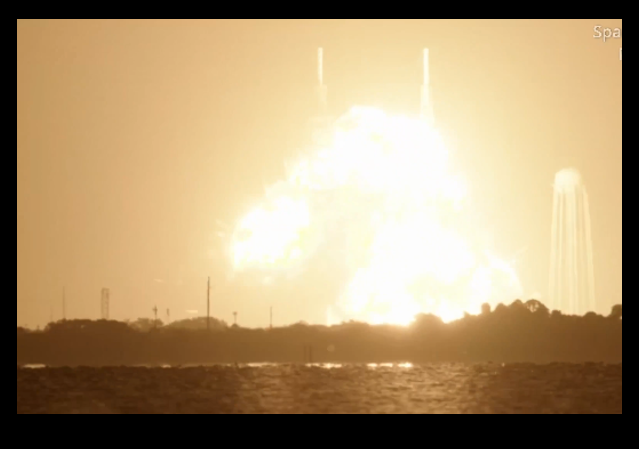
Blue Origin’s much-anticipated New Glenn rocket suffered a dramatic and fiery setback during its recent test launch, erupting in a massive explosion on the launch pad at Cape Canaveral and dealing a significant blow to billionaire founder Jeff Bezos’s space ambitions.
The explosion occurred around 9 p.m. EDT as engineers were counting down to a brief test firing of the New Glenn’s seven methane-fueled BE-4 first stage engines at the Cape Canaveral Space Force Station. Blue Origin was gearing up for a June launch to put a batch of Amazon “Leo” internet satellites into orbit.
As the engines appeared to begin firing, something clearly went wrong at the base of the rocket. The 188-foot-tall first stage became enveloped in a rapidly growing fire and moments later, the 86-foot-tall upper stage could be seen tilting and starting to fall as the first stage apparently began collapsing.
Then the vehicle suddenly exploded as its load of methane fuel and liquid oxygen ignited in a roiling fireball.
The rocket was destroyed, and as the smoke cleared, there was no sign of the erector-gantry used to move the New Glenn from its hangar to the pad and to raise it from horizontal to vertical. Likewise, one of two tall lightning towers was no longer visible.
🚨 JUST NOW: Jeff Bezos’ New Glenn rocket has EXPLODED into a MASSIVE fireball on the launchpad at Cape Canaveral in Florida
It literally looks like a NUCLEAR BOMB went off.@ElonMusk responded: “Most unfortunate. Rockets are hard.”
Insane to watch. pic.twitter.com/UI4QjkmLzS
— Nick Sortor (@nicksortor) May 29, 2026
This was an uncrewed ground test; the rocket was being prepared for an upcoming orbital mission to carry Amazon “Leo” (low Earth orbit) internet satellites, but these units were not on the vehicle during the static fire.
The cause of the explosion is still being investigated. The incident will likely delay New Glenn’s planned launch schedule by months, though the exact timeline will depend on findings and the extent of infrastructure damage.
It is the only launchpad that Blue Origin has for its 322-foot-tall New Glenn rocket, which is named after John Glenn, the first American astronaut to orbit Earth. Repairs will most likely take months, at the least.
The rocket had been set to carry 48 satellites for Amazon’s internet constellation, Leo, an acronym for “low-Earth orbit.” Leo is a competitor to SpaceX’s Starlink network. The Amazon satellites were not onboard.
“It’s too early to know the root cause but we’re already working to find it,” Mr. Bezos wrote on social media. “Very rough day, but we’ll rebuild whatever needs rebuilding and get back to flying. It’s worth it.”
Most unfortunate. Rockets are hard.
— Elon Musk (@elonmusk) May 29, 2026
The incident comes on the heels of SpaceX’s recent Starship test launch, which, despite its own technical hurdles, managed to advance the iterative progress that has come to define Elon Musk’s approach to spaceflight.
NASA has selected both SpaceX and Blue Origin to develop lunar landers to ferry astronauts from lunar orbit down to the surface as part of the Artemis program. Blue Origin’s lander architecture relies on multiple New Glenn launches to assemble and send its lander system toward the Moon, meaning New Glenn is a critical piece of its Artemis role.
Therefore, this setback may also delay the next phases of the Artemis mission to land humans on the Moon as well as the development of a lunar base.
Musk and Bezos remain direct competitors in the race to return astronauts to the moon in the face of China’s expressed goal of landing astronauts on the moon by 2030. Both companies are developing lunar landers for NASA’s Artemis program.
NASA’s Artemis III mission, set to unfold next year, will, in low Earth orbit, “test integrated operations between the Orion spacecraft and one or both commercial landers from SpaceX and Blue Origin respectively.”
In light of the launch pad explosion on Thursday, NASA Administrator Isaacman said they “will provide information on any impacts to the Artemis and Moon Base programs as it becomes available.”
Setbacks like this underscore just how difficult and high-risk cutting-edge spaceflight remains, even for the most well-funded and experienced players.
While Blue Origin faces a challenging rebuild and investigation ahead, its long-term ambitions—and its role in NASA’s Artemis program—remain significant. At the same time, SpaceX’s steady, iterative progress highlights the value of persistence through failure.
Both companies are pushing the boundaries of what is possible, and continued competition and innovation between them will be critical to advancing U.S. leadership in space.
Here’s hoping both Blue Origin and SpaceX achieve safe and successful tests launches in the months ahead and continue driving America’s return to the Moon and beyond.
Donations tax deductible
to the full extent allowed by law.







Comments
Darn shame losing that rocket, America needs to get to the moon and get busy building habitation facilities for an orbital transition port, moon base and lunar harbor.
SpaceX Falcon Heavy has greater lift capacity and is fully operational with a 100% success rate. Then there is Starship with even greater capacity. So far, Bezos’ outfit is really just a glorified space tourism racket.
I believe the New Glenn rocket has successful launched. As Musk said rockets are hard.
You can go on youtube and find vids of a lot of failures of US rockets in the late 50s and 60. Then of course there was the Apollo 1 fire and the 2 shuttle disasters. Rockets are hard and explosive.
Check your petty triumphalism. Competition is key to American exceptionalism.
Do you want the CCP to be the first to establish a moon base? I don’t.
And no, Blue Origin is not just a rich man’s gilded bobble.
Please stop, I’m just citing facts. SpaceX has launched ~7,500 tons of cargo into space….less than 50 tons for Blue Origin. Musk has 12,000+ satellites up and generating cash flow…Bezos has less than 500. But hey! That flight full of progressive Hollyweird chicks was tots inspiring!
Rats… I bet Christopher Nolan wishes he could have used that ‘disassemble” for “Oppenheimer”. Better explosion than in the movie. Watch the early Atlas missile launches for a similar course. Metal becomes very brittle at super cold temps.
Nah. He’s moved on to casting Helen of Detroit and angering the entire population of a European country.
Destructive testing–the one sure way to know.
Musk > Bezos
In this level of space flight failure is expected and Musk embraces it. Bezo’s Blew Origin explosion has set back a whole bunch of plans as discussed by Scott Manley. The explosion was the equivalent to a one kiloton bomb. It will take a year to repair if only the pad was wiped out. The assembly building… well… have to see.
Uh they both blew up their little rocket ships. Sounds like they’re tied now.
SpaceX is a rocket factory: Musk produces Starships like Teslas on an assembly line. Losing one booster can’t stop him because he has more already built and waiting in line. Not so Bezos. He has been set back years.
Not only that, but SpaceX has more pads in Texas and Florida. Even if an accident takes out one pad, they can switch to another to keep flying. But Blue Origin has no backup. That was their only functional pad.
They’ve also launched from CA.
Where are you getting this? Their “prospectus”?
Bezos had started construction of a “B” pad there at LC-36, and it may be better to just accelerate construction of that, rather than trying to repair “A” pad.
Historically, there were two pads there, A and B, but only the one now.
A lot like Old Glenn’s unfortunate Senate career.
A moment to reflect on Musk’s accomplishments…
While Bezos’ rocket was doing a fantastic Castle Bravo imitation, Musk tosses rockets filled with satellites into orbit with the same frequency as I go to the supermarket and lands the boosters back on earth with such finesse and precision that you’d swear it’s AI.
Remarkable.
Well Castle Braco was 15 mt, 15000 times larger.
It was still an impressive boom.
SpaceXs launch record is enviable, Falcon 9 is a workhorse. Now if they can only get the bugs out of startship.
no next day deliveries?
Much like Bezos and his Blue Origin, Mamdani will witness NYC blow up on the launch pad in the near future.
Hours after Blue Origin’s rocket exploded on the Cape Canaveral pad, SpaceX went right ahead and successfully launched a Falcon 9 rocket from a nearby pad.
Upset, Bezos says, “What the …….?”
And Musk replies, “Rocket’s hard, Jeff.”
Yup. Ask Starship. Wait. You can’t.
Musk builds cheap prototypes of Starship very fast, flies them immediately, and expects them to blow up. They use the explosion data to fix the next prototype, which is already sitting on the assembly line.
On the other hand, Bezos spent nearly a decade carefully designing, polishing, and perfecting New Glenn so it would work perfectly on its very first try. The rocket that just exploded was not a rough prototype; it was an expensive, finished production model meant to fly paying customers next week.
The biggest difference is that SpaceX protects the launchpad: When Starship explodes, it almost always happens high up in the air over the ocean, or safely downrange. This leaves their launch towers standing so they can fly again quickly.
Blue Origin destroyed their only pad: The fire and shockwave heavily damaged the critical infrastructure they need to launch rockets. Rebuilding a new launchpad will take a year or more.
You sound like a fan but may I advise some caution if you’re thinking of putting a lot of money on the Martian colony any time soon.
In reply to Concise:
Thanks. I’ll take that to heart.
SpaceX did lose a pad to explosion. They switched over to the new pad but the older one took a year to rebuild. The new design with flame diverter is better anyway.
They are on version 3 of starship. Massive changes between versions. This is sort of rapid prototyping brought to aerospace engineering. Who would have thought. It would be exciting to be part of it.
Fun times. More pyrotechnics ahead.
I’m a big fan of unintentional explosions.
Until they develop a better method than a flying blowtorch, they’ll never be able to reliably throw stuff at the moon.
Was that a “Thumb’s Down” from New Glenn?