


DOJ Charges Ship Operator, Employee in Francis Scott Key Bridge Disaster
Construction workers filling potholes on a bridge in the early hours of a Tuesday morning never made it home, because it appears that safety was shortchanged to save a few dollars.
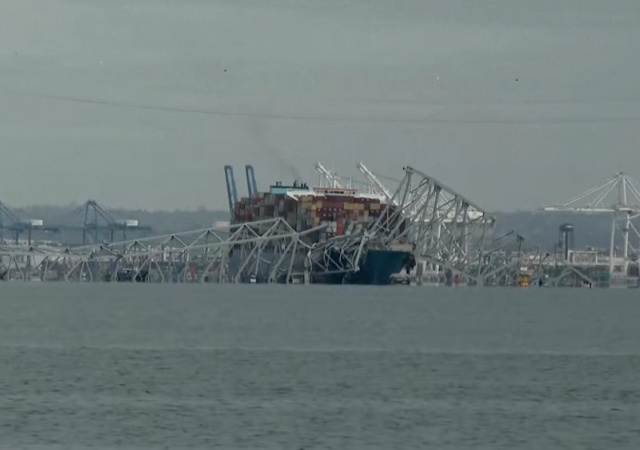
In March 2024, the Francis Scott Key Bridge in Baltimore was hit by a cargo ship that severely damaged the bridge and killed road workers
My colleague Mary Chastain reported last month that reconstruction plans hit a major snag when Maryland officials “canceled a key construction contract.”
Now the Justice Department has unsealed criminal charges against two companies and the ship’s technical superintendent.
The crash killed six highway workers and cut off traffic to one of the US’ largest shipping ports, officials said, adding it will cost billions to rebuild the bridge.
Synergy Marine Pte Ltd, based in Singapore, and Synergy Maritime Pte Ltd, based in Chennai, India, along with Radhakrishnan Karthik Nair, 47, who worked for both companies as the technical superintendent for the “Dali,” are charged with conspiracy, willfully failing to immediately inform the Coast Guard of a known hazardous condition, obstruction of an agency proceeding, and false statements.
“The government’s investigation also found that Synergy employees, including its shore side technical managers, fabricated and directed the fabrication of safety inspections and certifications related to vessel systems,” US Attorney Kelly O. Hayes for the District of Maryland said at a press conference in Baltimore Tuesday. She said investigators believe Nair, who is an Indian national, is in India.
An investigation indicated that the disaster was triggered by a loose wire, allegedly caused by the ship’s operators cutting corners on safety.
The Dali, bound for Sri Lanka, lost power twice in a four-minute span as it moved to sea from the Port of Baltimore, causing it to crash into the Key Bridge in the early hours of March 26, 2024. Investigators say a loose wire in a switchboard likely caused the first power loss that led to its steering failure.
After regaining power, the ship found itself in trouble again. The Dali turned to a certain pump to supply fuel to two generators but the pump was not designed to automatically restart after the first blackout, so a second blackout occurred, the indictment says.
If the Dali had used the proper fuel pumps, according to the indictment, the vessel would have regained power in time to safely get under the bridge. Instead, it crashed into a supporting column of the bridge, killing six construction workers who had been filling potholes.
“As alleged, the bridge was struck and collapsed because those who were responsible for the ship’s operation deliberately cut corners at the expense of safety,” said Jimmy Paul, head of the FBI’s Baltimore office.
BREAKING:The Department of Justice has just filed criminal charges against the Singapore shipping company behind the deadly Baltimore Key Bridge collapse.
"Today, the United States unsealed an indictment charging 3 defendants, Synergy Marine Private Limited, Synergy Maritime… pic.twitter.com/3JAXOXNvz1
— Andrew Kolvet (@AndrewKolvet) May 12, 2026
The proposed penalties for the firms and the technical superintendent are severe.
The state sought damages for the destruction of the bridge, environmental harm to the Patapsco River, lost revenue and broader economic impacts.
The settlement does not resolve any claims Maryland has against the shipbuilder, Hyundai, according to the attorney general’s office.
If convicted, Synergy faces up to five years of probation for each felony count and a fine of up to twice the gross gain or loss tied to the allision.
Nair faces a maximum of five years in federal prison for conspiracy; six years for each Ports and Waterways Safety Act violation; 10 years for each count of misconduct or neglect of ship officers; and five years for each obstruction and false statement count.
Six construction workers filling potholes on a bridge in the early hours of a Tuesday morning never made it home because it appears that safety was shortchanged to save a few dollars.
With Maryland’s rebuild already mired in contract cancellations and billions in costs still ahead, the people of Baltimore and every American who relies on the nation’s ports and bridges deserve to see these charges pursued to the fullest extent of the law if proven in court.
Donations tax deductible
to the full extent allowed by law.







Comments
Good! Nail them!
It deflects blame from safety officials.
Explain what you mean please.
The Feds set up the safety system. When it fails, they have to make it a criminal matter on somebody else rather than a design flaw in the system, which would be their fault.
In 1977, the Federal Government sent out a “survey” which covered all bridges and ports. As I remember it was called “ASH” for American Shipping Hazards. It was a relatively small paper for states and cities to fill out.
The head of the committee which established the survey was from Maryland.
The object was to get information on heights, types, supports, traffic and spans of bridges. The survey also covered maximum height, width, length and displacement of vessels going under the bridge.
The information was to be used to determine the number of “dolphins” or protective piers that would surround the supports of the bridge.
The Key Bridge was opened in 1977 and was not subject to the ASH survey.
However, in 2013, the same survey was sent out (because more bridges had been constructed or replaced in 40 years.)
Neither the State of Maryland nor the City / Port of Baltimore filled the survey out. (As I remember, it was only 11 pages or so.)
If the State and City officials had filled out the survey, barriers to the supports would have been constructed. They did not and so the barriers were not constructed.
That’s the blame that is being deflected.
Now blacklist the individuals, the supervisors of the individuals and the supervisors of the supervisors all the way up the chain. Everyone in any executive function and Board of Directors gets permanently banned from any maritime operation at sea, on shore, in a port so if ‘Big Global Shipping Co’ hires any of these folks that Co is banned from access to US ports. That would be enough to get the attention of the corporatist/globalists and maybe they’d start paying more attention or even hiring US.Citizens to crew their vessels.
“… severely damaged the bridge.”
That’s my nomination for understatement of the year.
I don’t know about this. I watched a maritime engineer explain what his interpretation of the report was and he indicated that a plastic tab used to identify a wire was inadvertently inserted into the slot where the wire belonged. I mean, these ships are freakin’ huge and this guy is looking at life in prison for a plastic tab that was out of place?
I will watch this carefully but I have reasonable doubt here.
best review…What’s Going On With Shipping?
https://www.youtube.com/watch?v=znWl_TuUPp0&t=667s
The label banding was placed over the collar, rather than above it which prevented the wire from being fully inserted in the terminal block.
I watched a video a while back on the trouble they had tracking down why the power dropped out.
https://www.youtube.com/watch?v=wHacCVJAvaA
I’m curious. How come the penalties are so stiff for this captain and crew, but there’s no penalty for a judge letting out a criminal and then the criminal commits murder.
Even though the criminal has a past history of violent behavior.
Maybe these judges should face stiff penalties so that gives some dumb person incentive not to seek such an office.
Because violating established safety regulations is different than trying to predict what a person will do in the future.
One has a hard baseline for compliance, the other is “this may or may not happen.”
it moved to sea from the Port of Baltimore
No. It tried to move to sea. It hit the bridge, instead.
And, maybe the port will insist on tugs all the way past all port obstructions, from now on.
Don’t worry. Gov Moore is putting his dual degrees in civil and structural engineering he earned at MIT to design and build a bridge that will be indestructible after which he will use his J.D. to sue everyone.
I don’t understand the states claims against the ship builder if the feds say that the chief engineer was responsible?
Defects in design and manufacture.
bu he ship appears to have been “as designd and as built”.
:as maintained” seems to have turned the whole thing into a donkey;s breakphast. And once designed and built, the builder is no longer responsible on poor maintainance. That is on the opeVator.
Because the builder hired the chief engineer.
It is very similar to if you get hit on the road by a negligent FedEx driver, you not only sue the driver but FedEx for hiring him, not supervising him correctly, not demanding compliance with rules and regulations, etc.
In short, follow the money and who can pay the fines.