


Appalachia Lithium Cache Could Power U.S. for Centuries
The newly published lithium resource numbers are estimates, and much more work needs to be done to take advantage of our current mineral capacity.
Back in February, I reported that the U.S. Geological Survey (USGS) estimated that 5 to 19 million tons of lithium are located in southwestern Arkansas. That is enough lithium to meet the world’s estimated 2030 demand for lithium nine times over.
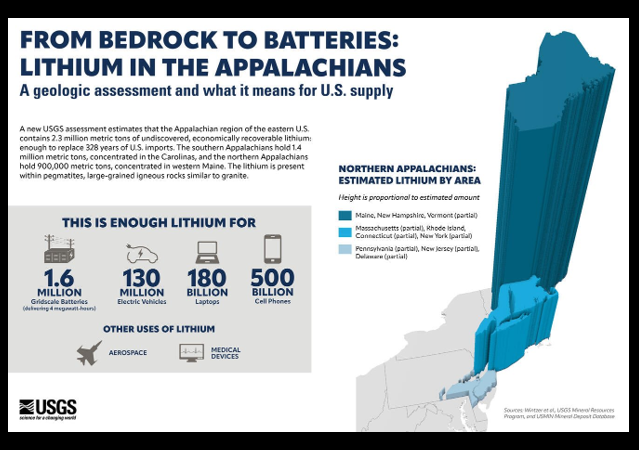
Now the USGS is saying that Appalachia contains an estimated 2.3 million metric tons of undiscovered, economically recoverable lithium, enough to replace 328 years of U.S. imports at last year’s level.
The southern Appalachians hold an estimated 1.43 million metric tons of lithium oxide, concentrated in the Carolinas, and the northern Appalachians hold an estimated 900,000 metric tons, concentrated in Maine and New Hampshire, according to estimates in a new USGS scientific paper published in Natural Resources Research. The lithium is present in pegmatites, large-grained rocks similar to granite.
“This research shows that the Appalachians contain enough lithium to help meet the nation’s growing needs – a major contribution to U.S. mineral security, at a time when global lithium demand is rising rapidly,” said USGS Director Ned Mamula. “USGS mineral science is the leading edge in the effort to restore America’s mineral independence by mapping our nation’s mineral resources. Everything else follows on the science: permitting reform and other policy changes to support investment in clean, responsible mining to 21st century standards, and mining workforce training for new American jobs. The United States was the dominant world producer of lithium three decades ago, and this research highlights the abundant potential to reclaim our mineral independence.”
The United States had one sole producer of lithium and relied on imports for more than half the lithium used last year, factors that contributed to its inclusion on the 2025 List of Critical Minerals published by the USGS. Lithium is used in the lithium-ion batteries that power computers, military equipment, vehicles, phones, electric tools, and energy-grid storage, as well as in aerospace alloys. Additional lithium is imported into the United States every year inside finished products made elsewhere and containing lithium-ion batteries. While Australia is the world’s largest producer of lithium, China is second, and accounts for the majority of world lithium refining and consumption.
🚨 @USGS has found that the Appalachian region of the U.S. contains enough lithium to replace 328 YEARS of imports!
Thanks to world-leading mineral science, permitting reform and renewed investment in domestic mining, @POTUS has reclaimed America's mineral independence. pic.twitter.com/INis76fW6o
— Secretary Doug Burgum (@SecretaryBurgum) April 28, 2026
The country currently operates just one full-scale lithium mine, Albemarle’s Silver Peak facility in Nevada, and this forces domestic automakers and battery producers to depend on imports for over half of their supply. As I have noted before, this situation becomes problematic when a foreign supplier becomes hostile.
As lithium demand is projected to grow more than 48-fold by 2040, driven by electric vehicles and energy storage technologies, securing new domestic sources has become increasingly critical.
USDS Director Ned Mamula notes that the US was the dominant world producer of lithium three decades ago. The newly published lithium resource estimates are preliminary, and much more work is needed to fully realize our current mineral capacity.
To quantify the region’s potential, USGS geologists compiled geologic maps, geochemical data, geophysical surveys, and records of known mineral occurrences. These inputs were combined with global datasets on lithium-bearing pegmatites to model the number and size of undiscovered deposits across the Appalachian belt, which stretches roughly 1,500 miles from Alabama to Maine.
The resulting assessment provides a probabilistic estimate, with a 50% likelihood that the region contains about 2.3 million metric tons of lithium oxide. Actual resources could be higher or lower, and further exploration will be required to determine the extent and economic viability of individual deposits.
The work is part of USGS’s ongoing mandate to assess domestic mineral resources and improve understanding of critical mineral supply potential in the U.S.
“USGS mineral science is the leading edge in the effort to restore America’s mineral independence by mapping our nation’s mineral resources,” said Mamula. “Everything else follows on the science: permitting reform and other policy changes to support investment in clean, responsible mining to 21st century standards, and mining workforce training for new American jobs.”
America is sitting on a lithium bonanza, from Arkansas brines to Appalachian pegmatites, but those world‑class reserves will mean little if Washington, D.C., and eco-activist bureaucrats keep strangling responsible mining with red tape.
We need to use this report as an opportunity to restore real mineral independence at home and end our dangerous reliance on Beijing for “white gold.”
Donations tax deductible
to the full extent allowed by law.







Comments
I am unconvinced that this information would have been revealed in a Harris autopen regime.
Just like fracking, the left seeks to bury this country in undeveloped resources and increased dependence on not necessarily friendly countries.
Like this piece notes, having the resources and using those resources are vastly different things. Leftists seem to be more interested in leaving stuff in the ground to save the local environment, and instead supporting Beijing’s economic growth, with concomitant military growth, human rights abuses, and environmental degradation.
Why is America’s 12% of global CO2 emissions (as of 2023) bad, but Beijing’s 35% of global CO2 emissions acceptable?
That’s great—not just for reducing dependence on China, but also for having resources closer to home instead of shipping them thousands of kilometers on bunker-fuel-powered cargo ships…
Also jobs.
Jobs that are shovel-ready for America’s next generation of public school graduates!
Fostering as much independence from foreign sources by locating and extracting critical minerals/rare earth domestically is an economic and Nat Security imperative.
Maine?
😂😂😂
Those estimates might be true for industrial uses but for pharmaceuticals, that amount of lithium would last about a week and a half in Maine.
It is *far* more likely that the falling-off-the-left-edge-of-the-planet legislature will pass a bill banning any lithium mining in the state than it would to encourage any notion of American self-sufficiency.
Those deposits may as well be on the moon.
Good thing there are plans to build a moon base,
Point of order:
Do you mean a moon base to mine lithium or a place to ship Maine residents?
Hmmmm…. I think we’re going to need a bigger base.
If we’re gonna start launching leftist/commie goofballs off the Earth I’d suggest the Sun as better option than the Moon. No base needed.
I disagree. I like the idea of requiring them to do hard labor. You don’t work you don’t breathe let alone eat. It might be tough though considering how many have never worked.
Maybe someone could put Bernie in charge, in view of his personal experience with commune maintenance.
First laugh of the day!
The blue color of those reserves on that map is exactly right. Blue states. We will never see one pound of ore extracted. Probably some rare insect in the mountains that will be disturbed. And the Chinese will buy off any politician that seems to think mining would be a good idea. The cognitive dissonance of the left will be something to behold, though — “What do you mean I can’t have my electric car because there’s no lithium for the batteries?”
That is what’s going on, China is funding as many groups as possible for this as well as rare earth minerals in our western states. Not hard to figure out who they are paying off.
It worked for the Soviets regarding nuclear power.
great
this would take 4+ more maga agenda admins
you think dems going to let that happen??
They seem to be certain it’s there even though it’s “undiscovered”.
In Bessemer City, NC, there has been a Lithium mine for as long as I can remember (a long time).
A campground and drive-in theatre in Kings Mountain, NC was bought by Albemarle who also bought a church building/land and a bunch of homes and businesses because there’s a large lithium deposit adjacent to an old mine that use to be run by Foote Mineral.
There’s gold in them there hills! Speaking of which, there once were gold mines in Kings Mountain, NC.
The old Reid’s gold mine as well above Charlotte.
russia and china will fire up their useful idiots for more marches, lawsuits and overall idiotic behavior to try and stop progress.
Buried under a bunch of idiot libtards. They’ll never extract an ounce.
Yup. Hell, my small VT town couldn’t even get a wood pellet plant built at the sight of an old Ethan Allen furniture plant. The locals in northern NE would love the high paying mining jobs with the collapse of the paper industry but progressives in Bangor, Manchester and Montpelier will fight it tooth and nail
The key thing is it needs to be kept for the U.S. and not exported.
That’s nice. Care to guess how much mining MA, northern NH and eastern VT are going to allow?
Eastern ME not MA
Maybe pass a law requiring some amount of locally mined lithium in all batteries sold in those states where lithium is present. No mining no batteries. No batteries no phone, computer, car, or power.
“(USGS) estimated that 5 to 19 million tons of lithium are located in southwestern Arkansas. That is enough lithium to meet the world’s estimated 2030 demand for lithium nine times over.”
Or to keep all of America’s Democrats emotionally stable for four months!