


Book Review: “Be A Refusenik: A Jewish Student’s Survival Guide”
It took courage to be a refusenik—just like it takes courage to be a proud Jew on campus today.
A delightful lithograph hangs in the Berkeley Jewish Art Museum, a block west of the University of California’s rattled flagship campus. It shows its creator, originally a Soviet underground artist, Eugene Abeshous, dressed as a Fiddler on the Roof extra, disembarking at Eretz Yisrael. The work is called Jonah and the Whale in Haifa Port because instead of a cruise liner, its protagonist exits the gaping mouth of a sea monster. Abeshous tells the story that was once on the front pages of American newspapers, but is now nearly forgotten—that of Soviet Jews leaving the belly of the beast.
In her recently released Be A Refusenik: A Jewish Student’s Survival Guide, historian of Soviet Jewry Izabella Tabarovsky used the struggle of the Soviet Jews in the 1970s and 80s as an inspiration for the young Americans facing antisemitism on college campuses. Tabarovsky put the half-century-old experiences of my and her parents’ generation side-by-side with the conflicts defining the lives of our children. Even if we are “separated by decades, borders, and ideologies,” she showed how the mindset of refuseniks can—and does—inspire the students today.
Refuseniks were the Soviet Jewish dissidents who were denied permission to make aliya. My maternal uncle, for instance, applied for his exit visa in 1980, lost his scientist job, had many unfortunate encounters with the sadistic Soviet bureaucracy, and was finally granted passage in 1987, after he made it on the Ronald Reagan list of 100 refuseniks.
My uncle was perhaps luckier than most, but this was a fairly typical refusenik fate. Yet when Tabarovsky tells American students to be refuseniks, she highlights another meaning of the word—the one who refuses to surrender to the forces of evil. Her book teaches how to dive into Jewish history to find the inner strength to resist.
In one key respect, Soviet antisemitism was similar to the contemporary American antisemitism—it sells itself as antizionism. In fact—and this is something Tabarovsky discussed in her Legal Insurrection lecture—our antizionism was invented by the Soviets; it was a product of the virtual freakout over the 1967 defeat of its Arab clients. The Antizionist tropes animating the vocabulary of American college professors are traceable to Brezhnev-era Soviet propaganda.
Antizionism, Tabarovsky shows, was something that Soviet Jews, like their contemporary American counterparts, experienced on a personal level—the hysteria whipped up in the media and echoed in local Communist meetings made Jewish existence unsafe. But the defiant Zionists inverted fear and responded with pride. For instance, when his bosses brought out Nathan Sharansky for a Soviet humiliation ritual before his entire institute and started drilling him about his Jewish ideological leanings, Sharansky responded by giving a brief lecture on modern Israeli history—and found an “intrigued” audience in his co-workers, many of whom, I’m sure, found it liberating to hear Soviet propaganda exposed.
Tabarovsky found many inspiring examples of Jewish resilience. She talks about the Georgian Jews who created their own Hebrew textbook, drowning their typewriter in a local stream afterward to avoid detection, and the pregnant Marina Furman who lit the menorah in her window for her KGB tail to observe.
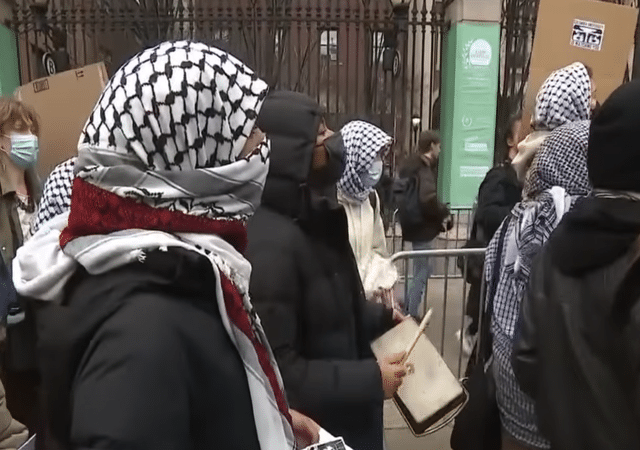
It took courage to be a refusenik—just like it takes courage to be a proud Jew on campus today. Tabarovsky cites many instances of the latter, like Elisha Baker, who got his shirt set on fire by the rioters in an antizionist campus encampment set up in the aftermath of the 2023 Simchat Torah massacre.
Highlighting similarities in Jewish resilience, Tabarovsky isolates the themes common to both the Soviet and the contemporary American experience that form what she dubs the “refusenik mindset.” She advises young Americans to “reclaim […] Zionism,” dedicate themselves to Jewish learning, bond with allies, “do the unexpected,” “reject victimhood,” and “lead with Jewish.”
“Lead with Jewish” is her most potent point. The author sees the refusenik mindset as an inversion of the “edgy intersectionalism” and an alternative for all Americans. Like the Soviet Union a century ago, Western wokesters promise universal liberation, requiring Jews to surrender their interests to the project. Tabarovsky rejects this option:
[R]ather than sacrificing your interests for yet another utopian vision, do what worked so gloriously for the refuseniks: Lead with your Jewish identity and your sense of what’s right for the Jewish people.
Chances are, you will discover […] that this path naturally aligns with the core values of American liberal democracy, with its emphasis on individual rights, equality before the law, pluralism, free speech, and constitutional checks and balances. And that, in turn, will place you alongside those committed to upholding one of the greatest democratic traditions humanity has ever built.
“Lead with Jewish” was a natural, if not an easy choice, in the USSR. As Aleksander Smukler, one of Tabarovsky’s heroes, quipped, “In the USSR, Zionism was like sex: There was no one to ask a question.” Everything Jewish was a target for the regime, which made it defiant, placing those with swarthy features and German-sounding names in leadership roles by the very virtue of their existence.
Tabarovsky quotes the Boston College professor and former refusenik, Maxim Shrayer, who believes that:
By the early 1980s, the KGB had largely succeeded in ‘bringing the dissident movement to a standstill through intimidation, trials, arrests and imprisonments, and the forced exile of dissidents.” But the Jewish refuseniks, all while facing the kinds of repressions described earlier, remained “the only standing force and movement of Soviet citizens who were defiant and publicly challenged in the Soviet regime—in their struggle, political, religious, and cultural activities, protests and performances, and daily lives.”
Shrayer probably overstated the case. If refuseniks remained the last standing overtly political movement, a small offshoot of the defanged dissidents mutated into and flourished as an underground bohemian culture that aimed, in the Russian-Jewish poet Joseph Brodsky’s turn of tongue, to “live vne,” or totally outside the Soviet social and cultural paradigms. Consider that Abeshous’s Jonah, with his soulful skyward gaze, bears a resemblance to other Brezhnev-era underground artists of his native St. Petersburg—I’m thinking specifically of the mitki movement. He was looking for a way of life void of Soviet officialdom—and found it in his Jewish heritage.
What made Jews unique among other Soviet ethnicities—or nationalities in Soviet parlance—is that Stalin didn’t consider us a nation because he didn’t connect us to a language and a land. This tentative status of Russian-speaking Jews came with multiple silver linings.
To properly propagandize the nations of the former Soviet empire, Stalin took the nationalist form and filled it with Soviet content. They invented post-revolutionary folklore fully aligned with Communist ideology and gave it to the ethnicities of the USSR. This practice started under the Korenization policy of the 1920s and went on until the dissolution of the USSR. For instance, the Friendship of the Nations Fountain, built in 1954 at the Exhibition of Achievements of National Economy in Moscow, shows gilded peasant girls in folk costumes representing the fifteen main ethnicities of the Union, supposedly living in happiness and plenty under the Soviet regime.
Jews, as Tabarovsky pointed out, were never treated this way, which was a bit lonely and plenty scary. However, it also made us singular.
Moreover, Korenization compromised folklore. And yet at no point of Soviet history did citizens turn on the TVs to discover to their utmost bewilderment that the Communist Party realized the age-old aspirations of the Jewish people as expressed in the story of Jacob and Esau—or to hear a klezmer song praising the people’s plenum.
Tabarovsky explained that following the Bolshevik Revolution, the Soviet regime deployed Yevsektsia—a small band of Bundists—to root out the Jewish tradition. Yevsektsia went after the Hebrew language, Zionism, and more broadly, the Jewish religion, but it hasn’t offered a reliable substitute. When, decades later, Soviet Jews began rediscovering their heritage, it was positioned completely outside of the official culture. Everything Jewish that we did was authentic—and completely vne.
It doesn’t mean that we never got anything wrong. In my native Kharkov, it was possible to get underground matzos for Passover. We had no idea what to do with them, so we ate them alongside bread. But the impulse was pure, and the custom was free of Stalinist legacy.
Here, too, we can draw a parallel to the contemporary U.S. because our institutions turned on Jews. Even Jewish organizations are largely toothless. “Young American Jews on campus,” Tabarovsky writes:
Don’t yet have a movement to join. October 7 revealed as much of a failure of Jewish establishment organizations as it did of Israeli security services and the IDF. Having failed to forestall—or even envision—the entrenchment of antisemitism in academia and progressive circles, many also proved too timid as campus erupted in anti-Jewish hate. These organizations are unlikely to produce a vision and ideas for the world in which young American Jews find themselves.
This makes all grassroots Jewish and Zionist life authentic—and attractive.
So why not be bold and, like Tabarovsky advises, do something unexpected? Unlike the Soviet Jews who were fighting to leave the inhospitable land, American Jews are fighting to stay in the largely friendly country whose very character was shaped by the intellect and creativity of our ancestors. After two thousand years of exile, America remains the last great diaspora standing. The Simchat Torah massacre might have been the beginning of the end of diaspora, but the country is worth fighting for, and it could just be the opening of a new chapter.
Donations tax deductible
to the full extent allowed by law.







Comments
I’d like to underline Katya Sedgwick’s penultimate phrase, “the country is worth fighting for”, because it must be understood that the ones trying to make life uncomfortable for the Jewish students in our educational institutions; those that feel they must wear the black and white checkered schmatas as a sign of their agression really wear them to keep their IQ above room temperature
There’s much to argue with in this review. There’s no question that antisemitism in various manifestations and depending on what period we’re talking about was an indelible part of the Soviet system, but the Soviet Jewish case is much more complex and intricate than what is presented here. Jews were in fact recognized as a legitimate ethnicity in the Soviet Union; Yiddish culture was flourishing in the 1920s and even parts of the 1930s and was revived to a limited extent from the 1950s and on. Most importantly many Soviet Jews maintained their Jewishness and had to find ways of doing so in a hostile environment. Many had matza on Passover and knew what it meant and read books that contained Jewish pieces that were published officially, as I discussed in my book The Soviet Jewish Bookshelf. Jewish collective memory in the Soviet Union was fragmented, but it was never erased and the Soviet Jewish experience cannot be reduced to the few refuseniks.
I never said that we weren’t “recognized” as a “legitimate” ethnicity. It was in passports, after all. What I said is that korenization projects avoided Jews for the most parts—and as a result, our culture was authentic.
Of course the Soviet Jewish experience can’t be “reduced” to a few refuseniks—like the Soviet experience in general can’t be reduced to dissidents. But Jewish culture was generally invisible and mostly underground in the Brezhnev era on which I focus.
Not exactly – Soviet Yiddish schools in the 1920s, Yiddish was one of the official languages of the Belorussian republic, etc. So Jews were very much part of the state policies in the 1920s and 30s. They were fully integrated into the overall society. Absolutely – there was very little public space for expressing Jewishness in the post-Stalinist eras, which is why Jews had to invent other discreet ways of cultivating their Jewishness, for instance through their home libraries.
I find the claim that Jews were fully integrated into the pre-war BSSR society strange considering that that society turned on them in a New York minute once Hitler invaded. That aside, Minsk was the most Jewish large city of the Russian Empire around the turn of the century. It’s not surprising that some accommodations had to be made.
Yes they did benefit from korenizatsiia and the culture that was created was both state-sponsored and “authentically” (inasmuch as there is such thing as cultural authenticity) Jewish. Below are quotes (with citations from 4 top Soviet Jewish historians). So what you say about Soviet Jews in the inter-war era is incorrect.
“During the interwar period, Minsk grew to be one of the world capitals of Yiddish language and culture. With the support of Soviet nationality policy, the language assumed a position of public prominence that it had never enjoyed before. Chapter 4 maps out the main stages of the Yiddish experiment, or the Jewish korenizatsiia campaign to promote the use of the language in the spheres of bureaucracy, culture, education, and everyday life on the Jewish street. … Enshrined in the Belorussian constitution, the new official status of Yiddish, together with the state support for Yiddish cultural, educational, and scholarly enterprises, turned the Belorussian capital into one of the most successful examples of the Yiddish experiment in the Soviet Union.” (Elissa Bemporad, “Becoming Soviet Jews,” 5)
“In tandem with these anti-religious and anti-nationalist campaigns, a flourishing of secular Jewish cultural life emerged in the Soviet Union that has largely been ignored by foreign observers. Although official Soviet nationality policy initially denied the Jews national status on the grounds that they lacked a territorial homeland, the Jews were accorded many of the same rights as the official minority nations, including the right to use one of their own languages—Yiddish. As a result, during this period Jewish writers and poets composed epic works that were published by one of the world s largest Yiddish-language printing presses;9 Yiddish folk singers and klezmer bands toured the country and released phonographic recordings; ethnomusicologists recorded, arranged, and published the tunes of the Jewish shtetls. Jewish research institutions, libraries, and museums were established in Kiev, Minsk, Odessa, Leningrad, Moscow, Georgia, Biro5 bidzhan and Samarkand; hundreds of thousands of Jewish students attended Yiddish-language schools; and seven State Yiddish Theaters entertained audiences nightly. In an effort to solve the Jews’ longing for a territorial homeland and to secure for the Jews the territorial underpinnings of nationhood, the Soviet Union even established a Jewish Autonomous Region in Birobidzhan in 1934, where Yiddish was promoted as an official language” (Jeffrey Veidlinger, “The Moscow State Yiddish Theater,” 5-6)
“In the 1920s, the Soviet Union was the only country in the world to have state-sponsored Yiddish-language publishing houses, writers’ groups, courts, city councils, and schools. The Soviet Union also supported the creation of a group of socialist Jewish activists — a Soviet Yiddish intelligentsia — dedicated to creating a new kind of Jewish culture for a new kind of Jew. (2) … Although some non-Soviet Jews accused the intelligentsia of self-hatred because they suppressed traditional expressions of Jewish identity, their actions are better viewed as an attempt to wrestle with the question of Jewish identity. In place of these institutions, the intelligentsia established new Yiddish ones that would inculcate a new secular Jewish identity.” (David Shneer, “Yiddish and the Creation of Soviet Jewish Culture: 1918–1930,” 11)
“…the Soviet cultural programs directed at Jews reached their targeted audiences and helped to develop a positive ethnic identity associated with the Soviet regime. This identity, though short-lived, was almost universal among Soviet Jews of the interwar period, and played an important role in how Jewish consciousness has been transmitted to subsequent generations. The examination of its features reveals implications of Soviet policies toward nationalities during the interwar period and of Soviet society in general.” (Anna Shternshis, “Soviet and Kosher,” xiv)
How does that go against my claim that Jews avoided korenization for the most part?
Although Yevsektsia promoted Yiddish over Hebrew and a remote Siberian settlement was created for the purpose of resettling Jews, both Lenin and Stalin understood that Jews will assimilate and all of those developments were short-lived.
When other nationality cultures were ubiquitous—and inauthentic—anything and everything Jewish had to be actively sought after.
Also the claim re the largest state-owned Yiddish press sounds like it was written in Lubianka. Why would a free country have a state-owned Yiddish press?
the violent only understand violence when it outdoes them