


DOE Unveils Nearly $1 Billion Fund to Boost Domestic Critical Minerals Supply Chain and Manufacturing
Meanwhile, China has inspired other nations to make plans to reshore their rare earth mining and processing capacity.
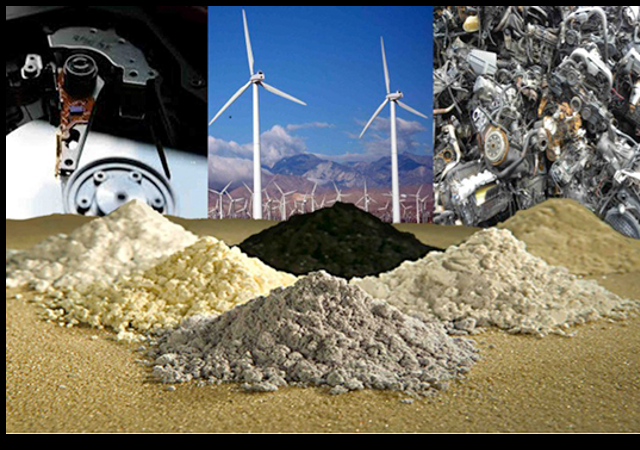
President Donald Trump came into office clearly interested in reshoring key industries and developing new ones.
One of the most significant goals for the Trump administration is the development of our rare earth mineral mining and refining capacities. China has essentially created a monopoly on substances essential for modern technologies, which has led to threats to supplies currently coming into this country.
Furthermore, cuts have already been made on shipments going to defense contractors (as my colleague Mary Chastain reported). Ford Motor Company was also forced to temporarily halt parts of its electric vehicle (EV) production as a result of these restrictions on critical rare earth minerals and rare earth magnets. These materials are essential for the production of electric motors, as well as several important components in both EVs and other vehicles (e.g., steering systems, seat motors, and wiper motors).
We already knew that this issue impacted Ford Explorer production at the Chicago Assembly plant recently, as The Blue Oval paused it last week after one of The Blue Oval’s suppliers rain out of magnets, which are used in that model to operate braking and steering systems, power seats, fuel injectors, and various other components. The plant reopened shortly thereafter, according to a Ford spokesperson, who added that the automaker had already decided not to keep it running for a week in the coming months regardless of this shortage. The company simply chose to shift that downtime due to the disruption in rare earth magnet supply.
Now, the U.S. Department of Energy (DOE) has plans to issue nearly $1 billion in funding directed at developing technologies for mining, processing, and manufacturing critical minerals in this country.
The department intends to offer funding to advance and scale up mining, processing and manufacturing technologies in the critical minerals and materials supply chains, sectors that have been dominated by China and other countries, the statement said.
“For too long, the United States has relied on foreign actors to supply and process the critical materials that are essential to modern life and our national security,” said Energy Secretary Chris Wright.
The department said the move is aligned with President Donald Trump’s executive order on maximizing energy development.
The department’s Office of Manufacturing and Energy Supply Chains (MESC) intends to offer up to $500 million in funding to expand U.S. critical minerals and materials processing and battery manufacturing and recycling.
The programs also include up to $135 million for rare earth elements supply chain development, $250 million for converting industrial byproducts into minerals, and $50 million for rare earth magnet and semiconductor materials processing.
But the U.S. is not the only nation taking proactive steps for reshoring critical mineral capabilities. Australia is providing over $1 billion to one firm in the quest to develop rare earth refining processes.
And that is one of the reasons the Australian government is loaning Iluka A$1.65bn ($1bn; £798m) to build a refinery to meet demand for rare earths which Iluka sees growing by 50-170% by the end of the decade.
“We expect to be able to supply a significant proportion of Western demand for rare earths by 2030. Our customers recognise that having an independent, secure and sustainable supply chain outside of China is fundamental for the continuity of their business,” says Mr McGrath.
“This refinery and Iluka’s commitment to the rare earth business is an alternative to China.”
Meanwhile, an Indian firm is seeking partnerships with Japanese and South Korean companies for the production of rare earth magnets.
India’s state-owned miner IREL is seeking to collaborate with Japanese and South Korean companies to start commercial production of rare earth magnets, a source familiar with the matter said, as part of efforts to reduce reliance on China.
The company is looking at both Japan and South Korea for rare earth processing technology, potentially through government-to-government channels, the source said, declining to be named as the discussions are not public.
Old and Tired: Green Energy Grifting.
New and Hot: Rare Earth Mineral Reshoring. https://t.co/bjxCXIaQ6i— Leslie Eastman ☥ (@Mutnodjmet) August 15, 2025
Donations tax deductible
to the full extent allowed by law.






Comments
Despite the crying need for rare-earth production, any time the US government attempts to pick winners and losers by subsidizing them, it always turns out to have been a horrible mistake. There are already projects in development, including one in my home state of Wyoming:
https://cowboystatedaily.com/2025/07/11/first-u-s-rare-earth-mine-in-70-years-opens-in-wyoming/
There is the existing rare-earth mine on the CA/NV border:
https://mpmaterials.com/mountain-pass
These are privately developed mines that do not need taxpayer dollars thrown at them. Heck, there’s a mine just outside of Nye, MT (the Stillwater mine) that just cut a huge number of miners and processors from their jobs…because the price of palladium has dropped like a rock.
Just get rid of the EV mandates and buyer subsidies from the various government entities and it will kill that horribly non-economic use of rare-earth element in the motors and batteries that is chewing up usage. Kill the bird-chopper (wind-power) subsidies and their usage of materials for generators and power-grid equipment will also cause that usage to dwindle to almost nothing.
Just keep the government the heck out of the economy, other than to protect the rights of the people, and we’ll be a lot better off.
Good news! These trade deals are ultimately about Communist China.
I think I am correct in saying that the biggest obstacle to our own domestic critical mineral mining and processing is the incredibly burdensome and expensive regulatory burden imposed by our own agencies both federal and state.
China is free of these burdens, not just environmental ones but those including any about using child and slave labor
Unless and until we unshackle our own industries from the dead hand of progressive bureaucracy, money is the least of reasons why we are forced to depend on our enemies for critical resources.
I hope all of our needed agencies involved are planning for this obstruction with lawyers and ‘how to’ methods to deal with the dirty part of this process. One of the benefits of free enterprise is we learn how to clean up our messes.
“For too long, the United States has relied on foreign actors to supply and process the critical materials that are essential to modern life and our national security,”
Isn’t it amazing that big players in the party who can’t figure simple s* like this out are somehow monster investors in the stock market, instead of crashing and burning regularly with all their eggs in one basket?