


When Primate Politics Turn Deadly: ‘Civil War’ Shattering Uganda’s Ngogo Chimps
Another interesting addition to the 2026 Bingo Card.
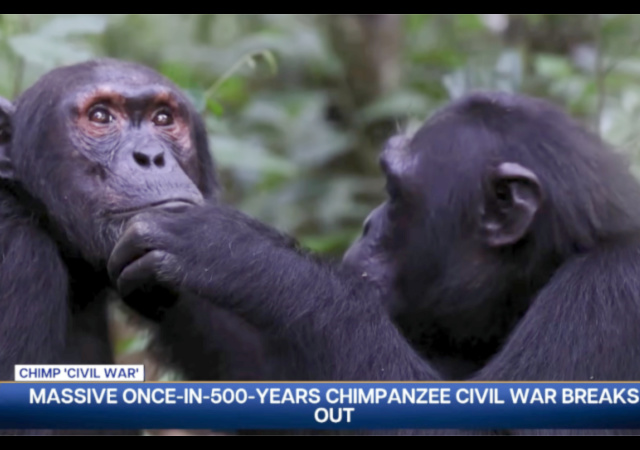
In the depths of Uganda’s Kibale National Park, an extraordinary and unsettling drama is unfolding.
However, this battle is not in a human legislature or courtroom, but is occurring within the world’s largest known community of wild chimpanzees. Once a cohesive society, the Ngogo chimps have splintered into rival factions locked in a brutal, years‑long conflict that researchers are now calling a “civil war.”
A community of around 200 chimpanzees living in Uganda’s Kibale National Park has fractured into two warring factions, with one group launching a years-long campaign of lethal attacks against the other.
The Ngogo chimpanzees have been studied continuously for three decades, but in recent years scientists have watched as a violent split unfolded in slow motion.
From around 2015, what had been a single cohesive group began to polarise. Social ties frayed, neighbourhoods within the community hardened into distinct factions and shared territory became a contested border. By 2018, the break was permanent.
What followed was remarkable – and troubling. The smaller of the two groups – the Western chimps – began making targeted raids into the territory of the larger Central group. Over the next six years, they killed at least seven adult males and 17 infants.
🇺🇬WORLD’S LARGEST WILD CHIMPANZEE GROUP LOCKED IN BLOODY CIVIL WAR
In Uganda's Kibale National Park, a Ngogo chimpanzee community of nearly 200 split into two rival subgroups in 2018.
A permanent split of a formerly tight knit chimp troop is exceedingly rare.
Since then, the… pic.twitter.com/47JZ4OFb1j
— NewsForce (@Newsforce) April 10, 2026
The news stems from a report published in Science. Lead author Aaron Sandel summarized the sequence of events.
Sandel said he first noticed them polarising in June 2015, when the Western chimpanzees ran away and were chased by the Central group.
“Chimpanzees are sort of melodramatic,” he said, explaining that following arguments there would ordinarily be “screaming and chasing” and then later, they would grooming and co-operating.
But following the 2015 dispute, the researchers saw that there was a six-week avoidance period between the two sets, with interactions becoming more infrequent.
When they did occur, Sandel said they were “a little more intense, a little more aggressive”.
A spate of deaths may have triggered the more recent violence, which appears to be ongoing.
The report suggested several things might have contributed to the split, including the sheer size of the group, which at one point was made up of nearly 200 chimpanzees and more than 30 adult males.
That may have led to “heightened feeding competition”, “reproductive competition” and weakened social ties following the deaths of several chimps in early 2014.
The group is still being observed, according to Dr Sandel.
“And the conflict is ongoing,” he said
Furthermore, according to the Science report, a respiratory epidemic killed off chimps that were connected to two factions that are now warring.
A third factor may have contributed to the fission. In January 2017, a respiratory epidemic killed 25 chimpanzees, including four adult males and 10 adult females (48). Although this occurred after polarization was already underway, it may have hastened the final separation. Two of the adult males that died were part of the Western cluster, and one of them was among the last individuals to connect the two groups. Taken together, these events suggest how networks may fracture in the face of multiple demographic and social changes (11, 49).
As researchers continue to chronicle this unprecedented “chimpanzee civil war,” the Ngogo conflict offers a haunting glimpse into how fragile even the most seemingly cohesive societies can be when stress, scarcity, and loss disrupt their balance.
That being said, I must admit I did not have “chimpanzee civil war” on my 2026 bingo card.
Another interesting item to add to the 2026 Bingo Card. https://t.co/hTTGS0QWfA
— Leslie Eastman ☥ (@Mutnodjmet) April 13, 2026
Donations tax deductible
to the full extent allowed by law.





Comments
It all started with Babrack Orangubama.
That wins the internet of the day award.
The chimpanzee is intelligent but not peaceful. They could learn much from the Bonobos.
The bonobos ain’t all that peaceful either. The myth of the peaceful and hypersexual bonobos is mostly the product of Western sociologists.
It’s all relative brother.
How soon will the democrats seek in the name of diversity to have them migrate to Chicago NYC LA Baltimore St Louis and Detroit (for starters).
There is a documentary of the chimpanzees of Ngogo
It’s worth watching and incredibly sad in parts
It was done a few years ago
I also wondered if the humans filming them influenced this is anyway
I don’t think these are many Jane Goodalls around
It’s rough out there in the wild
Wait, I saw this movie!
The group led by Caesar wins.
I didn’t realize it was a documentary.
Was there “wealth” disparity …. DEI? Did they see a documentary on European migrants?
Why is this “troubling”? I bet 99% of people couldn’t find that region let alone country on a map and never heard of the chimps. This is in the “so what” category.
I watch wild burro barfights on closed-circuit video almost every night. No big thang.
The BBC thinks viewers ought to take this seriously. Seriously?
Can we rule out if any of them are trans?
Cuz…. themes.
Blame Trump. Or global warming. Or Zionists. Or the lack of “common sense gun reform”. Or racism. Or ICE. Whatever.
As a straight white male I’m certain this will somehow be all my fault.
I’m gonna go out on a limb (pun intended) and suggest we’ll soon see lectures about how this is a cost of climate change.
Ngogo?
I thought it was No Go. As in some places the police won’t go…
Leave a Comment