


January 2026 Inflation Eases a Bit to 2.4%
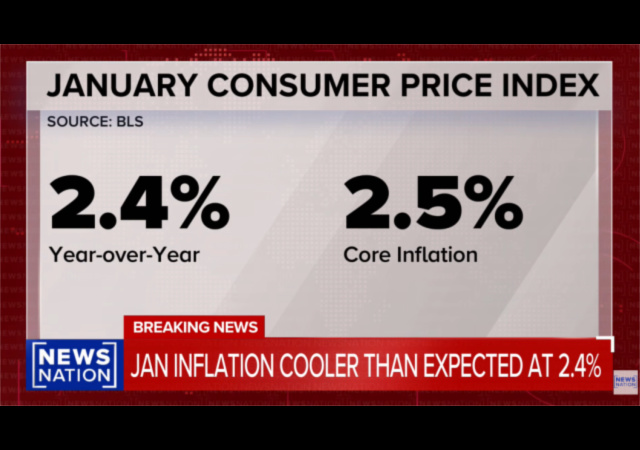
The core CPI, which eliminates food and energy, hit 2.5%, the lowest since 2021.
We had a decent January jobs report.
We now have a solid January inflation report.
The Consumer Price Index (CPI) for all items eased slightly in January to 2.4%, down from 2.7% in December.
The core CPI, which eliminates food and energy, hit 2.5%, the lowest since 2021.
Core CPI is at the lowest level since 2021. pic.twitter.com/Nbs3l2vdFG
— Geiger Capital (@Geiger_Capital) February 13, 2026
You can thank the decrease in energy prices for the low inflation all prices index because some shelter and food prices went up, but not enough to cause a panic:
The index for shelter rose 0.2 percent in January and was the largest factor in the all items monthly increase. The food index increased 0.2 percent over the month as did the food at home index, while the food away from home index rose 0.1 percent. These increases were partially offset by the index for energy, which fell 1.5 percent in January.
The index for all items less food and energy rose 0.3 percent in January. Indexes that increased over the month include airline fares, personal care, recreation, medical care, and communication. The indexes for used cars and trucks, household furnishings and operations, and motor vehicle insurance were among the major indexes that decreased in January.
The all items index rose 2.4 percent for the 12 months ending January, after rising 2.7 percent for the 12 months ending December. The all items less food and energy index rose 2.5 percent over the last 12 months. The energy index decreased 0.1 percent for the 12 months ending January. The food index increased 2.9 percent over the last year.
Let’s nitpick:
Food
- Food at home: +2.1% in 12 months, +0.2% in a month
- Cereals and cereal products: +3.4%% in 12 months, +1.2% in a month
- Flour: +1.7% in 12 months, -0.8% in a month
- Bread: +2.9% in 12 months, +0.0% in a month
- Meats, poultry, fish, and eggs: +2.2% in 12 months, +0.2% in a month
- Meats (all): +9.2% in 12 months, +0.6% in a month
- Ground beef: +17.2% in 12 months, +1.6 in a month
- Fresh & frozen chicken parts: +2.1% in 12 months, +0.3% in a month
- Eggs: -34.2% in 12 months, -7.0% in a month
- Milk: +0.3% in 12 months, +0.4% in a month
- Cheese and related items: -1.2% in 12 months, +0.6% in a month
- Fruits & veggies: +0.8% in 12 months, +0.1% in a month
- Apples: -0.5% in 12 months, -1.3% in a month
- Bananas: +5.4% in 12 months, -0.7% in a month
- Potatoes: -2.3% in 12 months, +0.9% in a month
- Lettuce: +4.2% in 12 months, -2.8% in a month
- Other fresh veggies: +1.4% in 12 months, -0.7% in a month
- Pop: +3.5% in 12 months, +1.5% in a month
- Coffee: +18.3% in 12 months, -0.9% in a month
- Sugar: +3.0% in 12 months, +2.6% in a month
- Butter: -5.0% in 12 months, -2.1% in a month
Energy
- Energy: -0.1% in 12 months, -1.5% in a month
- Gasoline (all types): -7.5% in 12 months, -3.2% in a month
- Gasoline (regular): -8.0% in 12 months, -3.4% in a month
- Electricity: +6.3% in 12 months, -0.1% in a month
- Utility (piped) gas service: +9.8% in 12 months, +1.0% in a month
Medicine
- Medical care commodities: +0.3% in 12 months, -0.1% in a month
- Prescription drugs: -0.5% in 12 months, 0.0% in a month
- Nonprescription drugs: +0.9% in 12 months, +0.3% in a month
- Health insurance: -2.2% in 12 months, -1.0% in a month
Shelter
- Shelter (overall): +3.0% in 12 months, +0.2% in a month
- Rent of primary residence: +2.8% in 12 months, +0.2% in a month
- Owners’ equivalent rent of primary residence: +3.3% in 12 months, +0.2% in a month
- Lodging away from home: -2.0% in 12 months, -0.1% in a month
Donations tax deductible
to the full extent allowed by law.






Comments
The Trump admin is making a real effort on the regulatory front to reduce economic friction which will lower prices. There’s a solid but growing effort to tackle fraud in some govt spending programs. The downside is lack of commitment to fiscal discipline aka balance the budget. Admittedly that’s a tough ask with lots of vested interests who will squeal loudly and fight aggressively against any effort to push their snout out of the trough. Gotta start getting a handle on it or we’re done. We spent $1.2 Trillion on interest payments last year, that’s 20% more than on the entire Defense Budget while adding another $2 Trillion to the National debt, now $38 Trillion with projected $2 Trillion ish annual deficits hereafter in the best case.
IMO the WH needs more humility in its communication strategy about ‘affordability’. It’s ok to reference the wins on the policy front but with the caveat of ‘we’ve got more to do’. An over reliance on Dow Jones is ineffective b/c what is up today is down next week and the problem that for most folks the stock market is not a ‘thing’ they own. The wealthiest 10% own over 93% of stocks/mutual funds/ETF. The bottom 80% own only 1% of stocks/, Mutual funds and ETF which leaves the last 6% owned by the 81st to the 90th%.
Stock market highs are cold comfort for the bottom 80% who don’t own stocks when prices have gone up significantly since 2019. Home price per sq ft up 52%, rent up more than 30%, healthcare up 17%, grocery prices up 26%, utilities up 41%. Sure inflation IS slowing but prices are still rising even from these sharply elevated levels. Telling the majority of the voters that things are great when they struggle to make ends meet is poor communication strategy.
The stock market doesn’t affect you if you don’t own stocks? Do you have a job? A pension? Do you buy any goods or services? Does the state of the economy impact you in any way? You might want to walk that back.
No strawman arguments please. I didn’t make any such that ‘the stock market doesn’t affect you if don’t own stocks’.
Let’s look at your assumptions anyway. Firstly a pension? Outside of Govt employees hardly anyone has a ‘pension’ anymore. Not in the way you seem to imply as a defined benefit; work 30 years and get a set income for life with maybe a small cola adjustment annually.
Most folks have a defined benefit pension aka a 401K or 403B with an IRA on the side. There are employers who push $ into it on behalf of employees but with vesting requirements and higher turnover rates they don’t quite work as well as we’d like. Even with 401K, 403B and IRA the bottom 80% only hold 1% of the stocks, mutual funds and ETF.
Jobs? Presumably you believe the stock price sets the # of employees. Why would a decline or rise in the price of a stock independent of other factors cause a rise or fall in the number of employees? It wouldn’t. Otherwise privately held companies and small businesses wouldn’t know whether to expand or contract their workforce.
Cost of goods and services has jack squat to do with the stock market valuation. Supply and demand sets the price for goods and services. That price point can be influenced by inflation which isn’t the price but the devaluation of the $ by increasing the money supply. If there are only $100 in circulation and the Fed prints $10 additional then the value of each $ has declined by 10%. That will show up in lost purchasing power.
Wall St isn’t the ‘Economy’ and the stock prices are a very poor measure of economic health. For example if a particular Corporation increased net profits by 25% year over year the stock price would rise. If they achieved this by closing down plants in Anytown, USA to take advantage of cheaper labor overseas with far less regulatory compliance costs the ‘economy’ in Anytown, USA would not be improved much less healthy. This process occurred over the last three decades and corporate profits increased, the stock market valuation went up but the ‘economy’ didn’t improve in the very many places the manufacturing plants, the mills and the mines were shut down. The move to globalism and financialization in service of corporatism devastated the broad middle class and hurt the economies of large sections of the USA.
I’d remind you that the stock market is supposed to be ….well …a market. Prices are supposed to go up AND go down. They ain’t supposed to only go up. Rising prices benefit the Current owners (aka sellers) while falling prices benefit prospective owners (aka buyers). It works the same way for any asset price like home prices a higher price is great for the seller, but not so great for the buyer.
The accepted measure of the heath of an economy is the GDP not ‘stock prices’. The formula is
C+ I + G +(X-M) or
Consumption + Investment + Govt spending + net exports (exports – imports) = GDP.