


Supreme Court Seeks Briefing on Constitutionality of Race-Based Redistricting in Louisiana
After a federal court ordered Louisiana to add a second majority-black congressional district to comply with the Voting Rights Act, a different federal court found the state violated the 14th and 15th Amendments by considering race when crafting the district
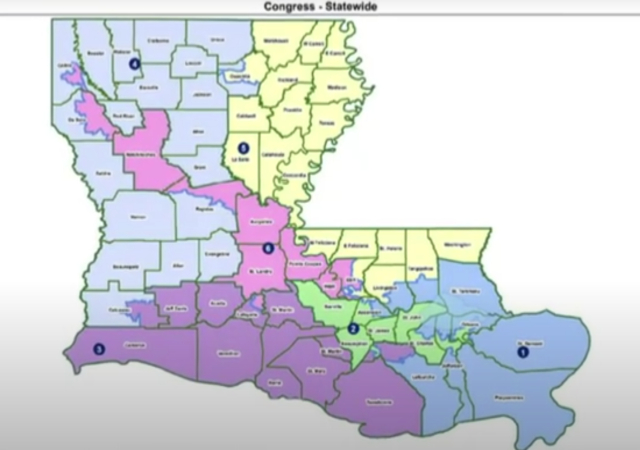
The U.S. Supreme Court on Friday directed parties in a Louisiana congressional redistricting case to brief the Court on whether intentionally creating a majority-black congressional district violates the U.S. Constitution.
The order for supplemental briefs signals the Court may want to reconsider its jurisprudence on the Voting Rights Act of 1965 (VRA).
Louisiana created the second majority-black district after the U.S. District Court for the Middle District of Louisiana found the existence of only one majority-black district likely violated the VRA.
After Louisiana complied with the Middle District’s order by passing S.B. 8, several “non-African American voters” in Louisiana challenged the new majority-black District 6 in the U.S. District Court for the Western District of Louisiana. The challengers argued S.B. 8 violated the Fourteenth and Fifteenth Amendments by improperly considering race.
The Western District agreed, declaring the new district unconstitutional for making race a predominant consideration. Louisiana then appealed the Western District’s decision to the Supreme Court.
Louisiana’s brief before the Court launched several attacks on the lower court’s decision:
1. Whether Plaintiffs failed to establish Article III standing.
2. Whether the district court majority erred in concluding that District 6 is an unconstitutional racial gerrymander.
3. Whether this case is non-justiciable.
Louisiana argued that the plaintiff “non-African American voters” lacked standing to challenge S.B. 8 because they could not assert the harm required to satisfy Article III of the Constitution. An Article III harm, the Supreme Court has held, must be “particularized,” meaning “the injury must affect the plaintiff in a personal and individual way and not be a generalized grievance.” (cleaned up)
Louisiana argued the plaintiffs failed to meet this burden because they failed to show that S.B. 8 placed them in the challenged district because of their race.
Instead, the plaintiffs’ placement was incidental to S.B. 8’s consolidation of black voters into the challenged district. Louisiana instead argued that if any voters in the new district suffered a constitutional harm, it was the black voters consolidated into the new district:
The problem here is that Plaintiffs offered no evidence to suggest that their challenge rests on anything more than a “general” objection to District 6.
* * *
They have expressly disavowed being Black voters, let alone the Black voters who were allegedly “carved” into District 6 based on their race. How, then, can they claim to have suffered an Equal Protection Clause violation from the supposed carving up of Black voters? (citation omitted)
Louisiana also argued the Western District erred in holding that Louisiana made race a predominant consideration in crafting the second majority-black district. Instead, Louisiana argued, the Middle District made race the predominant consideration by requiring Louisiana to create the district.
Louisiana also pointed to evidence from the legislative record that the state legislature only enacted S.B. 8 at the behest of the Middle District and that political—not racial considerations—predominated the debate on how to comply with the Middle District’s order. Namely, the legislature wanted to comply with the Middle District’s order in a manner that would keep prominent Republican incumbents from ending up in majority-Democratic districts:
[T]he Legislature plainly had two non-negotiable criteria: District 6 had to be majority-Black (because of [the Middle District’s decision]) and had to protect Speaker Johnson and Representative Letlow. That the incumbency-protection motivation was co-equal with—and almost certainly more important to the Legislature than—race ends this inquiry in the State’s favor.
Lastly, in passing, Louisiana urged the Court to hold that claims like the plaintiffs’ are non-justiciable, meaning the claims are not suitable for resolution by the courts.
The Court held in Rucho v. Common Cause (2019) that “[p]artisan gerrymandering claims present political questions beyond the reach of the federal courts.” Racial gerrymandering claims, however, remain justiciable.
The Court ordered supplemental briefs directing the parties to three pages of the challengers’ 57-page brief raising the question of whether intentionally creating majority-black districts violates the Fourteenth and Fifteenth Amendments of the U.S. Constitution.
The Fourteenth Amendment guarantees “the equal protection of the laws.” The Fifteenth Amendment guarantees the right to vote regardless of race.
The Court previously held in Allen v. Milligan (2023) that an Alabama redistricting plan likely violated the VRA by failing to create a second majority-black district. The holding in Milligan was narrow, focusing on whether a lower court faithfully applied the Court’s precedents in determining that Alabama likely violated the VRA:
The concern that §2 [of the VRA] may impermissibly elevate race in the allocation of political power within the States is, of course, not new. Our opinion today does not diminish or disregard these concerns. It simply holds that a faithful application of our precedents and a fair reading of the record before us do not bear them out here. (citation omitted)
The order for supplemental briefs suggests the Court may wish to consider the “concerns” that the VRA “impermissibly elevate[s] race.”
The Court originally heard arguments in the Louisiana case during the 2024–25 term but rescheduled the case for reargument during the 2025–26 term over the dissent of Justice Clarence Thomas:
Congress requires this Court to exercise jurisdiction over constitutional challenges to congressional redistricting, and we accordingly have an obligation to resolve such challenges promptly.
The order for supplemental briefs:
Donations tax deductible
to the full extent allowed by law.







Comments
The use of race as a factor in districting is discriminatory on its face and should be banned.
There WAS a valid argument to be made for some Affirmative Action policies coming straight out of the 60s. Historically all white fire and police depts in areas with large minority percentages in particular were obviously not due to random chance and needed to be given wake-up calls.
That said, what’s the valid argument for those sort of corrective policies to be permanent? You don’t (say) normally go on antibiotics For Life if an initial dose will address the issue – continued a needed short-term correction after it’s no longer needed is no longer treating the problem, it’s replacing it with new problems.
Race quotas are (imho) like that.
Wether there’s directly a quota (You MUST hire or promote X% of Race Y) or in effect a quota (You MUST gerrymander weird-looking voting distracts to carve out majority-minority districts that don’t arise naturally) you’re now discriminating to “end discrimination”. It reeks of “you must destroy the village to save the village” thinking.
No thanks.
you said “there was a valid argument..”
but the solution was not valid
lets agree the hiring of only whites was a racist act
the solution would be more market based
the government has no right to be the (only) fire department..to be the only ones to have access to water etc
if a particular race said we will only hire people of our race as long as it doesnt prevent others from doing the same …thats the solution
as long as courts didnt /dont rule in favor of one race over another….
for example where the water would come from to fight the fires
eventually one race might see that the other race was doing a better job and want to join them..but thats not even the point
forcing the racist whites to take in non whites doesnt lead to a better society…only resentment …like we have
same way that sports teams so non whites as having really good players and said come play ball
“continued a short term correction”
thats the problem…
once you allowed that “short term” it never ends
like someone blackmailing /extortion
they’ll never stop
Were all white fire departments more competent? Is there evidence that mostly black fire departments are less competent?
No, there was never a valid argument for it. Yes, all-white police or fire departments didn’t happen by accident; it happened by racial discrimination and that was wrong. On it being determined that racial discrimination was wrong, the only valid option was to stop it. Not to keep on doing the same thing but with reversed polarity! That doesn’t fix the wrong, it only makes it worse.
Any individual who had been the victim of such discrimination, i.e. someone who had applied for employment as a policeman or fireman, and had been fully qualified, but had been wrongly rejected, should have been able to sue for compensation and given preference for the next vacancy if he still wanted it.
But random non-white people who had never been the victims of the discrimination, because they had never applied, and couldn’t have applied because they were too young and unqualified, were not entitled to any compensation and should not have been given any preference.
It also perpetuates the racist notion that all people of a given race have the same political issues and preferences.
Maybe they will consider reestablishing freedom of association in non-monopoly markets, if they’re tossing out unconstitutional features of the civil rights law.
What seemed like an obvious answer at first turns out to not be so clear.
[T]he Legislature plainly had two non-negotiable criteria: District 6 had to be majority-Black (because of [the Middle District’s decision]) and had to protect Speaker Johnson and Representative Letlow. That the incumbency-protection motivation was co-equal with—and almost certainly more important to the Legislature than—race ends this inquiry in the State’s favor
Essentially, we got away with this before, so now you can’t change it, tied together with Black = Democrat Voter.
But: correlation of Black = Democrat may be correlation without causation, so the the Dems could win.
This worried me more:
An Article III harm, the Supreme Court has held, must be “particularized,” meaning “the injury must affect the plaintiff in a personal and individual way and not be a generalized grievance.”
This would seem to mean that no voters would ever have standing to sue on any election related matter unless they were grabbed by the collar and yanked out of a voting booth.
It’s hard to believe that drawing District boundaries on race would even be entertained in 2025. But, it makes complete sense when you understand that grievance politics is entirely about advantaging one racial group with the express intent of disadvantaging another racial group. This, of course, is the very definition of ‘racism.’
It’s also a functional definition of “Democrat”.
understand that grievance politics is entirely about advantaging one racial group with the express intent of disadvantaging another racial group
Well, no. It’s entirely about getting and keeping those votes. It does that by playing the groups off against one another.
I have yet to find, in the Constitution, the article or amendment that states that one is entitled to a congressperson, governor, state or city legislator or mayor or, in fact ANY governmental official of their own race.
Black candidates tend to fail because far too many campaign to a race rather than trying to represent the whole of the district in question.
Government intervenes to solve one problem and after a few years one problem becomes many problems.
over lord and war lord jussie crookette from texas is leading the way
Just maybe, Thomas is pushing to air some of this past dirty laundry and get the ball rolling on real, good change before he has to depart. (Which I certainly hope is later, rather than sooner.)
I don’t want to sound overtly racist but I always preferred Daytona cars to Indy…
SCOTUS is gonna have a choice of:
1. Removing racial considerations from drawing districts
2. Continue to permit race based districts
Regardless of any other issues or considerations, ultimately, those are the two possible results. Hopefully they choose to remove direct considerations of race. It is past time to stop the racist fiction that all members of racial group X are politically and/or ideologically monolithic. Either our culture, society and laws will reflect a commitment to be colorblind or we move backwards by keeping ‘race’ as not only the dominant and defining characteristic of an individual but also reinforce continued legalized, institutional racism.
You can take one look at a district map and determine if there has been egregious gerrymanding by the shape of the districts. Moat of Louisiana seems gerrymanded.
Yes, but gerrymandering for non-racial purposes is legal. Gerrymandering for racial purposes is usually illegal, but under SCOTUS’s current precedents it’s sometimes required. It shouldn’t be, but it is.
Hence the Middle District ordered LA to gerrymander and then the Western District ordered it not to obey the first order. SCOTUS in the past has been less than helpful on this topic. let’s hope this time they’ll get it right.
What reasons are there to gerrymander. Just make the districts as square as you can get them.
The Supreme Court seeks a brief?
Good grief.
Are they so muddled in their heads that they can no longer even look outside and tell if it is raining or not?
Or, this is a Man, that is a Woman…
Supreme Court of what?
I know Thomas is surrounded by fools.
But this just about tears it.