


Report: Left-Wing Donors Bankroll ‘Decoy Dan’ Sullivan in Alaska Senate Race
As if we needed more evidence that this man is a plant.
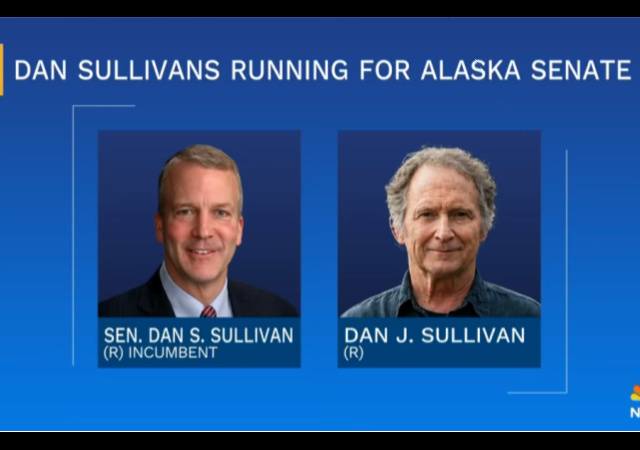
The New York Post found that progressive donors have primarily funded the super PAC supporting Republican “Decoy Dan” Sullivan in Alaska’s Senate race.
Sullivan is known as “Decoy Dan” because he filed to run using the same name and party affiliation as incumbent Republican Alaska Sen. Dan Sullivan.
The news fuels theories that Democrat operatives put Sullivan on the Alaska ballot to confuse voters, especially as the race between Sen. Sullivan and former Democrat Rep. Mary Peltola has grown close.
The super PAC is called Right for Alaska:
New financial disclosures support that theory. Right for Alaska, a super PAC that has spent close to $1.15 million to support “Decoy Dan,” took in approximately $990,000 from the left-wing Sixteen Thirty Fund, according to Federal Election Commission data.
Right For Alaska, whose mailing address is located in the Twin Cities suburb of Hudson, Wis., also got $1.8 million from the Liberty Force Action Fund, a dark money 501(c)(4) that doesn’t have to disclose its donors.
Both Right for Alaska and the Liberty Force Action Fund list as their treasurer a man named Thomas Datwyler — previously linked to lying former Long Island Rep. George Santos (R-NY).
Datwyler did not immediately respond to requests for comment.
The Alaska Division of Elections removed “Decoy Dan” from the ballot, citing evidence that he chose the same name and party as Sullivan to confuse voters. He is using a name he doesn’t typically use and even designed his campaign website to look like the incumbent senator’s.
Not only that, but challenger Sullivan’s campaign has numerous ties to Peltola.
It doesn’t help that “Decoy Dan” participated in those No King protests, supported Peltola during her House runs, and changed to the Republican Party right before he filed to run.
[Featured image via YouTube]
Donations tax deductible
to the full extent allowed by law.






Comments
The fix to these shenanigans is to narrow the opportunities for them by:
1. restoring closed primaries
2. Set a minimum threshold of being registered in the political party whose nomination/ballot line you seek or to vote in the primary of January 1st of the election year.
3. Get the State out of the way in his the political parties select nominees, accept/reject party members, If the ‘whackadoodle party’ chooses to require an in person interview by the individual and a certified letter accepting their application be presented to the County Clerk for those seeking to register as party member and requires a registration as a party member for a decade with never missing any election in that timeframe plus a 20 year in State/in District residency rule so be it.
Let the political parties govern themselves. Restore real primaries exclusively within the party to select nominees from among the candidates the party itself actively and affirmatively accepts. The nominee then appears on the ballot line in the Nov General election. Anyone who doesn’t like any of that can file to vote or compete as an Indy in the general election and their ballot access or voting right wouldn’t be impaired (assuming they otherwise meet ballot access/voter eligibility criteria).
Chief, everything you want is already in place in Alaska. Parties are completely free to choose their own candidates, if they like. The primary election does not choose candidates or the parties, it merely looks for the four most popular candidates, regardless of party, to advance to the final round. A party can choose to endorse a candidate in the primary, or it may stay out of it, as it likes.
Since they have ranked choice in the general, I don’t understand why Alaska bothers having two rounds.. Why whittle it down to four? Just let everyone who wants to run, and allocate the preferences until someone has a majority. But either way, your comment misses the target altogether.
It turns out the reason they whittle it down to four is because of a ballot design choice that seems really stupid to me. Rather than have one box before each name, in which the voter can write a number, they have five bubbles after each name, which the voter fills in to indicate “first choice”, “second choice”, and on to “fifth choice” (since write-in is an option). Obviously such a design can only accommodate a fixed number of candidates. If you had ten candidates you couldn’t put eleven columns of bubbles, there’d be no room.
NYC, which uses ranked choice for primaries only, does a similar thing. It doesn’t limit the number of candidates, but it does limit the number of preferences you can show. So if there are ten candidates you can only vote for your top five, so you have to make sure to include one of the majors in that top five or your vote will eventually be discarded. That’s even dumber than Alaska.
Australia’s been using this system for nearly a century, and no one finds it confusing. Even young children know how to vote in class elections or whatever. There’s nothing confusing about putting a 1 next to the person you really want to vote for, then a 2 next to your second choice, and all the way through a 10 or a 15 next to your last choice.
Really? So the mandatory voter registration cut off date to complete registration as a member of a political party is on Jan 1 to vote in the CLOSED primary elections restricted to ONLY members of the political party they held this spring? Those seeking registration as member of a party were subjected to party selected criteria? Those seeking to run as a member of a party were subjected to party selected criteria? The legal authority for such party selected criteria is authorized by statute?
Ranked choice is goofy IMO but If you really gotta have it then run it like the AP Football poll. Rank the candidates one time 1st to worst. If it’s ten candidates then the top pick gets 10 points down to the last choice who gets a single point. Add the total points and the winner is whoever has most points. Simple.
Well, we start with an open primary.
And you know, many cross lines to load the deck.
So, we wound up with one single Democrat running against three Republicans in a ranked choice election.
Now, a very good deal of us refuse to rank the candidates.
That is just the way it is.
If everyone did so, at each consolidation of votes, the ranking would shift according to preference, no votes would be dropped and it might actually work.
But, for those of us, dead set on our preferred candidate and the rest of us that just don’t feel like sorting through it all.. if your candidate does not stay on top, your vote stops there, and only those ranked votes continue on to the next conglomeration.
So, now we have the one Democrat running against a field of Republicans which will in fact result in a good old fashioned split vote.
And, I can’t honestly see a path for the Republicans.
As someone that has run for state and federal office, the effective duopoly of the democratic and republican parties means we cannot escape their monopoly on mediocrity and anti-Americanism without a concerted effort to field and vote for American-First candidates IN PRIMARIES.
The two-party country we live in needs to destroy the duopoly of these parties. Watching them turn us into a third-world trash hole distresses me constantly.
We need to pull both parties to Americans-First principles. Vote in your PRIMARIES.
“The Alaska Division of Elections removed “Decoy Dan” from the ballot, citing evidence that he chose the same name and party as Sullivan to confuse voters. He is using a name he doesn’t typically use and even designed his campaign website to look like the incumbent senator’s.”
The website sill has him on the ballot at elections alaska gov election 2026 General SampleBallots
The AK courts overruled the Division of Elections and said that fake Dan had a right to be on the ballot or some such BS.
Yeah, that was an establishment decision if ever there was one.
AK “supreme” court.
“Justice” Aimee Oravec:
“Where’s the statutory authority to divine the intent of a candidate? People run for office for different reasons,” she said. “There’s no limiting principle.”
The court was probably correct. The statutory language that the AG relied on didn’t really say what she wanted it to say. It allows her to remove candidates who didn’t fill in their paperwork properly, or are objectively ineligible to the office they seek, e.g. if a 29-year-old filed for the senate, but it doesn’t allow her to inquire into a candidate’s motives.
First rule of politics: SHOW ME the MONEY.
Second rule of politics: Name i.d. is king.
Third rule: Win at all costs. IE: smear opponents, rig polls, confuse voters, fake controversies, etc.
Great game.
Right For Alaska: “This is one way to prove voters are as stupid as we contend they are, through victory!”
Democrats do cheat. All the time.
Decoy Dan
a. Was a No King protester against Trump
b. Supported Democrat Mary Peltola
c. Changed to Republican Party 5 minutes ago
Therefore Decoy Dan
a. Is an honest person
b. Is a lying SOB
c. Is part of a conspiracy
This should be 75% of the GOP ads from now to election day. “Make sure you get the “real” Dan Sullivan and the like.
Scene from a Democrat National Committee planning meeting:
“OK, dude. Pass out the doobies, and let’s start brainstorming.”
Ranked choice should help the real Dan Sullivan, and in fact makes me wonder what the point of running the fake one was. What do the Dems hope to gain from it?
In a first-past-the-post race, any votes the fake Sullivan takes from the real one hurt him and help Peltola. If 51% of voters want Sullivan, the real one, but 2% mistakenly vote for the fake, Peltola could eke out a win.
But with ranked choice, anyone who really wants to vote for the real Sullivan but votes for the fake out of confusion will surely give their second choice to the real one, which means the vote ends up with him anyway. So if 49% each vote for the real Sullivan and Peltola, and another 2% mistakenly vote for the fake and then the real one, he wins. Do the Dems not understand this?
Closed party primary coupled with lengthy active party membership requirements with parties allowed to set additional PARTY requirements of candidates to compete for nomination with an R/D or other party affiliation/ballot line would do it far more cleanly and simply. If the whackadoodle party (W) decides to require ambidextrous candidates who’ve been active party members for 3 decades then that should be their choice without any interference. Any prospective candidate who doesn’t meet the Party requirements can file to run in another party primary (assuming they meet that party qualifications) or seek to qualify as an Indy for the general election. Nobody meeting the basic constitutional qualifications would would be prevented from a candidacy …assuming they also met statutory threshold for ballot access.
Problem being a lot of us won’t rank, so if your preferred candidate drops off in the running, so does your non-ranked vote.
Pure Election Fraud. If someone told you to vote on Nov. 4th it would be fraud. Common sense is gone.
– Why he is on the ballot: Alaska election officials initially removed him, but the Alaska Supreme Court ordered that he be allowed to run.
Ballotpedia News
– Primary result: He finished third in the August 18 primary, receiving approximately 2.5% of the vote, which qualified him for the general election under Alaska’s top-four system.
AP News
+1
– Latest controversy: President Trump publicly criticized the second Sullivan’s candidacy in mid-October, and reports describe continuing concerns.
Bottom line: Dan J. Sullivan remains a candidate for the November 3, 2026, election. He is a different person from the incumbent Senator Dan S. Sullivan.