


‘Dogs of War’: Colossal Biosciences Plans Genetically Engineered Military Canines
The company’s goal is to produce genetically engineered working dogs outfitted with high-tech gear. The first puppies are expected in early 2027.
I have been following the work of scientists at Colossal Biosciences, who created a genetically engineered mouse dubbed the “woolly mouse” as a step toward their goal of resurrecting the woolly mammoth.
Their work produced a new breed of mouse with several mammoth-like traits.
Then the team used genetic technology to revive an animal even cuter….the dire wolf.
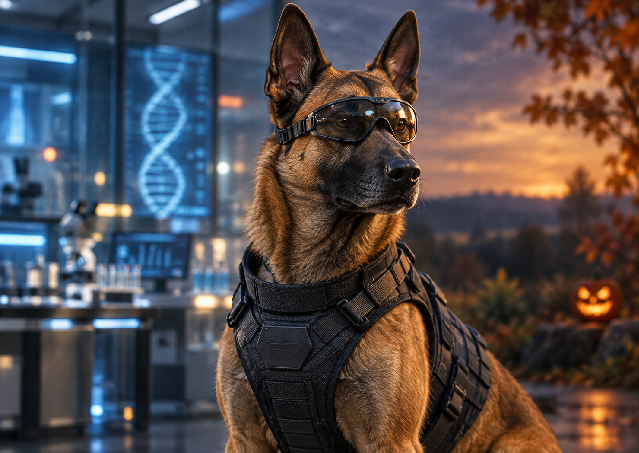
Now, just in time for Halloween week, Colossal Biosciences CEO Ben Lam is announcing a new venture to create real “dogs of war” with a decidedly science-fiction twist: genetically engineered working dogs outfitted with high-tech gear from defense contractor Anduril.
Lamm launched Warhound with Anduril founder Palmer Luckey as a partner, and the company has raised $200 million to develop healthier, more capable canines for military, police, and emergency-response missions.
On Thursday, that idea came out of stealth as Warhound, backed by $200 million in funding from investors including Sequoia, 8VC, Corner Ventures, and In-Q-Tel, a venture firm backed by the CIA and other U.S. intelligence agencies. The round values the company at $1.2 billion.
Warhound’s dogs, which do not exist yet, will take on tasks that are dangerous for humans or difficult for machines, such as bomb detection, searches, and other specialized operations. In its launch announcement, the company said that more than 80% of the U.S. military’s working dogs come from Europe, and less than half of them are fit for service.
Excited to announce WARHOUND. https://t.co/IGmIiZ461L
— Ben Lamm (@BenLamm) October 23, 2026
Before anyone pictures Frankenstein’s Fido patrolling the neighborhood, the dogs don’t exist yet, and the venture’s stated goal is to improve their health, protect their handlers, and tackle dangerous jobs machines still struggle to do. Warhound chief executive David Spirk stressed the firm’s mission objectives.
“Our long-term goal is simple: healthier dogs, better-prepared teams, and more service members and first responders coming home safely,” Spirk said, adding that he cares deeply about “protecting people and helping the animals who support them.”
Before joining Warhound, Spirk held several defense-related positions, including senior counsel at Palantir Technologies and chief data officer at both the Defense Department and U.S. Special Operations Command, or SOCOM.
According to the announcement, Luckey and Lamm conceived the idea for Warhound years ago at the annual Moonshots Summit, a gathering where entrepreneurs discuss ambitious ideas.
…According to Warhound, overseas suppliers provide 80% of military working dogs. The company also says the United States must train roughly 200 dogs to field 100, in part because so many fail to complete training.
Ultimately, Warhound’s team will identify the genetics that produce traits essential to an effective military dog and then create top-of-the-line gear for these canines. The firm hopes to have the first batch of puppies in early 2027.
“If you can standardize the training and you know the genetic disposition and performance capabilities, we think that we can we can lower (the failure percent) to 10% washout or less,” Lamm said. “Let’s vertically integrate everything so that we can clone and deploy the top dogs. You’re not worried what you’re going to get.”
In addition to “domesticating that supply chain (and) enhancing the dogs genetically we will also be further enhancing them,” Lamm said. Deployed dogs may get protective body armor, ear and eye coverings, and integration with military technology such as like EagleEye, Anduril’s in-development artificial intelligence-powered military helmet and high-res 3D heads-up display.
Anduril is also developing, with Meta, battlefield augmented reality glasses. Warhound hopes to have its first puppies born in the first quarter of 2027 and will likely have some demonstrations next year of Anduril’s potential technology applications for the working dogs. “Man’s best friend deserves man’s best tech,” said Anduril founder Luckey said in a statement.
The plan is for these dogs to receive standard working-dog training. American Humane Society will certify the training and help retired dogs find homes.
These genetically engineered “dogs of war” might sound like the premise of a Halloween-week creature feature, but healthier working dogs and safer American troops would be a welcome departure from the usual mad-scientist ending.
I’ll be watching to see whether Warhound can deliver on those promises while protecting the animals that make the mission possible.
If it succeeds, it will be another wonderful example of American ingenuity helping more two-legged and four-legged heroes come home safely.
Donations tax deductible
to the full extent allowed by law.






Comments
There is no reason we should depend on Europe for our Dogs
Period
But this will not end well and I’m against it
Let’s hope American ingenuity works better than Brazilian ingenuity.
Brazilian scientists crossed gentle, low-producing European bees with aggressive, super-producing African bees to create a gentle, super-producing bee. Instead they got a poorly-producing bee that was super-aggressive. They got out. Welcome, killer bees.
Breed for the crocogator, get the alladile,
I started to look up crocogator, thinking it was some genetic term when it occurred to me…
You dog.
It’s like Dr. Doolittle’s Pushyou-Pullme. Cheap to feed, but poops all over the corral.
Mr. Burns could teach these fellows a thing or two about productive dogs,
https://www.reddit.com/media?url=https%3A%2F%2Fi.redd.it%2Fn37udk1rqbch1.jpeg
https://encrypted-tbn0.gstatic.com/images?q=tbn:ANd9GcReokuaIi6nU5VjCp29GTgL0bQQx9kYewkjeJItRJ3O-Q&s=10
https://gifrific.com/wp-content/uploads/2026/08/mr-burns-release-the-hounds-the-simpsons.gif
The Times of New York will brag that this story is conformation of their story from a few months back about the Iraeli “rape dogs” who were being used to help in the ‘genocide’ against the Gaza Arabs.
Working dogs are driven by cooperation in a task, provided that the trainer is as dedicated to the task and the dog as the dog is expected to be. Modern training is more fun oriented and not capable of producing good working dogs.
Old school: The Koehler Method of Dog Training, and following on Utility dog training and tracking dog training. Excellently covered by Vicki Hearne in (1) Adam’s Task; (2) Bandit; (3) Animal Happiness. Ignore cover blurb on all, written by uncomprehending reviewers. Hearne takes no prisoners.
I have 2 Belgians. These mofos are wired differently than other breeds. They are NOT good pets. Labs are good pets.
I can only describe it as- think of other working dogs are annoying at “certain” things.
Ok- combine all of them and put them on Hunter Biden levels of cocaine.
Training them is not hard. You break them for basic obedience on a stump with a command collar and then work the snot out of them (and you) for whatever it is you intend.
I can only imagine what genetically improving them will do.
I’ve had four Dobermans (serially, one at a time). Trained the first through UDT. They make fine pets but are into self-respect.
Imagine the training and directional cues that could be ‘piped in’ to those goggles (and earbuds?) from a distance. Imagine ‘a/b’ training algos directing those cues, or AI directing them in combat situations. It gets very creepy very fast.
Are you all going to use something other than the Google Gemini engine to make AI generated photos around here?
Tom Kagan: Qarlo, this is my wife, Abby; my daughter, Loren, and…
Qarlo: CO! Qarlo Clobregnny, Private, R-M-E-N-T-N-D-O, reporting!
Tom (to Qarlo): No, Qarlo, it isn’t that way here. Macbeth is just a cat.
How about we genetic engineer some illegal aliens to not be criminals.
You’re talking science fiction, Sweetie. That is far in the future, if ever at all.
Nice doggie…nice doggie.
I can’t wait till gang bangers get a hold of these and feed their pit bulls to them.
I was sitting here thinking about how pit bull fights were against the law, and I’m expecting a huge public outcry along with condemnation by PETA.
The attack of the clones, brought to red states by the DSA.
I can’t imagine what will happen to these dogs when they are too old, can’t be given to the public
Su we just going to kill them?
More unwanted aggressive dogs
What could go wrong
Please do try to read through to the end of an article: “The plan is for these dogs to receive standard working-dog training. American Humane Society will certify the training and help retired dogs find homes.”
If you follow Mike Ritlan at all, the after market for working dogs is pretty sad. Or at least it was a few years back. These do not make good pets.
Sure but if the public by and large doesn’t rush to adopt retired ‘dogs of war’ then what? Given the number of ‘normal’ dogs euthanized annually for lack of folks willing to adopt them it seems like a legit question.
Retired K-9 already face higher challenges for adoption. Many folks are simply frightened at the idea of military/police working dogs in their homes. Then there’s the financial costs. The agencies/dept the K-9 loyally worked for doesn’t typically have a lifetime veterinary care ‘pension’ for the dogs.
There’s something like 10,000 regular K-9 retiring each year who need placement into their retired ‘forever home’. No good stats on placement or breakdown on euthanasia for this category of dog but it seems common sense the # would be higher given basic bias/fear against them. Add medical costs for injuries the led to retirement or even cancer from exposure on the job and costs add up quickly. Let’s not forget potential civil suits in our overly litigious society for a ‘dog bite’ by a ‘trained killer’.
IMO before we move forward on creating genetically enhanced chimeric K-9 who’d almost certainly face even higher challenges for adoption let’s get the funding in place to ensure their medical costs and ‘retirement’ costs are provided by the agency/dept which they served before retirement and sadly that’s probably gonna require vigilant oversight to ensure the agency/dept doesn’t seek to cut costs by substituting euthanasia of retired K-9 instead of meeting their financial duty and IMO moral obligation to support these loyal K-9.
it’s shameful, the way our military treats ‘mans best friend’
It’s well placed fear.
Their primary job is taking people down. I stopped short of bringing mine through Schutzhand / Ringfence for this reason.
Despite all the training, stray bites and take downs are a lot more common than anyone will admit.
Sure is and especially for those folks who seek one b/c they think its ‘cool’ but don’t know diddly squat about dogs. We always had GSD growing up. Had a couple retired K9 growing up as well. If you and the entire household aren’t afraid of them and provide strong/positive leadership they should fine. My main, really only worry would be their protective nature/training kicking in when some stranger shows up who is actually a good guy not a bad guy. On the other hand my pair of Mastiffs were very chill but super protective (not over aggressive), patrolled perimeter and put themselves between any potential threat and my Wife and Daughter which is kinda the goal and they do it without any training.
Like race horses that go to slaughter?
Please do research on the slaughter of working dogs today
Read all the way through
Oh, I’m sure they’ll find “homes”. Gangbangers, warlords… there are a lot of people who’d love to get their hands on a fully trained military working dog.
They are close to geriatric when they retire.
Ever meet a retired Army Ranger with good knees and doesn’t have 10,000 back injuries?
Summary by Paula:
Genetic engineering is going to the dogs.
I don’t get it. The Belgian Malinois is absolutely Wired! How much more of a working dog would you even want? They’re crazy intense, focused, athletic. I just do not get this at all. Not at all.
The purpose of genetic engineering isn’t about making a dog “higher drive” (since, as you noted, the Malinois is already maxed out), but rather about overcoming specific biological limitations such as:
Heat and Climate Tolerance: A major vulnerability for military working dogs in regions like the Middle East is heatstroke. Genetic tailoring could target metabolic and respiratory efficiency, allowing dogs to operate in extreme heat or high altitudes without crashing.
Extended Service Life: Breeding or engineering for flawless hips, elbows, and spines could eliminate the degenerative joint diseases that retire elite working dogs early.
Leave a Comment