


DC Appeals Court Upholds Preliminary Injunction Blocking Trump’s Ballroom Construction
The majority said that the president likely lacks “statutory authority to construct the ballroom” since Congress has that authority under the Constitution.
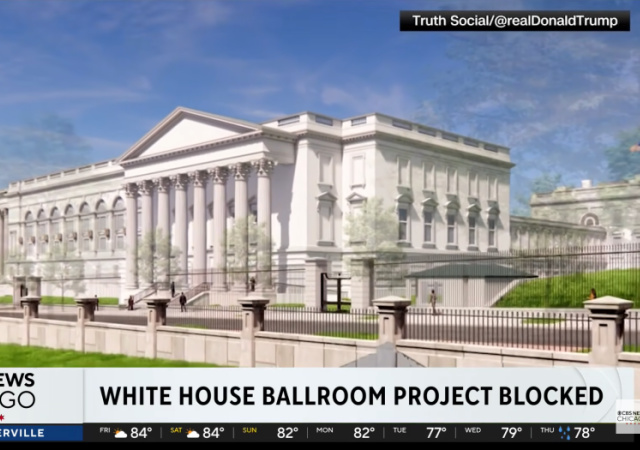
In a 2-1 vote, the D. C. Circuit Court of Appeals upheld a preliminary injunction blocking construction of the White House ballroom.
The majority said that the president likely lacks “statutory authority to construct the ballroom” since Congress has that authority under the Constitution, even if the construction is for security reasons.
The court did not say if the ballroom is a good or bad idea. It’s all about who gets to decide White House renovations:
This holding has nothing at all to do with whether the proposed ballroom is desirable, or not, as a matter of policy. This ruling does not even necessarily mean that the Defendants may not ultimately construct the ballroom. What it does mean is that the Defendants may not do so during the district court’s expeditious litigation without securing Congress’s authorization, as the Constitution and laws require. At this preliminary stage, the National Trust has shown, compellingly, that Congress has not ceded unfettered authority to the Executive Branch to dramatically redesign, reshape, and reconstruct the White House—the People’s House—to fit a particular President’s desires.
“We will stay this decision for fourteen days to allow the Defendants, if they choose, to seek Supreme Court review,” the majority added.
The majority cited Art. IV, § 3, cl. 2 of the Constitution:
Congress has exclusive authority to regulate the construction and demolition of White House structures. The Constitution’s Property Clause vests Congress with plenary control over all real property that belongs to the United States. U.S. CONST. Art. IV, § 3, cl. 2 (“The Congress shall have Power to dispose of and make all needful Rules and Regulations respecting the Territory or other Property belonging to the United States[.]”); see Ashwander v. Tennessee Valley Auth., 297 U.S. 288, 331 (1936) (The Clause’s “broad terms” encompass “the due regulation of all * * * personal and real property rightfully belonging to the United States.”) (quotation marks omitted). In addition, the Constitution’s District Clause confers on Congress comprehensive legislative authority over the District of Columbia as “the Seat of Government of the United States[.]” U.S. CONST. Art. I, § 8, cl. 17.
Congress even added a statutory exclamation point, which is an ironclad legislative provision passed by Congress in 1912: “there shall not be erected on any reservation, park, or public grounds[] of the United States within the District of Columbia, any building or structure without express authority of Congress.”
In July 2025, President Donald Trump revealed plans to build a 90,000 sq. ft. ballroom, which would demolish the East Wing.
Private donations would cover the costs, not the taxpayers.
Demolition began in October 2025, leading to outrage and lawsuits.
The assassination attempt on Trump at the White House Correspondents’ Dinner (WHCD) made him push harder for the ballroom, citing the venue’s security limitations.
No doubt the administration will take the case to the Supreme Court.
I don’t think the private donations will make a difference since the statute does not mention money.
Donations tax deductible
to the full extent allowed by law.







Comments
Most visiting diplomats prefer dining in a tent and the portable toilets behind the White House are very warm and inviting. So why build a ballroom?
And the democrat in the back said, “Everyone attack!”
And it turned into a ballroom blitz
‘Hey you’re not allowed to tear down the building that you already tore down’.
This is exactly why respect for the courts in general has cratered, because of stupidity like this.
What are they going to do, demand he REBUILD the building that was already torn down?
So what is the point of this injunction other than to just screw Trump.
The point is to show whose boss or rather to show that Trump isn’t a king or something.
Children, behaving as such.
This has nothing to do with the demolition. The statute the court cited says “there shall not be erected on any reservation, park, or public grounds[..] of the United States within the District of Columbia, any building or structure without express authority of Congress.” Note “erected”, not “demolished”. So it’s the construction that the court says requires Congress’s permission.
It seems to me that the big flaw here is that the White House is neither a reservation, nor a park, nor public grounds. At least as I understand the term, and maybe I’m wrong, but it seems to me that it means areas that are open to the public, like the Mall. I don’t think an office building or a construction site are public grounds. Unless the statute specifically defines the term otherwise. I don’t know.
As for the constitution, Congress certainly has the right to regulate White House construction, and could easily have passed a law limiting how the president manages the grounds, but I’m not aware that it has ever done so. Every previous president since the thing went up has seemed to regard it as within his authority to make alterations as he saw fit; why, after more than 200 years, are we suddenly discovering that all those presidents were wrong?
Maybe the decision explains this. I haven’t read it. But if it doesn’t, then I think this is another major flaw.
“”Every previous president since the thing went up has seemed to regard it as within his authority to make alterations as he saw fit; why, after more than 200 years, are we suddenly discovering that all those presidents were wrong?”
They weren’t Trump.
Nobody except lawyers, judges, and jealous whiners care about the statute or slicing and dicing language as lawyers love to do in order to muddy the waters, especially one funded with private money…so let’s just keep an ugly hole in the ground with stall tactics.
Bottom line is We The People approve of the much needed Ballroom (plus whatever ‘items’ they conceal underneath), and want the damn thing finished so America can have State functions in a secure place that showcases respect to guests that only America can do instead of what the clowns want; in a tent or an unsecured hotel conference room so some lunatic can take potshots at OurPresident.
The people have had it with snake-oil selling lawyers and scumbag judges trying to one-up a duly elected President…especially one using private monies to build something that honors the past while allowing something nice for future events. This is exactly why WTP can have nothing nice or easy, there’s always some self-loathing PITA trying to stop good progress.
Thank you, I like what you wrote.
Maybe the decision explains this.
Well, it’s not really a decision, yet. This is a stay (which was stayed…) to come to the decision.
The appellate court vomited out 100 pages in ruling against the president. Generally speaking, if an issue is so clear as a matter of statutory or constitutional law, 100 pages of garbage isn’t really necessary. Courts only need 100 pages of garbage’ to manipulate an outcome when the law is against them. I’ll stick with the dissent here: To begin with, the district court had no jurisdiction because the Trust has no standing to stop construction at the
White House. The ballroom is also likely within the President’s authority to make improvements to the Executive Residence at the White House. Finally, the balance of equities overwhelmingly favors the government. The district court
elevated the aesthetic displeasure of a single passerby over the government’s security interests in the ballroom and the security risks of leaving an open construction site at the President’s home and office. These errors in equitable judgment require vacating the injunction.
Nothing like ignoring the precedence of the construction by every president before him. Stupid decision as expected from the DC circuit. So off to the supreme court we go.
Did Truman go to Congress when he completely redid the White House?
Yes, but it was in danger of collapse. A total gutting occurred with the exterior remaining.
https://rarehistoricalphotos.com/white-house-renovation-1949-1952/
Neither Nixon with his bowling alley, nor FDR with their swimming pool renovations went to Congress for funds as both were privately funded, similar to the ballroom.
Let’s see what SCOTUS has to say……
What about the new situation room which is supposed to be built under the ballroom? Can they do that according to the appeals court or do they have to put the dirt back. It’s a national security issue as is the ballroom for that matter.
If the statute means what the court says it means, then NO construction may happen without Congress’s explicit authority, and every previous president was wrong. If that’s what the statute really means, then we must go with it. But it doesn’t seem likely to me that it really means that.
There are probably thousands of examples of presidents/the executive branch maintaining, remodeling, and renovating thousands of properties without the consent of Congress. That’s precedent. If Congressional approval was necessary for every act necessary to construct, revise, upgrade, maintain, rebuild, etc. every federal property, it would never have time for anything else. Maybe Congress transferred this authority to the GSA?
See my take below on what it might mean. I think your instincts may be correct.
Exactly.
Do remember to take into account the budgeting process, though. Congress has probably approved LOTS of construction through it being included in some line item in the budget.
I’d argue there’s a big distinction between an appropriation and authorization. For example if Congress votes to authorize the DoD to build a dozen battleships then all this does is grant permission ….no funds were allocated in a budget appropriation. Likewise if Congress votes to authorize $2 Trillion in the budget to DoD to pay for those battleships they still haven’t granted permission to build them via an authorizing statute. In sum Congress is supposed to do two things: authorize X to be done then pass an appropriation to fund X to be done.
This grants the Executive lots of room to stop doing anything Congress didn’t authorize but merely funded …including activities or programs which had an authorization but it expired and yet funding continues b/c of the broken budget process of CR.
There’s no such thing as “precedent”. If the statute says what it’s alleged to say, then it doesn’t matter how many previous presidents have broken the law, it’s still the law and Trump must follow it.
The only real question is what does the statute really mean. If it really means what the court says it does, why has no one noticed until now?
…IF the President is asking for taxpayer funds from Congress…PDJT is not.
It has NOTHING TO DO with funding. The statute explicitly bans any construction in “reservations, parks, and public grounds” without Congress’s permission. IF the White House is a park, then the court is right that permission is required. Dragging the funding in is a red herring, and dishonest.
But that’s a big IF.
If Obama had done this (not that he ever would) the press and the left (but I repeat myself) would be falling all over themselves telling everyone what a wonderful idea it was. And if you brought up these issues to them you’d be ridiculed and silenced.
The part that frosts my Pop Tart here is that the Ballroom was clearly a ruse to build a new secure situation room beneath the structure. I’m wondering if that structure was approved by Congress? I’ll bet it was and that this argument is actually moot.
The closest clear congressional approval found is the FY2009 appropriations law for the Executive Residence, which funded “care, maintenance, repair and alteration, refurnishing, improvement” of the White House and its executive residence functions. Then FY2010/2011 appropriations for the White House/Executive Residence/White House Repair and Restoration again allowed transfers among those accounts, and a later FY2011 law separately funded “East Wing Infrastructure Systems Replacement” at $84.5 million. That points to Congress approving White House structural and systems work in past budgets,
I suppose this line item can be carried forward from year to year?
Not a ruse if it is stated, it is a necessary function that just about every building has, a secure facility underneath.
Previous presidents have said they want a ballroom. But instead of getting a design, lining up donors, demolishing the east wing and starting construction they went to Congress with their hand out and Congress either said no or did nothing.
Obama converted a tennis court into a basketball court. He didn’t get approval before doing so. The usual sources argue he didn’t have to because the expense was minor and could be handled through normal white house maintenance.
However the statute could be read as to have required Obama to get approval from congress. The amount of money spent or how the project was managed is irrelevant.
A basketball court is not an “building or structure”, and is not “erected”. So the statute wouldn’t apply, even if the White House is in a park.
Ridiculous
Did Congress intervene when Nixon closed in the White House pool? It’s still gone, fyi.
All privately funded too.
It’s irrelevant whether Congress intervened. The only question is what does the statute mean?
The funding is also irrelevant. The statute doesn’t say one word about funding.
Also, closing a swimming pool is not “erecting a building or structure”.
Ignore those God damn Traders and just keep going. Dare them to enforce their own decision.
Congress could fix this in a day, but won’t.
Congress won’t seemingly do anything that doesn’t involve growing government. And removing responsibility from themselves while they’re at it.
While the 2 judges who were Obama and Biden appointed used the Constitution to make their case, they have no belief in the constitution as our founding document. The ballroom is being built with private money. The new Situation Room wad in the defense appropriations bill. They had to dig down for security. The President is replacing grass with a ballroom.
The key issue appears to be whether the plaintiff has standing even to file the lawsuit.
It doesn’t. Unless the decision offers something persuasive showing otherwise. I haven’t read it, but from what I know of the case the plaintiff is simply some busybody interfering caniness whose only supposed “injury” is that when she jogs past the White House she will have to look at a building that offends her aesthetic taste in architecture.
They don’t have standing, by why let get in the way of TDS?
Commassar Judges are good at finding some reason to toss wrenches in the gears of government.
If itvwould have been some “Democrat ” doing the project you wouldn’t hear a peep from the Left.
Correct.
Especially if they have TDS.
Honestly, I don’t mind throwing wrenches into the gear of government. The problem is they’re then greasing the gears in the parts that will grow gov’t power (and the ability to grift).
“The Congress shall have Power to dispose of and make all needful Rules and Regulations respecting the Territory or other Property belonging to the United States…”
First, this occurs in Art IV, sec 3. This section concerns the admission of new States. Is the “Property” mentioned in the section located within the mentioned “Territor(ies)” that are not yet States? This may be the case, because if this power of Congress were meant to be of general effect it would have been included in Article I.
Second, it says Congress can “dispose” of this property (wherever it may be located). Does this mean Congress can discomfit the Executive at any time by putting all executive officers and employees out of their buildings so that they could be sold or destroyed? I would find that hard to believe. This may only mean the Congress can dispose of properties the Executive no longer finds useful.
Third, it says Congress can “make all needful Rules and Regulations” for these properties. Is there a rule or regulation that says the POTUS can’t modify the White House to suit his (executive) needs? The court did not cite any such thing, and I would think it would have been cited if it exists.
Fourth, who is responsible for the upkeep of federal property occupied by the Executive branch? Although Congress would normally appropriate the funds necessary for maintenance/improvements, does the executive need permission to upgrade, renovate, and otherwise modify a property that’s occupied by executive offices? The statute seems to suggest that. But maybe that’s an unconstitutional intrusion into the authority of the executive.
Precedent:
I asked Google AI “What branch of government was responsible for the repair of the Statue of Liberty?
Answer:
The major 1980s repair of the Statue of Liberty was managed by the executive branch through the National Park Service (part of the Department of the Interior) in partnership with a private non-profit foundation, rather than being funded or directed by legislative appropriations.
I then asked, “Did Congress authorize this repair work?”
Answer (bolding mine):
No, Congress did not formally pass legislation to authorize or fund the 1980s restoration work. Because the monument was already under the jurisdiction of the National Park Service (an executive agency), the executive branch had the existing authority to maintain it and partner with the private sector.
I then asked, “What branch of the federal government has responsibility for maintaining and improving buildings and property occupied by the executive branch?”
Answer: The executive branch itself is responsible for maintaining and improving its own buildings and property, primarily operating through the General Services Administration (GSA).
Core Agency in Charge
General Services Administration: The GSA Public Buildings Service acts as the federal government’s landlord, managing over 360 million square feet of workspace.
Property Ownership: GSA manages a vast portfolio consisting of roughly half federally owned buildings and half leased commercial properties.
Scope of Work: GSA handles day-to-day operations, repairs, historic preservation, and modern renovations for civilian executive agencies.
This doesn’t seem to admit of a role for Congress with the exception of funding unless there is a rule or regulation that constrains the POTUS and if the clause in Article III doesn’t only apply to properties within territories (prior to their admission as States).
It says “territory”, not “territories”. You are confusing two completely separate concepts. This refers land and other property that belongs to the USA. Not that the USA has sovereignty over, but to which it actually owns title, such that it can exclude trespassers from it, and sell it if it likes.
So yes, Congress could vote to sell the White House, and while the president could veto that resolution, Congress could override the veto. It’s not likely to do so, but it has the full authority to.
Yes, I know. But the section deals with the admission of new States. Because the clause in that particular section, that’s strongly suggests the second references the first, and continues in the same vein.
What argument is there that explains why this particular authority is found in a section dealing with the admission of new States, and not in Article I with the general powers of Congress (where it would belong if the court is interpreting it correctly)?
No, the section deals with two unrelated subjects. Article 4 makes miscellaneous provisions regarding relations between the states, and between the union and the states. So this belongs there as much as it does in Article 1. Article 1 section 8 does cover those properties where Congress has exclusive jurisdiction, but that’s not most of the USA’s property.
If vile, narcissist-incompetent-dunce, Obama, had proposed this ballroom renovation, the equally vile, Obama-worshiping/-deifying media lapdogs/trained seals/sycophants/stenographers would have gleefully proclaimed it to be the best idea, ever, and offered their full-throated and enthusiastic support.
This opposition to the ballroom, is a about the Dhimmi-crats’ infantile and spiteful 24/7 opposition to and obstruction of anything that President Trump does.
Note: The court seems to be saying that the entire White House grounds is a park.
If so then it would appear the decision is correct that nothing may be constructed without Congress’s permission. I’m not sure that this is correct, though. Even if it’s called a “park”, is it a park within the meaning of 40 USC § 8106?
More parsing and word-smithing to make an allowance that doesn’t exist in order to facilitate their thinly veiled obstructionist argument. It’s not a Park.
The Court saying so doesn’t make it so,..Is the Pentagon now a Park?
The court saying something doesn’t make it so, but it cites sources. Are those sources reliable? And more importantly, those sources calling it a “park” doesn’t tell us what “park” means for the purpose of this statute. I went looking for a definition of the term in this chapter, and couldn’t find one. So I would tentatively dispute the court’s determination that it is a park.
Next these same judges will block PDJT from re-erecting the torn down statues by The Demented Democrats because he didn’t get permission first.
Are statues “buildings or structures”?
And Obama built basketball courts with no issues.
A basketball is not a building or a structure, and is not erected.
If the law is indeed worded this way (“Congress has exclusive authority to regulate the construction and demolition of White House structures”.), then this regulation clearly addresses intent and effect. Without a doubt, the administration has no intention of demolishing (as a final consequence). Nor does it intend to erect a building where none existed before. The administration is remodeling an existing building, and this does not require congressional approval.
The underground work continues. The bloggers at Powerline have a good take on the whole mess:
https://www.powerlineblog.com/archives/2026/08/appellate-court-orders-halt-to-ballroom-construction.php
The court order that was upheld explicitly permits the underground portion of the construction to continue. And the appeals court repeated that point. So there’s no reason for that work to stop.
The law is worded: “there shall not be erected on any reservation, park, or public grounds[] of the United States within the District of Columbia, any building or structure without express authority of Congress.”
It doesn’t mention demolition at all. Nor does it mention funding. But it does mention erecting buildings and structures, which would include the ballroom. But only if the White House is a park within the meaning of the act.