


LIF to OMB: Strengthen Federal Grantmaking Nondiscrimination by Barring Funding of Intersectionality
“Unless OMB identifies intersectionality expressly, agencies and recipients of Federal financial assistance may continue using composite or rebranded terminology to preserve the same identity-based preferences the rule is designed to end.”
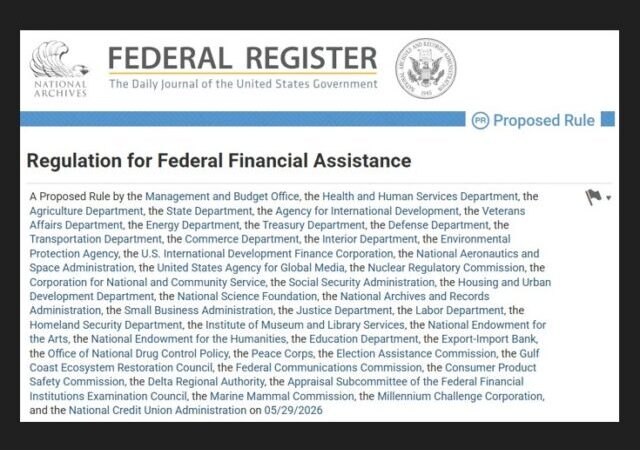
On July 9, 2026, the Legal Insurrection Foundation (LIF) and the Defense of Freedom Institute for Policy Studies (DFI) submitted a public comment recommending that the Office of Management and Budget (OMB) expressly address intersectionality in its proposed revisions to the federal grantmaking rules.
This comment is part of an ongoing joint LIF/DFI effort to highlight the discriminatory basis and danger of intersectionality, as documented in our April 2026 Report, Intersectionality – The Rise of a Dangerous Anti-American Ideology and How to Stop it.
OMB is the White House office that sets government-wide management and budget policy, including rules for federal financial assistance. Its proposed rule, Regulation for Federal Financial Assistance, published May 29, 2026, as Document No. 2026-10817, would revise federal financial-assistance requirements to improve transparency, accountability, oversight, and burden reduction. It also would help ensure that taxpayer dollars are used lawfully and that recipients comply with standards of equal treatment under the law.
If accepted, LIF and DFI’s recommendation would make those revisions even more impactful. It would expressly identify intersectionality as a mechanism by which identity politics can evade otherwise strong protections for equal treatment.
The concern is not with OMB’s direction. It is with the anti-American nature of identity politics and with the way intersectionality packages that ideology for use in public programs. Intersectionality sorts people into overlapping identity categories—race, sex, sexuality, class, religion, disability, immigration status—and treats those combinations as measures of marginalization.
It is the octopus at the center of the identity-politics ecosystem. Each tentacle may appear and reappear under a different label: racial equity, gender equity, climate justice, multiculturalism, LGBTQ+ inclusion, or “lived experience”—the categories are endlessly shifting and proliferating. But the body connecting them is the same framework of group-based grievance and preference. Once that framework enters a grant program, it can shape who qualifies. It can influence who gets priority, how applications are scored, what recipients must report, and what compliance burdens they must satisfy.
That is why the recommended clarification matters. A funding notice does not need to say “racial preference” or “sex-based preference” to produce the same result. It can simply award priority to “women of color,” “LGBTQ+ immigrants,” “BIPOC persons with disabilities,” or “communities experiencing intersecting forms of marginalization.” The labels sound softer. The legal and constitutional problem remains. Protected characteristics are still doing the work—only now they are bundled, renamed, and hidden behind intersectional terminology.
This is not a theoretical concern. Federal money has already flowed to intersectionality-related grants, research projects, workshops, equity audits, consultant contracts, and training programs. The public comment letter points to a half-million-dollar National Science Foundation study on intersectionality in STEM. It cites a Washington Free Beacon analysis identifying 101 NSF-funded intersectionality projects totaling more than $62.5 million from 2014 to 2018. It also notes a broader federal-grant search identifying nearly 250 projects since 2008 using the keyword “intersectionality,” with approximately $230 million in reported obligations and $140 million in outlays. The largest spending occurred between 2022 and 2024, averaging roughly $75–80 million per year. These are not stray academic experiments. They show how identity politics can turn taxpayer dollars away from statutory purposes and toward ideological sorting. OMB’s proposed reforms are aimed in the right direction. Naming intersectionality would help ensure those reforms reach one of the chief frameworks used to preserve identity-based preferences under more technical language.
Intersectionality also creates waste and burden beyond the grant dollars themselves. Recipients can be pulled into consultant-driven trainings, subjective reporting systems, internal equity reviews, workshops, audits, and compliance exercises. These exercises are built around vague ideological concepts rather than measurable program outcomes. Staff time and grant dollars move away from actual program delivery and toward process rituals. The result is an expanding bureaucracy of identity accounting. Consultants are paid. Reports are produced. Boxes are checked. Meanwhile, the public purpose of the grant recedes into the background.
OMB’s rule can reinforce a better approach. Federal grants should be awarded and administered through identity-neutral, merit-based criteria; objective performance measures; statutory needs assessments; and clear program requirements. Helping people in need does not require sorting them into ideological identity stacks. Need can be measured through lawful, concrete, program-related facts. It need not rest on group-based axiomatic assumptions about oppression and privilege.
The letter’s recommendation is constructive and targeted. OMB can make its revisions stronger by clarifying that agencies may not use protected characteristics directly, through proxies, or through composite “intersectional” categories when those methods produce preferential or adverse treatment. That clarification belongs across the grants framework: program planning, funding notices, merit review, risk review, award conditions, disparate-impact rules, national policy requirements, and cost allowability.
The stakes are larger than wording. Identity politics is adaptive. If one label becomes legally vulnerable, another can replace it. Intersectionality is especially dangerous because it lets identity-based decision-making continue under newer, denser, more technical vocabulary while claiming to serve equity, inclusion, or community need.
OMB deserves support for taking on unlawful discrimination and restoring merit-based federal grantmaking. The point of the letter is to help make that effort durable. Federal funds should advance statutory purposes, not the anti-American ideology of identity politics. Naming intersectionality directly would close a practical gap. It would strengthen OMB’s reforms and make clear that equal treatment cannot be evaded by stacking protected characteristics into a new label.
Nora D. Clinton is a Research Scholar & Project Manager at the Legal Insurrection Foundation. She was born and raised in Sofia, Bulgaria. She holds a PhD in Classics and has published extensively on ancient documents on stone. In 2020, she authored the popular memoir Quarantine Reflections Across Two Worlds. Nora is a co-founder of two partner charities dedicated to academic cooperation and American values. She lives in Northern Virginia with her husband and son.
========================
Donations tax deductible
to the full extent allowed by law.







Comments
Intersectionality is communist inspired garbage. Ban it completely. Any use of it should result in immediate rejection of the grant. Furthermore I’d put the grant writers on a list of people whose future grant requests are to be closely scrutinized for any improprieties (if that is legal to do).
“That is why the recommended clarification matters. A funding notice does not need to say “racial preference” or “sex-based preference” to produce the same result. It can simply award priority to “women of color,” “LGBTQ+ immigrants,” “BIPOC persons with disabilities,” or “communities experiencing intersecting forms of marginalization.” The labels sound softer. The legal and constitutional problem remains. Protected characteristics are still doing the work—only now they are bundled, renamed, and hidden behind intersectional terminology.”
Similarly, or even more importantly, they will expressly state that they do not exclude people of various conditions, when that is precisely what they do: they hide their discrimination under the cover of “inclusion,” when they are in fact, being preferential in their selection; they practice racism under the banner of “antiracism.” Being white or Asian are obvious ones, with myriad examples, but also things like age, which they readily use to discriminate. Those alleged “exclusions” are a big red warning flag to white and Asian.
Don’t think for a New York minute that a “trans” candidate will not be selected over a person with normal biology associations; they will virtue signal EVERY time. And firing? All the “racist,” “sexist,” “pick your favorite phobias,” will never get fired, claiming “discrimination, even though it is most likely discrimination by merit.
Demsocialists cannot survive unless they pit different groups against each other and lie about the reason (which is usually Demsocialists).
Judge people by their record, their merit, and leave the other garbage behind.