


Female-Only Film Scholarships At Wright State U Challenged By Equal Protection Project
Complaint: “A male student who satisfies every academic, financial, and programmatic qualification remains ineligible because he is male. That is precisely the type of discrimination Title IX prohibits.”
The Equal Protection Project (EqualProtect.org) has become “famous” for the work we have done challenging race- and ethnicity-based DEI discrimination in higher education. But we’ve also focused increasingly on sex discrimination cases, as we recently noted, Title IX Impact of Equal Protection Project In Focus at Bloomberg News.
The vast majority (but not all) of the sex discrimination cases we have filed have been over discrimination against males for academic scholarships and programs. There is no legitimate governmental interest in discriminating based on sex in academics, unlike in sports.
Now that the Supreme Court has ruled definitively, in the girls sports cases, that sex under Title IX refers to biological sex not gender identity, we see this as an area for further expansion.
Our most recent filing on July 30, 2026, was against Wright State University in the Dayton, Ohio, area, for two film scholarships limited to females.
From the Civil Rights Complaint filed with the Office for Civil Rights of the U.S. Department of Education:
We bring this civil rights complaint against Wright State University (“WSU”) located in the vicinity of Dayton, Ohio, for offering, administering, and promoting two (2) scholarships that discriminate on the basis of sex in violation of Title IX.
Most scholarships at WSU are awarded through the university’s online scholarship application. Others, including the scholarships challenged in this complaint, are administered directly by individual academic departments and require students to submit separate applications.2 WSU explains that “[s]ome departments or divisions may offer other scholarships to continuing students not awarded through the online application” and instructs students to “[c]heck with the chair of your academic department for any other options.”
The scholarships listed below are currently offered to WSU students and applicants for admission, according to the WSU website, and violate Title IX of the Education Amendments of 1972 (“Title IX”) and its implementing regulations3 by discriminating against students based on their sex.
SCHOLARSHIPS THAT VIOLATE TITLE IX (2)
1.Carol Trevino Film Production Fund
Link: https://www.wright.edu/enrollment-services/financial-aid/continuing-student-scholarships
Archived Link: https://archive.is/wip/ftqn5
Discriminatory Requirement: “Available to a female, junior or senior majoring in MotionPictures.2. Tricia E. Small Endowed Scholarship
Link: https://www.wright.edu/enrollment-services/financial-aid/continuing-student-scholarships
Archived Link: https://archive.is/wip/ftqn5
Discriminatory Requirement: “Must be a junior or senior female student majoring in the Motion Picture Program, have demonstrated financial need and have a minimum gpa of 2.5.”***
Here, the challenged scholarships expressly limit eligibility to female students. WSU therefore excludes otherwise qualified male students solely because of their sex. A male student who satisfies every academic, financial, and programmatic qualification remains ineligible because he is male. That is precisely the type of discrimination Title IX prohibits.
The same conduct also raises serious constitutional concerns. Because WSU is a public university, its administration of these scholarships constitutes state action subject to the Equal Protection Clause of the Fourteenth Amendment. Classifications based on sex are subject to heightened scrutiny and require an “exceedingly persuasive justification.” United States v. Virginia, 518 U.S. 515, 531–33 (1996); Sessions v. Morales-Santana, 582 U.S. 47, 57 (2017). It does not appear that WSU offers comparable scholarships reserved exclusively for male students or otherwise provides equivalent opportunities. Accordingly, WSU cannot plausibly contend that these female-only scholarships are necessary to remedy educational opportunities that WSU previously denied to female students or that the scholarships serve another important governmental objective. Neither proposition is supported by the facts alleged here.
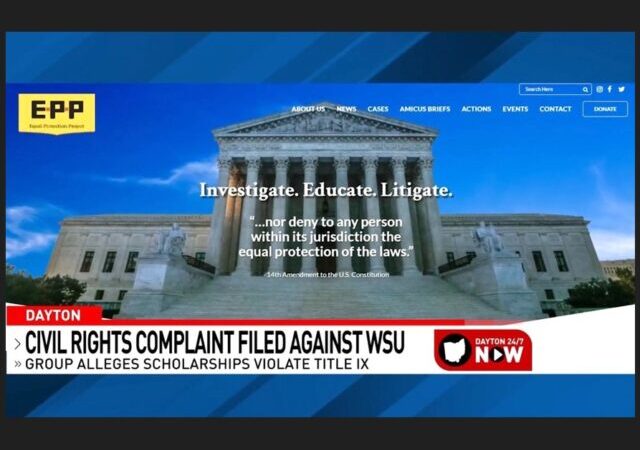
Dayton247 News covered the story and interviewed me:
An organization has filed a civil rights complaint against Wright State University for alleged discrimination within their scholarships.The Equal Protections Project is a group that challenges alleged discrimination in higher education.
The areas they focus on usually involve Title VI, race, color and national origin, or Title IX, sex discrimination.
The group is citing two scholarships at Wright State that say only women can apply for. Both are in film.
Carol Trevino Film Production Fund
Tricia E. Small Endowed Scholarship“We’re asking Wright State to open these scholarships up to everybody. They should not be sex based. We don’t want the money cut off. We want the students to get the money. But everybody should have a fair shot at it,” said Founder and President of the Equal Protections Project, William Jacobson.
According to the Equal Protection Website, complaints have previously been filed in Ohio for both the University of Toledo and Bowling Green State University.
Dayton 24/7 Now reached out to Wright State University regarding the complaint being filed. A spokesperson said:
Wright State University has not received notice regarding a complaint filed by the Equal Protection Project with the Office for Civil Rights of the U.S. Department of Education.
Reminder: we are a small organization going up against powerful and wealthy government and private institutions devoted to DEI discrimination. Donations are greatly needed and appreciated.
=============
Donations tax deductible
to the full extent allowed by law.




Comments
At least Van Dreissen allowed Beavis And Butthead to sit in on the feminine hygiene film.
That’s as may be. I don’t know how long the DOE takes to send out notice to the targets of complaints. But that doesn’t address the substance. Do these two programs exist, are they correctly described, and if so how do you justify them? Now that they’ve been brought to your attention, will they be brought into line with the law, or do you intend to defend them, and if so how?
Why not just say you’re a woman and apply if you’re a male?
Do they make those “No Boys Allowed” videos I’ve heard rumors of?