


Federal Appeals Court Throws Out Florida’s ‘Stop W.O.K.E. Act’
Florida AG Uthmeier responds: “According to the CA11 panel majority, public university professors have a First Amendment right to teach white supremacy and critical race theory, and the legislature cannot pass laws that say otherwise.”
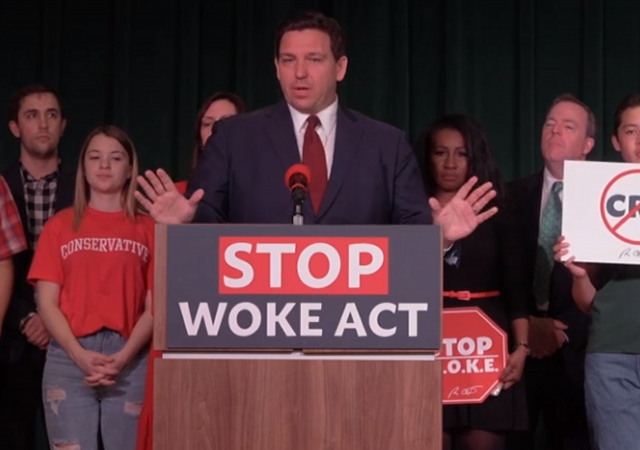
Florida’s Stop Woke Act has been blocked by a federal judge—again. The law championed by Governor Ron DeSantis suffered yet another setback in Pernell v. Lamb, when a federal appeals court affirmed the district ruling that enjoined the Individual Freedom Act, aka, the “Stop W.O.K.E. Act.”
DeSantis was at the forefront of the battle against DEI and critical race theory in schools and the workplace. But the law he backed was beset by legal challenges shortly after it passed in April 2022.
As Professor Jacobson explained, the Florida Act targeted certain employment practices by private corporations, particularly race-shaming tactics that have become common, as well as the training in and teaching of these race-shaming theories in public higher ed.
The law makes it an act of discrimination “on the basis of race, color, national origin, or sex” to subject any student or employee to “training” or “instruction” that “espouses, promotes, advances, inculcates, or compels” belief in any of eight concepts, including:
1. Members of one race, color, national origin, or sex are morally superior to members of another race, color, national origin, or sex.
2. A person, by virtue of his or her race, color, national origin, or sex, is inherently racist, sexist, or oppressive, whether consciously or unconsciously.
3. A person’s moral character or status as either privileged or oppressed is necessarily determined by his or her race, color, national origin, or sex.
4. Members of one race, color, national origin, or sex cannot and should not attempt to treat others without respect to race, color, national origin, or sex.
5. A person, by virtue of his or her race, color, national origin, or sex, bears responsibility for, or should be discriminated against or receive adverse treatment because of, actions committed in the past by other members of the same race, color, national origin, or sex.
6. A person, by virtue of his or her race, color, national origin, or sex, should be discriminated against or receive adverse treatment to achieve diversity, equity, or inclusion.
7. A person, by virtue of his or her race, color, sex, or national origin, bears personal responsibility for and must feel guilt, anguish, or other forms of psychological distress because of actions, in which the person played no part, committed in the past by other members of the same race, color, national origin, or sex.
8. Such virtues as merit, excellence, hard work, fairness, neutrality, objectivity, and racial colorblindness are racist or sexist, or were created by members of a particular race, color, national origin, or sex to oppress members of another race, color, national origin, or sex.
In the education setting, the law applies to K-12 (not challenged in this case) and universities. Professors who fail to comply face unspecified “disciplinary measures” and potential termination.
Several professors and students sued to block the law on the grounds that it violates their First Amendment rights by suppressing politically disfavored viewpoints. The district court granted a preliminary injunction in November 2022. The 11th Circuit upheld it in a short-form order that Professor Jacobson also covered here.
Now, a divided 11th Circuit panel (2-1) has affirmed the district court’s preliminary injunction blocking enforcement of the higher-education provisions of the Act. Judge Britt Grant (Trump appointee) wrote for the majority, joined by Judge Charles Wilson (Clinton appointee); Judge Barbara Lagoa (Trump appointee) dissented.
The panel held that the Act’s restrictions on professors’ speech about race, sex, and national origin violate the First Amendment. “If the First Amendment offers any boundary of protection at all for public university classrooms,” Judge Grant wrote, “this statute crosses it.”
“The Act is a wide-ranging, ex ante restriction on the speech of every public university professor in the state,” Grant continued.
Judge Lagoa pushed back. She said the majority’s reasoning “glossed over the classroom reality”: “[A] professor’s words do not operate in a vacuum; they carry a ‘coercive effect’ because the professor maintains authority over the students’ grades.” It also defies legal precedent: the state retains authority, she concluded, to “restrict a professor’s viewpoint in a public classroom, even if the professor’s viewpoint represents his professional opinion.”
Florida Attorney General James Uthmeier doubled down, calling the majority opinion “totally incoherent and inconsistent with the intent of the First Amendment”:
According to the CA11 panel majority, public university professors have a First Amendment right to teach white supremacy and critical race theory, and the legislature cannot pass laws that say otherwise.
Totally incoherent and inconsistent with the intent of the First Amendment. https://t.co/mwj1ha7wJO
— Attorney General James Uthmeier (@AGJamesUthmeier) July 7, 2026
The AG has not announced whether the state will appeal the court’s decision. Florida’s remaining options are to seek rehearing en banc before the full 11th Circuit or petition the Supreme Court for review. Either path faces long odds, especially given the circuit court’s own legal precedent.
This is not the first time the appeals court has found the Florida Act unconstitutional. In Honeyfund.com Inc. v. Governor, the 11th Circuit held an analogous provision—one barring mandatory workplace meetings that endorsed these same eight concepts on race, sex, and national origin—enforced unconstitutional viewpoint discrimination.
In both the education and workplace provisions, the Pernell panel concluded, quoting its own language from Honeyfund, “speech is not regulated incidentally as a means of restricting discriminatory conduct—restricting speech is the point of the law.”
Rather than face another likely loss in court, Florida might do better against the woke educational bureaucracy by simply gutting it. Professor Jacobson predicted as much back in 2023, when DeSantis moved to defund DEI offices and positions rather than regulate classroom speech outright—a pivot that “would not implicate—at least not directly—the First Amendment concerns” that have now sunk the Act twice at the circuit level.
Donations tax deductible
to the full extent allowed by law.



Comments
You wanna teach bullsh1t, then fine. You teach bullsh1t but you will be teaching it without a single cent of public money and every form of accreditation that’s received via State Government approval will be rescinded and no longer approved in the future.
I do not understand the relevance of the first amendment.
The employer, the State of Florida, tells its employees what should not be talked about when they are “on the clock.”
Should the state be able to ban teachers from teaching that Hitler and Stalin were right all along?
As a matter of fact, Florida can and does. Teachers MUST follow the prescribed curriculum or face disciplinary action, up to and including losing their license.
Of course, it’s up to the administration to know what’s going on.
Parents, talk to your kids and ask what they’re learning. Look over the materials. Email, call, and/or meet with the teacher to discuss concerns.
Yes and no. Teachers must follow the curriculum, but so long as they present a Woke viewpoint in defiance of actual content, they’re generally considered untouchable. By contrast a teacher who presented say YEC materials in a science lesson e.g. centuries or millennia of geology laid down during a volcanic eruption mere decades ago, they’d be sacked because science is impermissible in a science classroom where it conflicts with mandated faith.
The rule that you’re talking about is the “government speech” doctrine. The First Amendment recognizes that the government can regulate words that a government employee says as part of his job duties.
The Supreme Court has not settled how that applies to university professors. Instead, Justice Kennedy (shocker) left a hole open for that issue in Garcetti v. Ceballos, 547 U.S. 410 (2006):
—-
There is some argument that expression related to academic scholarship or classroom instruction implicates additional constitutional interests that are not fully accounted for by this Court’s customary employee-speech jurisprudence. We need not, and for that reason do not, decide whether the analysis we conduct today would apply in the same manner to a case involving speech related to scholarship or teaching.
—-
Of course, the federal judiciary largely consists of people who accept leftist nonsense, like that the First Amendment protects the right of government-employed university professors to indoctrinate children with cultural Marxism. So the dominant position in the federal appellate courts appears to now be that the “government speech” doctrine doesn’t apply to university professors given their sacred entitlement to indoctrinate young people and punish them for not parroting whatever bullshit the left believes today. The Supreme Court will clearly need to settle it.
Cut the funding, When the woke colleges whine tell them to use their alumni donations.
No law says anyone should give colleges money from their tax payer base.
This is bullsh*t.
Require alternative viewpoints in the curriculum: a white supremacy lecture if a white shaming lecture allowed. Both disgusting though.
Like the Equal Time Rule with the FCC?
How can states legally mandate teaching critical race theory and diversity, but can’t prohibit it? Isn’t forced speech also a 1st Amendment violation?
I’ve been arguing for years that requiring me to do any sort of affirmative DEI statement (much less some denunciation of a group to which I belong) is a religious requirement. And it should be opposed on that basis.
Mandating Woke thought, speech, and conduct is permissible in the eyes of Leftists, and too many of the Right wish to find a way to reach compromise so sign off on this.
Prohibiting mandated Woke thought, speech, and conduct is impermissible in the eyes of Leftists, and too many of the Right who wish to find a way reach compromise and so likewise rule against it.
And so democracy dies in darkness as the Left, and RiNOs, agree that the 1st Amendment protects Leftist religious doctrine and dogma in the classroom, just as the Left also protected Jim Crow, whilst insisting that government has no right to prevent free speech except for all the free speech the Left prohibit.
#DoubleStandardsFtW!
Cut all public funding to colleges and universities. They are free to teach what they want. I don’t have to pay for it and pay at exorbitant rates.
Huh.
Because those 8 points listed are almost entirely what used to be the standard for employment law. If you did anything that was forbidden by those 8 points you were guilty of (at least) creating “a hostile work environment.”
Is the court decision saying that I can now go around spouting stuff about how awful n-words are and telling jokes about po***cks and k**es and blondes? Because that’s what throwing out those rules means.
The other issue unaddressed is the position of the audience relative to the speaker. While the Professor should be able to publish racist nonsense and accept speaking engagements, including voluntary ones on his own campus (assuming all other normal parameters are met) I don’t think the audience can be captive or involuntary. IOW the presence of a captive audience should be a limiting factor for the speech of the speaker.
Unless of course as GWB spoke to, we’re gonna remove the aspects of ‘power dynamics’ from workplace disputes. So if your boss/professor can say whatever they want despite the official position/code of conduct of the employer to those with less power (workers/students) under their control day to day and dependant upon a favorable performance and/or academic reviews/assessment of the boss/professor then its free rein for all. Say what you please to your underlings and your employer can’t make you stop. Ridiculous ruling.
Some professors publish their own textbooks, mandate that their students buy them, and expect their students to express views consistent with said professors’.
It worse than that. Some of the textbooks are actually mostly written by their graduate students,
Either the Civil Rights Act is unconstitutional nonsense that needs to be thrown out or the Stop Woke Act is constitutional.
Federal Fascist Activists must put up or shut up.